


Pound Sterling-Dollar Forecast: UK Policy Clarity Holds Key to Recovery
BofA expects a medium-term Pound Sterling recovery, but UK policy uncertainty and the US Dollar’s appeal during a narrow US equity rally complicate the path.
Bank of America’s forecast for the Pound to reach $1.45 by the end of 2027 depends on a recovery that has yet to emerge convincingly from recent trading.
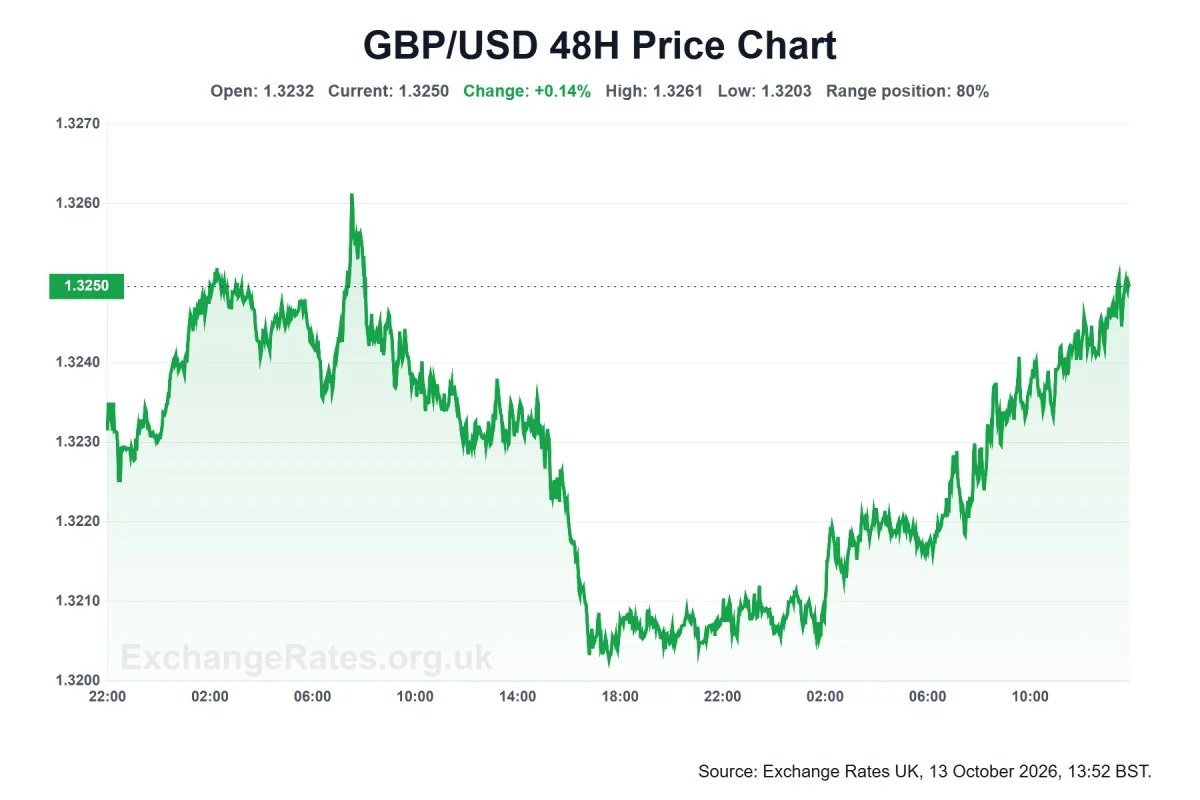
GBP/USD was near $1.3250 at the time of writing, up 0.30% on Tuesday, following a 2.10% fall during September.
Pound to Dollar (GBP/USD): 1.324505 (+0.26%)
Dollar to Yen (USD/JPY): 158.36742 (-0.10%)
BofA’s latest Global FX Weekly retains a $1.37 projection for end-2026, alongside the longer-term $1.45 forecast, which stands roughly 9.4% above the latest rate.
Strategists Michalis Rousakis and Claudio Piron write: “Elsewhere, we maintain a constructive medium-term view on GBP but prefer to await greater clarity on UK policies.”
UK resilience helps, but the policy test remains
Its quantitative FX team writes: “UK data have recently surprised consistently to the upside, while growth expectations have been revised materially higher.”
Those observations support Sterling’s relative appeal, particularly against a Euro weakened by French fiscal concerns, but they do not remove the uncertainty around Britain’s own Budget on 28 October.
Higher government borrowing costs can reflect concern about fiscal credibility as well as expectations of monetary tightening.
In his 8 October speech on financial resilience, Bank of England Governor Andrew Bailey warned that doubts about government finances can drive yields higher and tighten financial conditions.
See our analysis of the Budget’s spending-credibility test which explores that risk alongside the protection offered by resilient activity.
BofA nevertheless expects the BoE to respond to the inflation threat.
Its central-bank assessment states: “We changed our BoE call- we now expect the BoE to hike twice in Nov ’26 and Feb ’27 to 4.25% to guard against risks of second round effects, assuming high energy prices persist into early next year and barring big downside surprises in data.”
The BoE held Bank Rate at 3.75% in September, with three of its nine policymakers preferring an increase.
The Dollar has support beyond interest rates
A tighter UK stance would not automatically improve Sterling’s yield advantage if US policy also became more restrictive.
BofA’s Federal Reserve call remains hawkish, although it acknowledges uncertainty about the number of increases still to come: “We maintain our call for a hike at both the Oct and Dec meeting, though we acknowledge the risks is that we may only get one more hike this year”.
The bank also sees investment in US technology companies as an important source of Dollar demand.
Adarsh Sinha and Claudio Piron explain why the composition of the stock-market rally matters: “Intuitively, such breadth measures tell us about the US vs. rest of the world prospects, which are key for the USD exchange rate. A broad rally typically reflects a global growth upswing, with cyclical sectors outperforming and growth differentials versus the US narrowing. In contrast, a technology-led rally reinforces the US exceptionalism narrative, attracting capital inflows and supporting the USD.”
For GBP/USD, this means a stronger UK economy can coexist with a firm Dollar if international investors continue concentrating their money in US assets.
Rousakis and Piron write: “However, risks continue to accumulate for already nervous markets, including the ongoing Iran war and associated supply shock, rising concerns about the existential risks posed by AI, the apparent intractability of fiscal challenges, renewed trade tensions and, of course, the upcoming US midterms.”
BofA therefore distinguishes a broadening equity rally from a general retreat in share prices.
Sinha and Piron write: “Looking ahead, what would a transition away from a narrow rally regime imply? A broadening would be USD negative from both the equity level & breadth effects, most clearly against high beta FX. An equity correction would be more nuanced: the level effect would be USD positive (except vs. JPY) but dampened if the sell-off is concentrated in large cap technology stocks.”
A more widely shared global expansion would give the Pound’s recovery a different foundation from a brief rise caused by disappointing US figures.
GBP/USD Exchange Rate FAQ
What is BofA’s Pound-Dollar forecast?
The bank projects $1.37 at end-2026 and $1.45 at end-2027.
How far is $1.45 above the current rate?
Roughly 9.4% above the 13 October rate of $1.3250.
Does BofA expect UK interest rates to rise?
Its forecast includes November 2026 and February 2027 increases, conditional on persistent energy costs and no major downside data surprises.