
- What is a forward exchange contract?
- How forward rates are determined
- Bank credit and hedging limits
- Why not hedge all at once during a weak yen period?
- The longer the period, the greater the impact of interest rate differentials
- Credit lines are limited
- The timing and amount of receipts may change
- Future exchange rates are unknown
- Basics of accounting for foreign currency sales
- Accounting treatment when a forward exchange contract is in place
- What are derivatives?
- What is hedge accounting?
- What is the allocation method?
- When a contract is made before recording a sale
- Flow in large-scale made-to-order production
- Contract price and contracts
- Payment at the time of delivery
- Additional payments such as for specification changes
- What I found out through research
- Disclaimer
- About ND Systems
- References
When I was involved in accounting for foreign currency transactions, I always had a question. During periods of yen depreciation, wouldn’t it be advantageous to bundle forward exchange contracts for future receipts? Why isn’t that done? My understanding was limited to the idea that booking early incurs some kind of cost, and I hadn’t delved into the mechanics of it.
In this article, starting from that question, I will organize the information in the following order: mechanisms of forward exchange contracts, costs included in forward rates and bank credit, how to think about the timing of contracts, and accounting for foreign currency sales. I will focus on general theories at the level learned in bookkeeping exams, and touch upon detailed standards in notes only where necessary.
I will cover the seller’s side, who sells products in foreign currency and receives payment in foreign currency. As an example, I will assume large-scale made-to-order production where there is a long time between order receipt and delivery. Numbers like [1] in the text will open the source page when clicked.
What is a forward exchange contract?
Exchange rates are the ratios used when exchanging yen for foreign currency. The rate for exchanging today is called the spot rate, and the rate for promising to exchange on a fixed future date is called the forward rate.
Forward exchange contracts are transactions where you agree with a bank in advance to exchange foreign currency and yen on a fixed future date (or period) at a fixed rate. The buying and selling rate is determined and contracted between the bank and the customer in advance, and once a contract is made, it cannot be canceled in principle, and there is an obligation to perform the delivery (execution of the contract) on the due date[3].
According to the explanation by 77 Bank, there are two ways to determine the delivery date: fixed date delivery, where a specific date is the execution date, and specific period delivery, where the execution date is within a certain period[4].
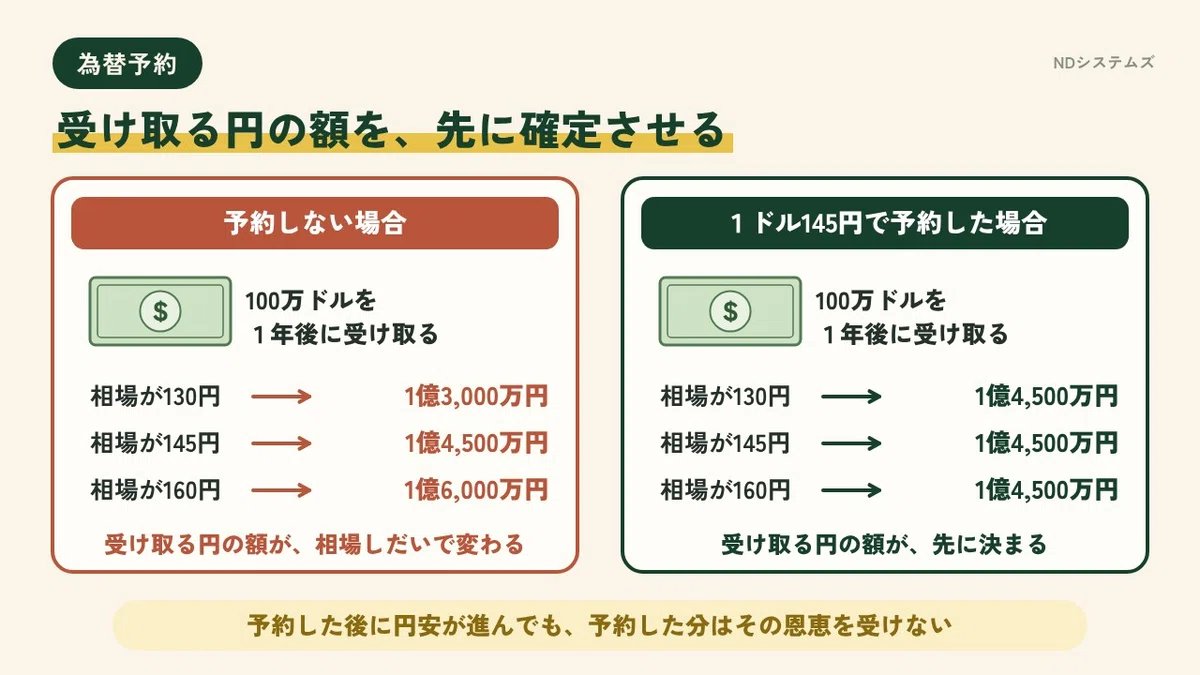
The purpose of a forward exchange contract for a seller is to determine the amount of yen to be received in advance. At the time the contract is concluded, the exchange costs and profitability are fixed[3]. In return, even if the yen depreciates further later, you cannot benefit from it for the contracted portion.
How banks name rates (TTS, TTB, TTM)
There are three ways to name the rates when a bank exchanges foreign currency with a customer.
-
TTS (Telegraphic Transfer Selling rate): The rate at which a bank sells foreign currency to a customer. Used when converting yen to foreign currency, such as for paying import costs.
-
TTB (Telegraphic Transfer Buying rate): The rate at which a bank buys foreign currency from a customer. Used when converting foreign currency to yen (yen conversion), such as for receiving export payments.
-
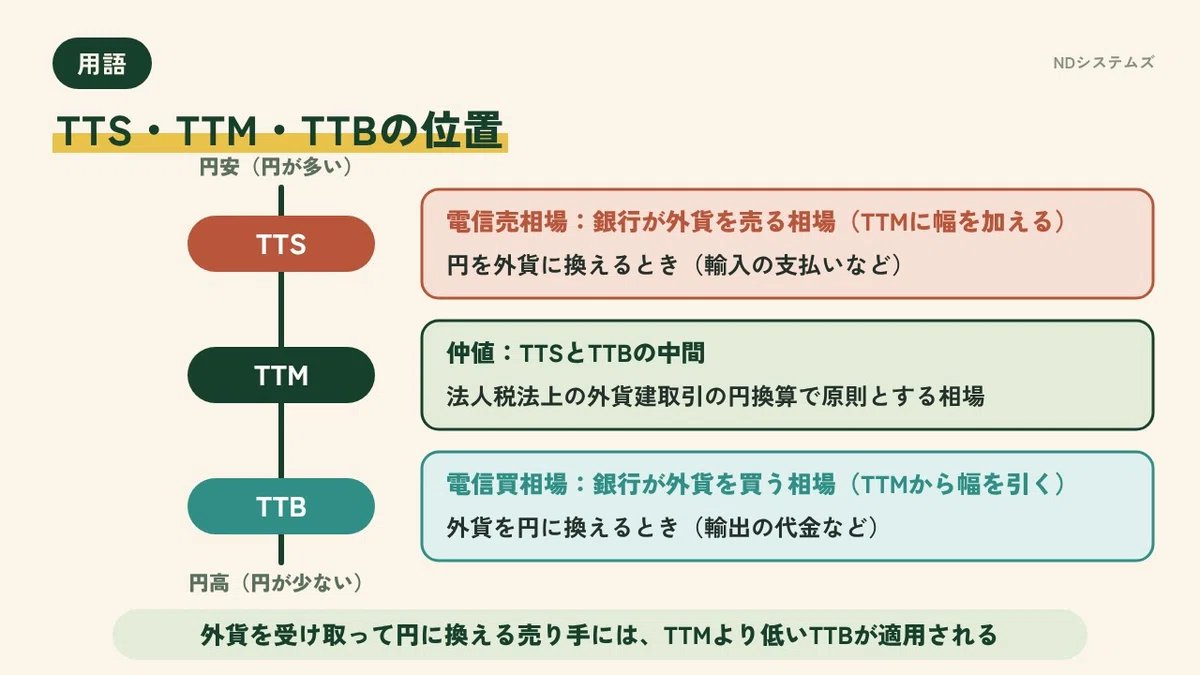
TTM (Telegraphic Transfer Middle rate): The rate between TTS and TTB. Under the Corporate Tax Law, this rate is used in principle when converting foreign currency transactions into yen[5].
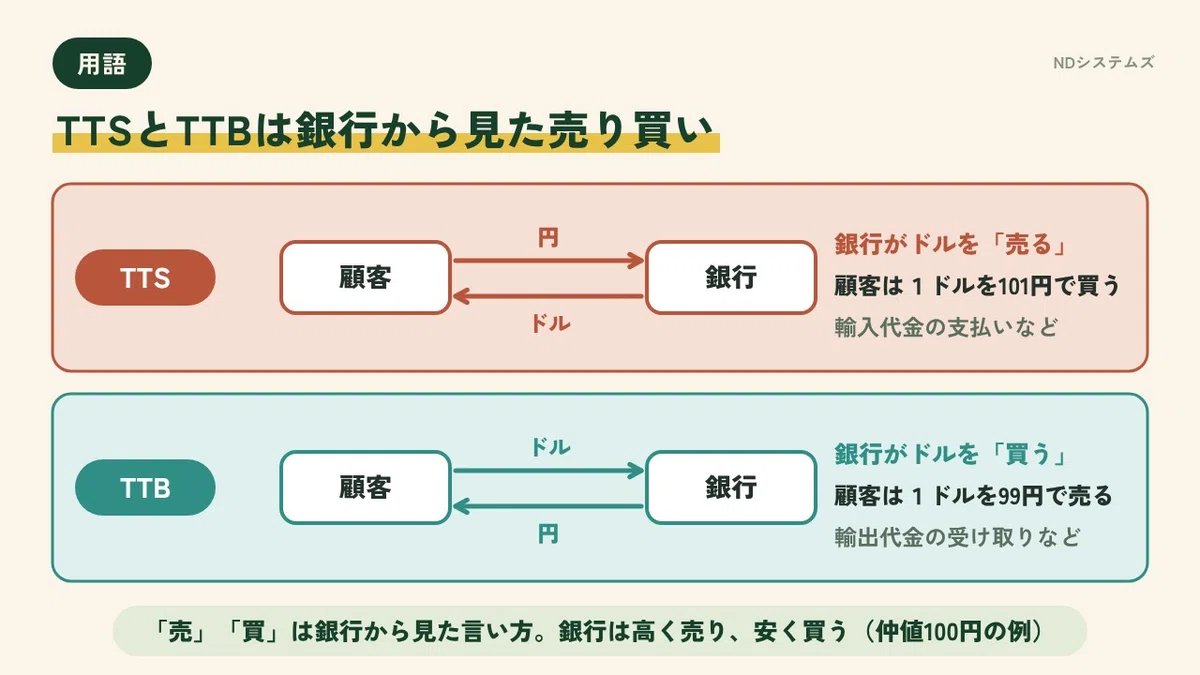
The “selling” and “buying” in TTS and TTB refer to the bank’s perspective on buying and selling. TTS is an abbreviation for Telegraphic Transfer Selling rate [7], and when a customer converts yen to foreign currency, the bank acts as the seller of the foreign currency, so the TTS is used. Conversely, when a customer converts foreign currency to yen, the bank acts as the buyer of the foreign currency, so the TTB is used.
According to the explanation from 77 Bank, an export hedge is a forward transaction where the customer sells foreign currency obtained from export proceeds to the bank (the bank buys the customer’s foreign currency) [4].
Banks sell foreign currency at a high price and buy it at a low price. TTS and TTB are rates calculated by adding or subtracting the bank’s margin (fee) to or from the TTM. In its explanation of foreign currency deposits, MUFG Bank defines TTS and TTB as “exchange rates that include exchange fees,” and provides an example where if the TTM is 100 yen and the one-way exchange fee is 1 yen, the TTS becomes 101 yen and the TTB becomes 99 yen [7].
When a seller receiving foreign currency converts it to yen, the TTB, which results in a lower yen amount than the TTM, is applied.
How forward rates are determined
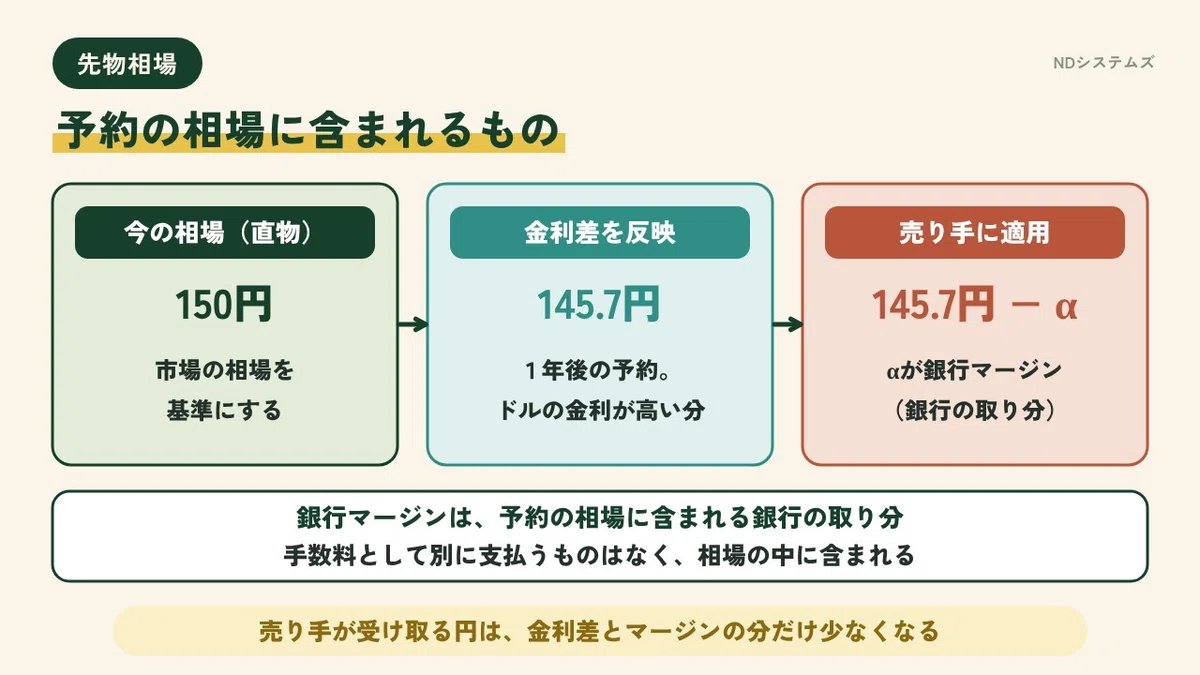
The content of the costs incurred by hedging earlier can be understood by looking at how forward rates are determined. The rate for a US dollar-denominated forward contract is determined by the interest rate differential between the US dollar and the yen and costs such as the bank margin related to the hedge, and no other direct expenses (such as commissions) are required [3].
In other words, in a forward contract, fees are not deducted separately; rather, the costs are baked into the forward rate itself. The bank margin refers to the bank’s share included in the forward rate, which is explained in detail with a diagram at the end of this section.
Why interest rate differentials are reflected in forward rates
When a seller enters into a contract to “sell 1 million dollars to the bank one year from now,” the bank takes on the obligation to receive dollars and pay yen in one year. From the bank’s perspective, by combining the following transactions, it can avoid the impact of market fluctuations during that period.
-
Borrow dollars now (pay dollar interest).
-
Convert the borrowed dollars into yen at the current spot rate.
-
Invest the received yen for one year (receive yen interest).
-
One year later, use the dollars received from the seller to repay the borrowed dollars.
If the dollar interest rate is higher than the yen interest rate, the bank pays more interest on the dollar borrowing and receives less interest on the yen investment. The forward rate becomes more yen-strong (the side where the seller receives fewer yen) than the spot rate by exactly this difference.
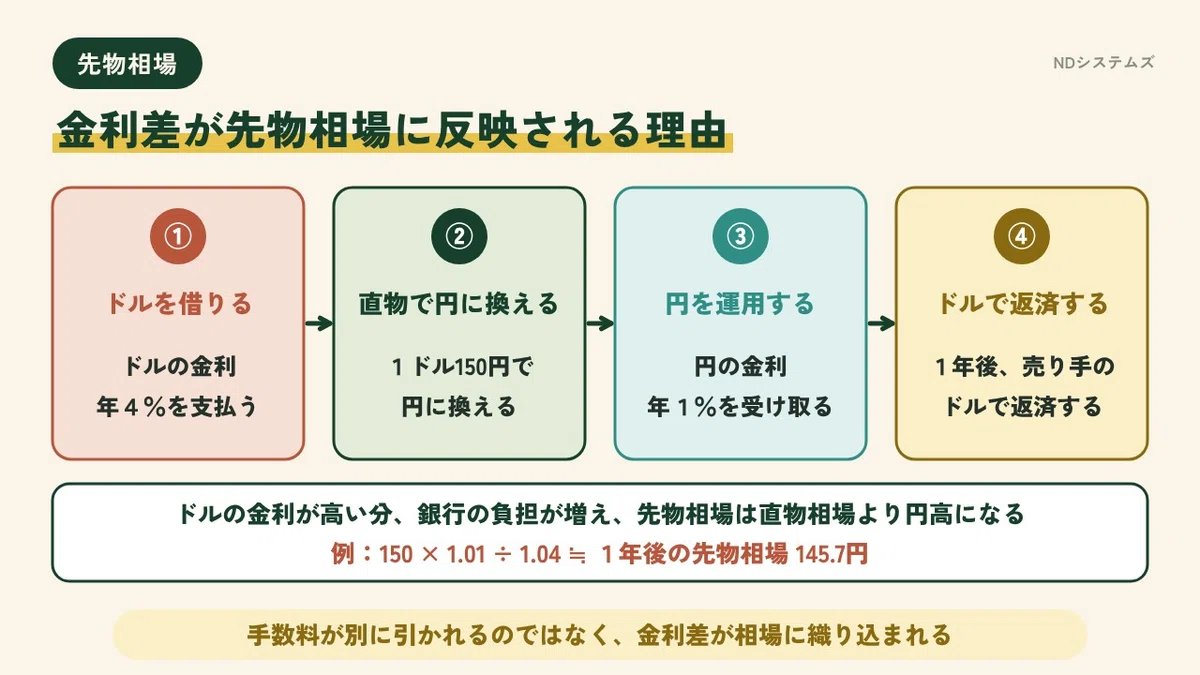
The logic of the calculation can be expressed by the following formula (approximate value excluding bank margin).
Forward rate = Spot rate × (1 + yen interest rate × years) ÷ (1 + dollar interest rate × years)
For example, if the spot rate is 150 yen per dollar, the dollar interest rate is 4% per year, and the yen interest rate is 1% per year, the forward rate would be as follows. The figures are hypothetical for illustrative purposes.
-
6 months later: 150 × 1.005 ÷ 1.02 ≒ 147.8 yen
-
1 year later: 150 × 1.01 ÷ 1.04 ≒ 145.7 yen
-
2 years later: 150 × 1.02 ÷ 1.08 ≒ 141.7 yen
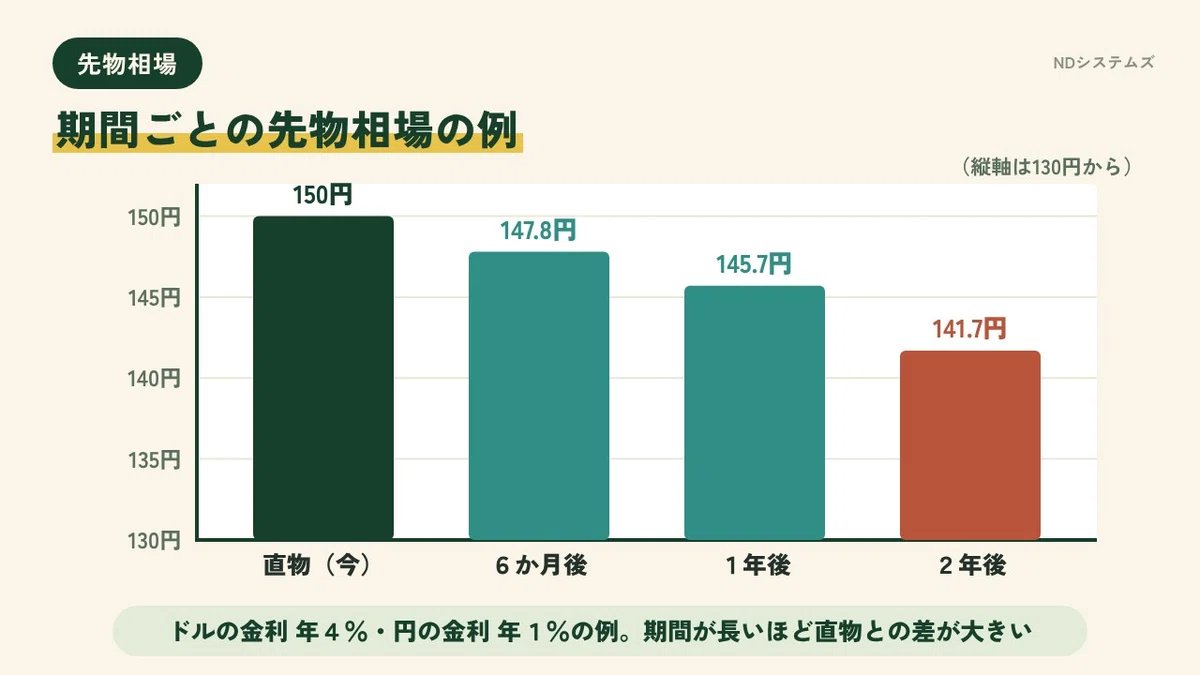
If you hedge $1 million for one year, the yen amount is fixed at approximately 4.3 million yen less than if you had exchanged it at the spot rate. A bank margin is added to this. The longer the hedging period, the greater the impact of the interest rate differential so if you hedge in bulk early on when dollar interest rates are higher than yen interest rates, this difference appears as a cost.
Note that if yen interest rates are higher than dollar interest rates, the situation is reversed, and the forward rate will be weaker than the spot rate. Also, the forward rate is not a prediction of future rates, but is calculated from the current spot rate and the interest rate differential.
What is a bank margin?
Bank margin refers to the bank’s share included in the hedged rate. As seen at the beginning of this section, since no direct costs such as fees are required for forward exchange contracts [3], the bank’s share is included within the rate.
Even in spot transactions, as seen before, TTS and TTB are considered “exchange rates that include exchange fees” [7]. Even for forward exchange contracts, according to the explanation by 77 Bank, the applicable rate is the telegraphic transfer selling or buying rate, which is adjusted based on the market rate by adding or subtracting the spot-forward spread (swap rate) [4]. The seller bears the cost in the form of receiving a smaller amount of yen.
Note that the bank margin is not the seller’s foreign exchange gain or loss. In the allocation method described later, sales are recorded at the hedged rate, so the margin appears as a reduction in the yen amount of sales, and no separate fee appears in the journal entries.
Bank credit and hedging limits
Forward exchange contracts cannot be canceled in principle, and an obligation to deliver arises on the maturity date, so they are treated as credit transactions by banks [3]. Some banks require a screening process before starting transactions [4].
What is credit?
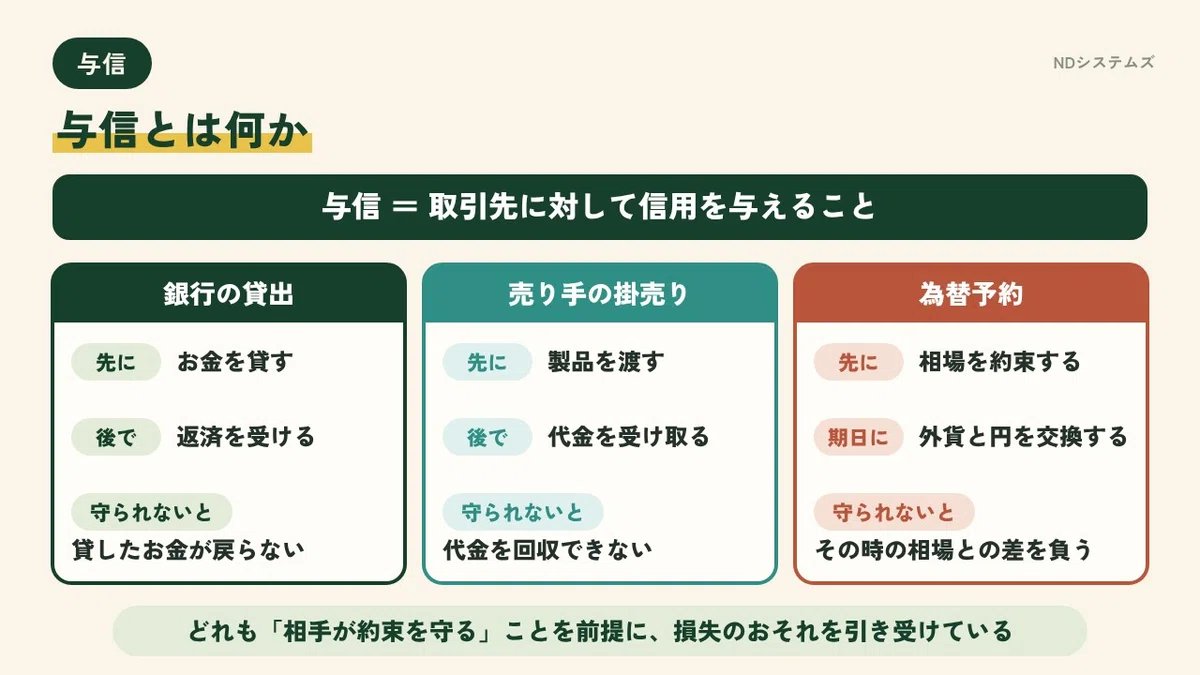
Credit means granting trust to a business partner [6]. In commercial transactions between companies, goods or services are often provided first and payment is requested later, and transactions are conducted based on the trust that the partner will pay [6]. Accounts receivable held by a seller are also a form of credit based on credit transactions [6].
Bank loans are also credit where money is provided first and repayment is received later. In forward exchange contracts, the bank does not provide money first, but it promises a rate based on the trust that the other party will deliver the foreign currency as promised on the maturity date. It has the same nature as loans or credit sales in that there is a risk of loss if the other party does not keep their promise.
Why forward exchange contracts are credit transactions
The reason why forward exchange contracts are credit transactions can be understood by considering the case where the seller cannot deliver the dollars on the maturity date. The bank must procure dollars at the rate at that time and may incur a loss equal to the difference from the hedged rate.
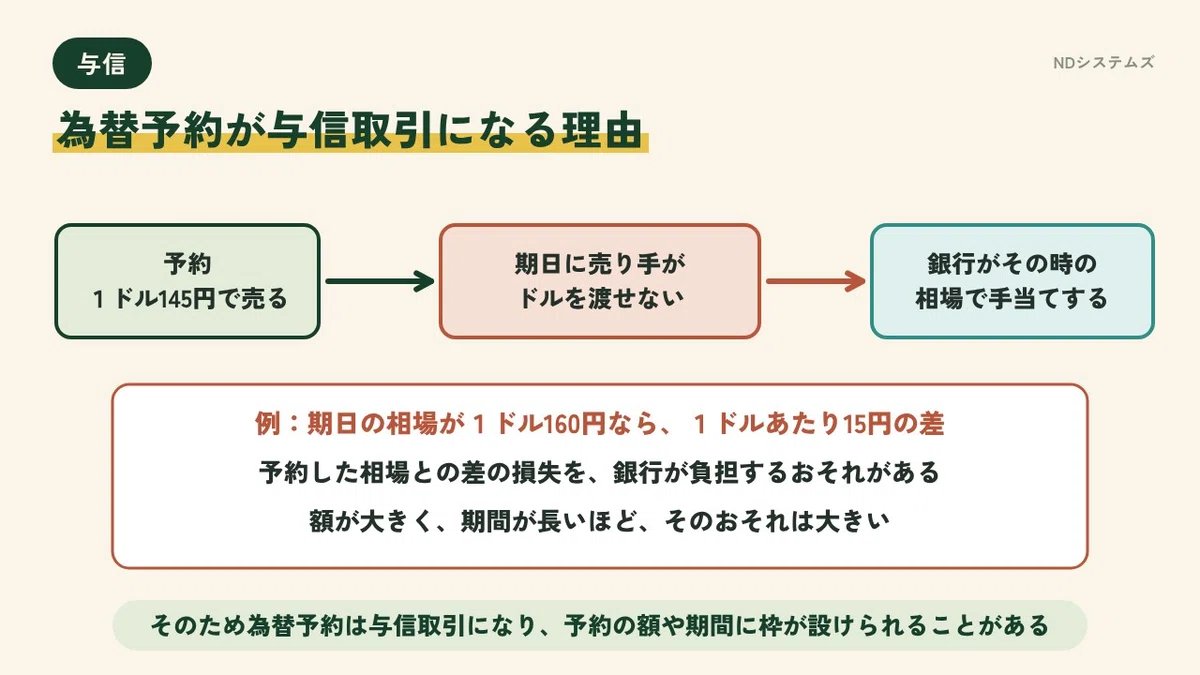
The larger the hedge amount and the longer the period, the greater the potential fluctuation in the exchange rate by the due date, and the greater the potential loss the bank may incur. Therefore, banks may set an upper limit (the credit line; also called a credit limit) on the amount or period that can be hedged for each client.
When a forward exchange contract is concluded, the exchange of foreign currency and yen does not take place; the obligation to exchange arises on the due date [3]. What the bank underwrites is the risk of loss if the counterparty fails to fulfill its promise on the due date, and the credit line is used to manage that limit.
Why not hedge all at once during a weak yen period?
Based on the above, the following reasons can be cited for the question at the beginning.
The longer the period, the greater the impact of interest rate differentials
In a situation where dollar interest rates are higher than yen interest rates, the longer the period of the contract, the more the forward rate will move toward a stronger yen. Even if you hedge during a weak yen period, if the period is long, the benefit of the weak yen in the spot rate will be reduced by the interest rate differential.
Credit lines are limited
If you hedge all at once for future receipts, you will use up your credit line for that amount and period. If a credit line is set, you cannot hedge beyond that range.
The timing and amount of receipts may change
In large-scale made-to-order production, specifications may change during manufacturing, or delivery dates may be delayed. Since forward exchange contracts cannot be canceled in principle, if the timing or amount of receipt deviates from the contract, it will be necessary to change the due date or adjust for the excess or shortage of the hedged foreign currency. In such cases, you may have to bear the difference from the exchange rate at that time.
Future exchange rates are unknown
Even if the yen is weak at that moment, it may weaken further or return to a stronger yen later. The purpose of a forward exchange contract is not to guess the exchange rate and make a profit, but to fix the amount of yen to be received and protect profitability.
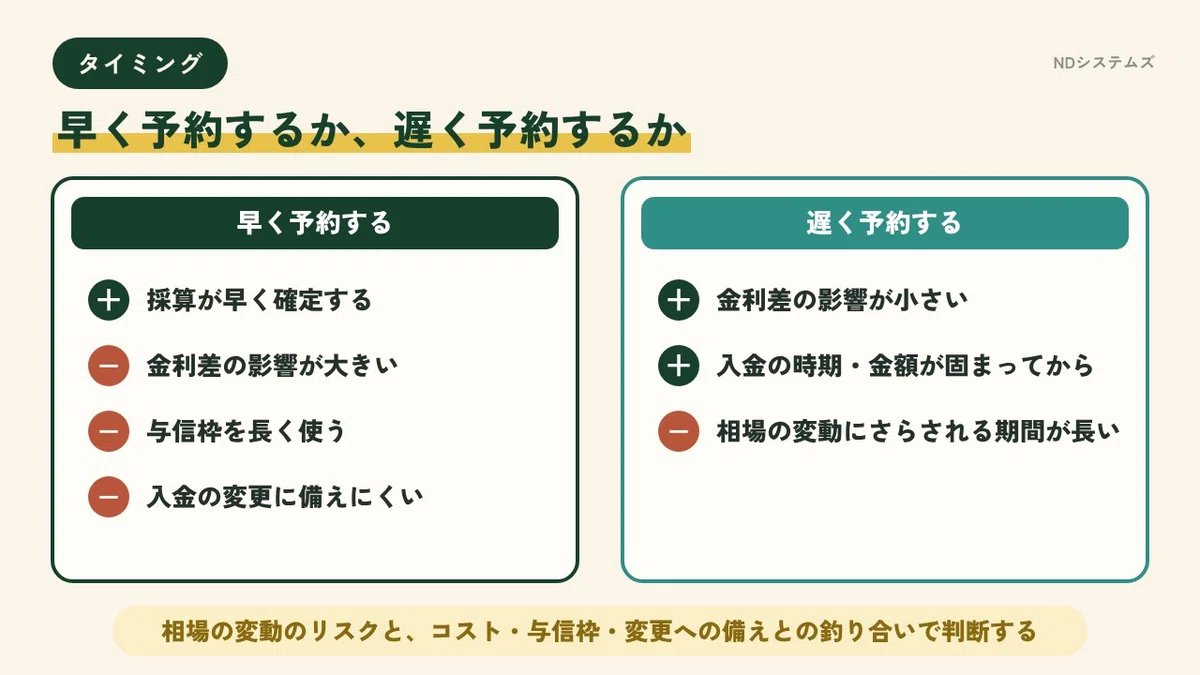
For this reason, there is a method of deciding the percentage and timing of hedging in advance as an internal policy in accordance with the certainty of orders and the schedule of receipts. There is no single correct answer for the timing of hedging; it is a judgment based on the balance between the risk of exchange rate fluctuations and the costs of hedging, credit lines, and preparation for changes.
Basics of accounting for foreign currency sales
First, let’s organize the processing when no forward exchange contract is made. Accounting for foreign currency transactions is stipulated in the Accounting Standards for Foreign Currency Transactions, etc. of the Business Accounting Council [1].
When a transaction occurs
In principle, foreign currency transactions are recorded at the yen equivalent based on the exchange rate at the time of the transaction [1]. In addition to the spot rate on the day the transaction occurs, the average rate of the previous month or the rate at the end of the previous month can also be used as the exchange rate at the time of the transaction [1].
In practice, there is a method of using the TTM on the transaction date. In corporate tax treatment, the principle is to convert to yen using the mid-rate (TTM) between the TTS and TTB on the transaction date, and on the condition of continuous application, revenue such as sales can also be based on the TTB on the transaction date [5].
When crossing the fiscal year-end
Foreign currency-denominated accounts receivable remaining on the closing date are re-converted into yen at the exchange rate on the closing date. The difference arising from this conversion is, in principle, treated as foreign exchange gains or losses for the current period[1].
When payment is received (settled)
The difference between the yen amount at the time of receipt and the amount of accounts receivable on the books is also, in principle, treated as foreign exchange gains or losses for the current period[1].
What is important to understand here is that the sales amount is determined at the time the transaction occurs, and subsequent fluctuations in the exchange rate do not adjust the sales amount but are treated separately as foreign exchange gains or losses. This approach, which treats the sales transaction and the payment settlement transaction as separate, is called the two-transaction basis.
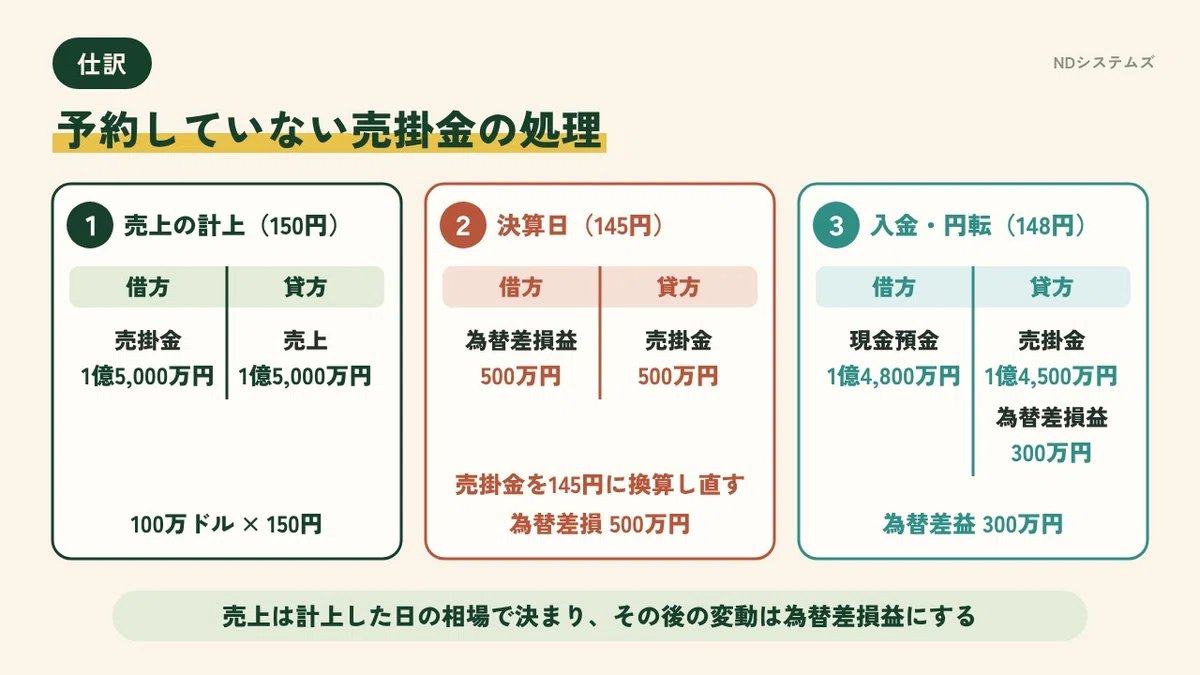
In the example in the figure, the rate on the day sales were recorded is 150 yen, the rate on the closing date is 145 yen, and the rate on the day of receipt and conversion to yen is 148 yen. Sales remain unchanged at 150 million yen, while a foreign exchange loss of 5 million yen is recorded on the closing date, and a foreign exchange gain of 3 million yen is recorded on the payment date.
Accounting treatment when a forward exchange contract is in place
Accounting treatment when a forward exchange contract is in place becomes easier to understand by grasping three terms: derivatives, hedge accounting, and assignment accounting. I will explain them in order.
What are derivatives?
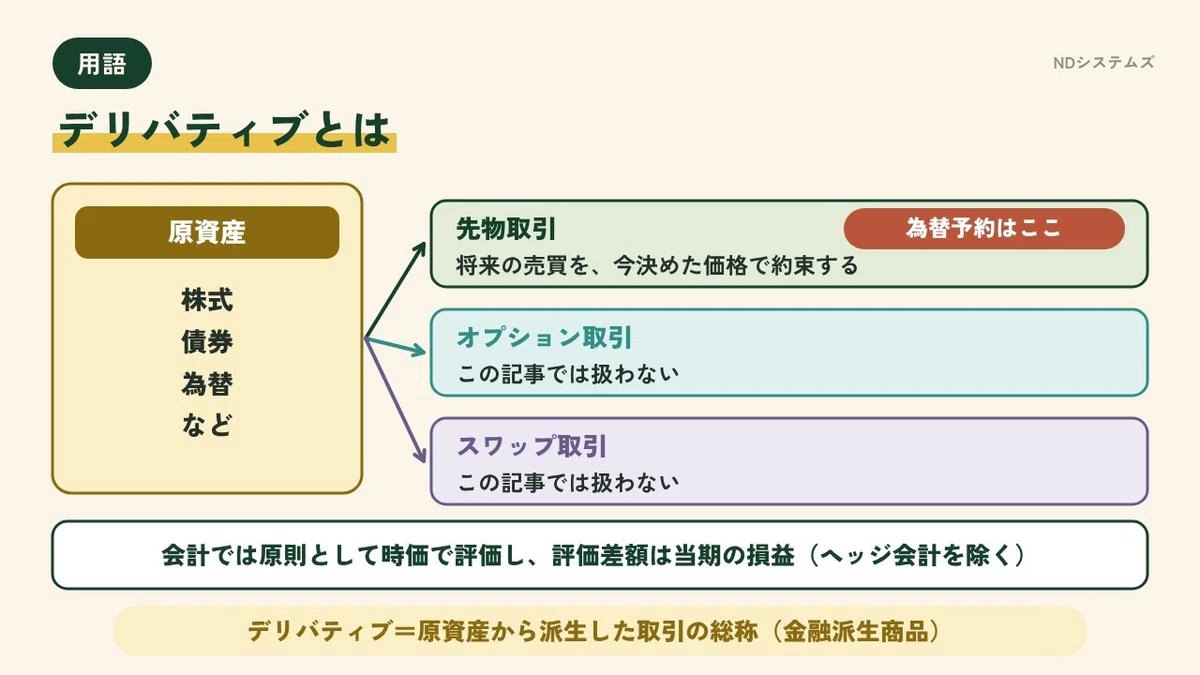
Derivatives is a general term for futures, options, swaps, etc., which are financial products derived from underlying assets such as stocks, bonds, and foreign exchange[8]. They are also called “financial derivatives”[8]. A forward exchange contract, which exchanges foreign currency and yen at a fixed rate on a fixed future date, is also a futures transaction with foreign exchange as the underlying asset, and can be classified as a type of derivative.
In accounting, net receivables and payables arising from derivative transactions are, in principle, valued at market price, and the valuation difference is recorded as profit or loss for the current period, except when hedge accounting is applied[9]. Market price refers to the amount re-evaluated at the time of the closing date, etc. In the case of a forward exchange contract, roughly speaking, the difference between the forward rate at the closing date and the contracted rate becomes the valuation difference.
What is hedge accounting?
Hedge transactions pair an asset or liability for which one wants to avoid loss (hedged item) with a derivative transaction used to reduce that risk (hedging instrument) [10]. For a seller preparing for exchange rate fluctuations in foreign currency-denominated sales or accounts receivable, the sales or accounts receivable are the hedged item, and the forward exchange contract is the hedging instrument.
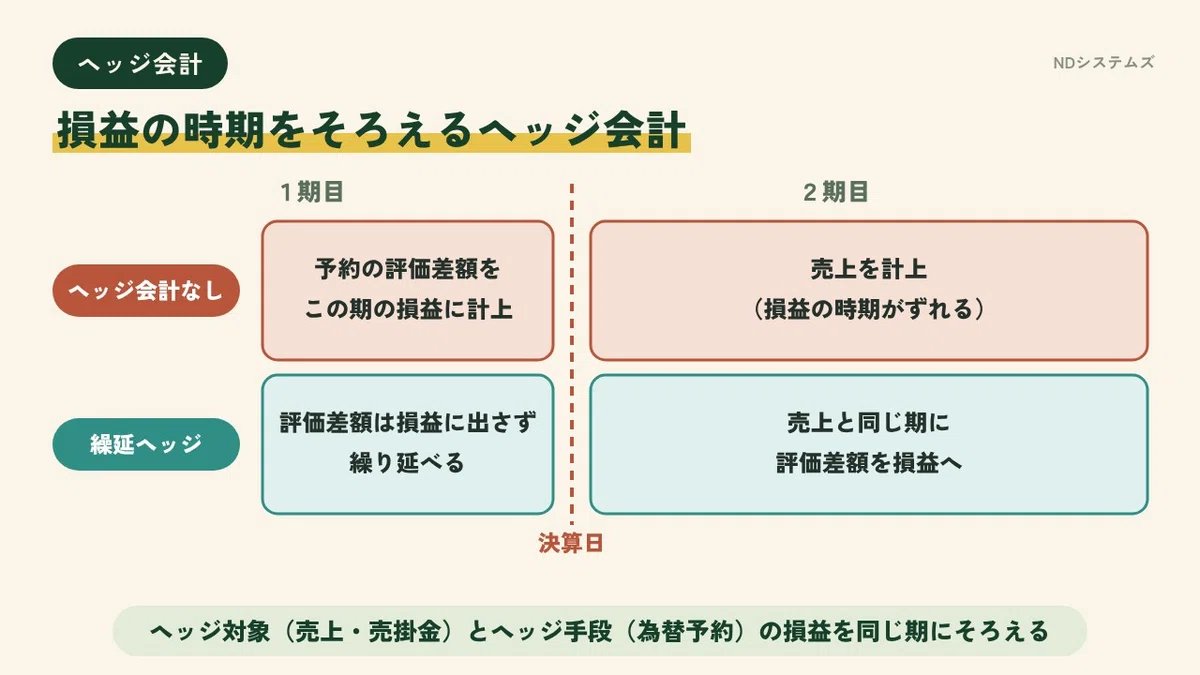
However, there are cases where the timing of recording profit or loss for the hedged item and the hedging instrument does not match[10]. This is because the hedging instrument, which is a derivative, is in principle valued at market price at the end of each period and the valuation difference is recorded as profit or loss, but this is not necessarily the case for the hedged item[11]. For example, in make-to-order production, if a closing date falls between the contract and the recording of sales, only the valuation difference of the forward exchange contract appears in the profit or loss for that period, while the sales are recorded in the next period. In this case, the effect of offsetting losses through hedging does not appear in the profit or loss for each period.
The special accounting treatment performed to solve this problem is hedge accounting [10]. Two methods are permitted: deferred hedge, which defers the profit or loss of the hedging instrument until the period in which the profit or loss of the hedged item is recorded, and fair value hedge, which values the hedged item at market price and records it as profit or loss. Certain requirements must be met to apply these [10]. Among these, deferred hedge is considered the principal method [11].
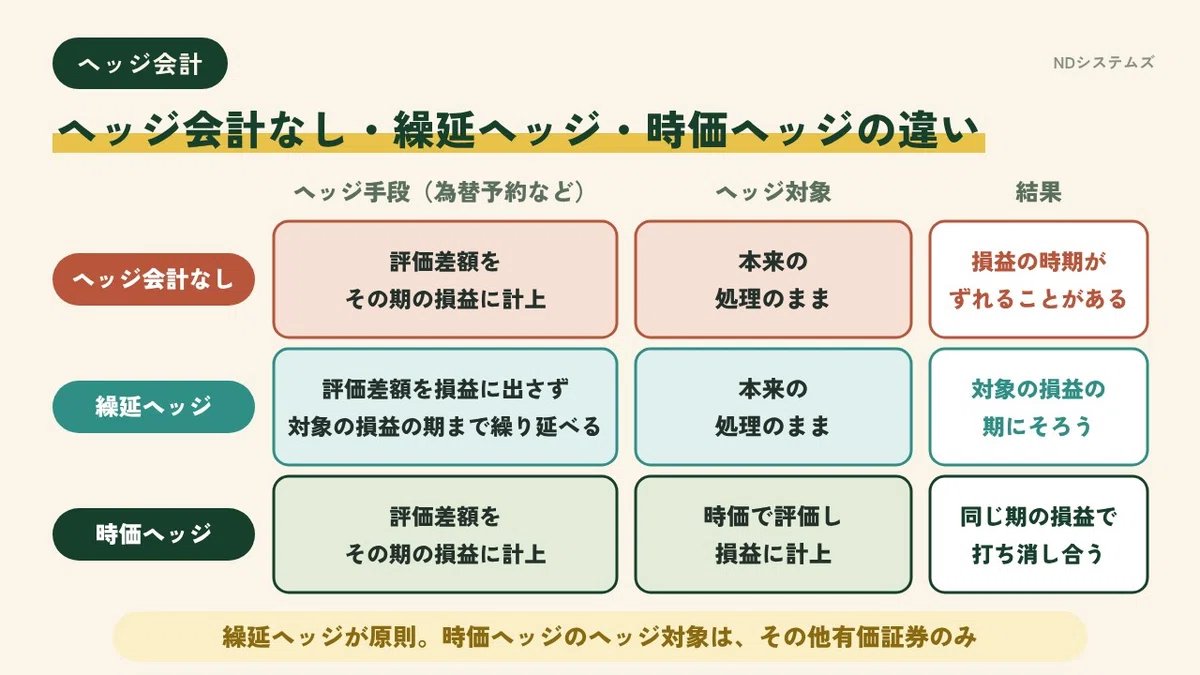
Fair value hedge records the valuation difference of the hedging instrument in the profit or loss for that period, just as when hedge accounting is not applied. The difference lies on the side of the hedged item.
If hedge accounting is not applied, the hedged item remains subject to standard accounting treatment. If the contract is made before the sale is recorded, there is nothing yet on the hedged item side to be recorded in profit or loss. In fair value hedging, unlike standard accounting, the hedged item is also measured at fair value and recorded in profit or loss [10] . Therefore, the profit or loss from the hedged item and the hedging instrument are recorded in the same period, effectively offsetting each other.
However, only available-for-sale securities can be considered as hedged items for fair value hedging [11] . Available-for-sale securities are a category of securities where, even if measured at fair value, valuation differences are generally recorded in the net assets section of the balance sheet rather than in the current period’s profit or loss [10] . Since foreign currency sales and accounts receivable do not qualify as hedged items for fair value hedging, it can be concluded that if hedge accounting is applied to a seller’s forward exchange contract, it will involve either deferred hedging or the allocation method described next.
Note that, as seen in the previous section, foreign currency accounts receivable that have already been recorded are retranslated at the exchange rate at the closing date even without applying hedge accounting, and the difference is treated as foreign exchange gain or loss [1] . Therefore, the exchange rate fluctuations of the accounts receivable and the valuation difference of the contract appear in the profit or loss of the same period even without applying hedge accounting. For the seller covered in this article, the timing mismatch in profit or loss occurs when the contract is made before the sale is recorded.
What is the allocation method?
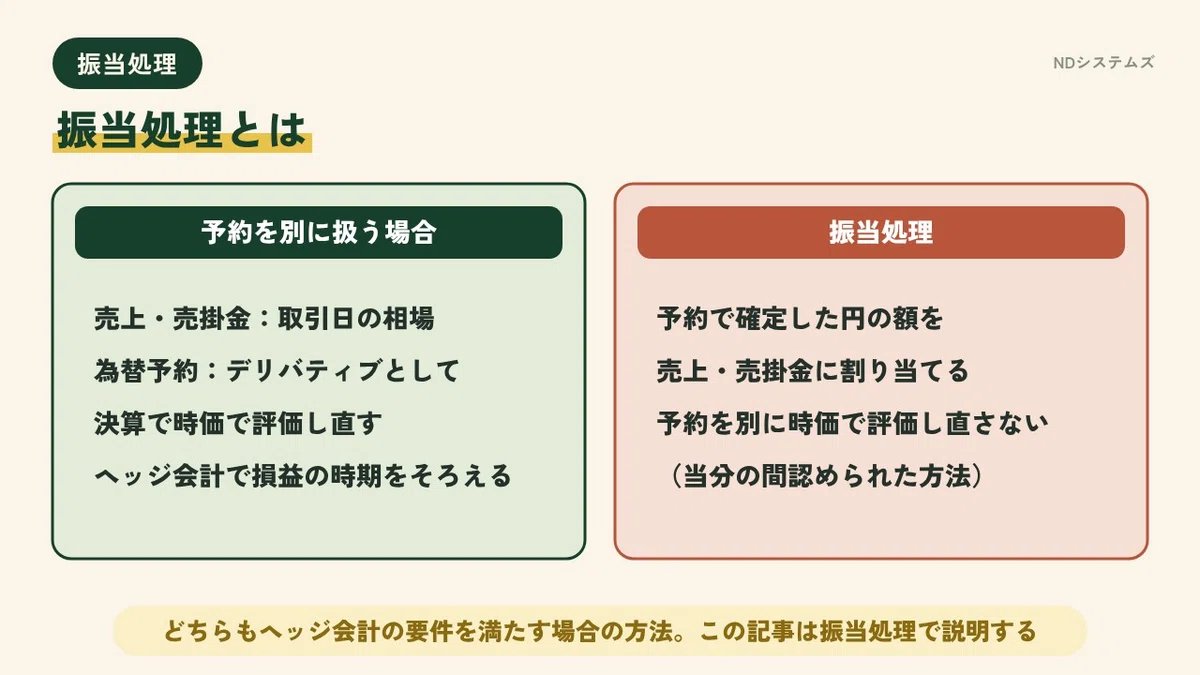
If the relationship between foreign currency accounts receivable and a forward exchange contract meets the requirements for hedge accounting, hedge accounting can be applied to that foreign currency transaction [1] . As a method for this, in addition to the hedge accounting method under the accounting standards for financial instruments, a method of translating foreign currency transactions or accounts receivable at the yen amount determined by the forward exchange contract is also permitted for the time being [1] . The latter is called the allocation method.
The allocation method is a way of directly assigning the yen amount determined by the contract to the sale or accounts receivable. Since the contract assigned to the accounts receivable is considered as a single unit with the accounts receivable, there is no need to separately re-evaluate the contract at fair value as a derivative, making the process easier to understand. This article explains the allocation method.
When a contract is made before recording a sale
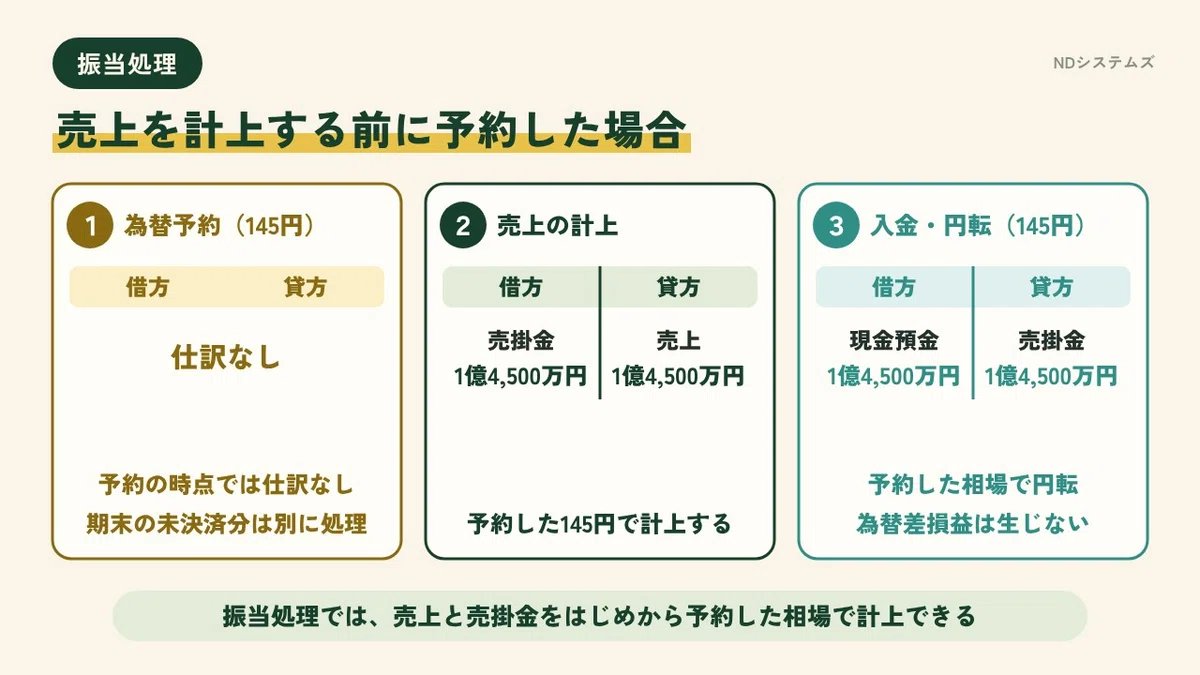
In the allocation method, if a forward exchange contract is concluded before a foreign currency transaction, the yen equivalent based on the contracted rate can be applied to the foreign currency transaction and accounts receivable, considering practical complexity [2] .
In other words, both sales and accounts receivable are recorded at the contracted rate from the beginning. Since the conversion to yen at the time of receipt is done at the contracted rate, no foreign exchange gain or loss arises.
Note: The outstanding balance of forward exchange contracts at the end of the period must be processed in accordance with the accounting treatment for derivative transactions [2] . In the case of made-to-order production where the closing date falls between the contract and the recording of the sale, that contract corresponds to the outstanding balance at the end of the period, so the treatment at the closing date must be confirmed separately.
Flow in large-scale made-to-order production
From here, we will organize the flow of forward exchange contracts and accounting procedures using a large-scale made-to-order production project with a long period from order to delivery as an example. The example is intended to explain the general form.
Contract price and contracts
In large-scale foreign currency contracts, it is sometimes agreed that payment will be received in installments, such as at the time of contract, during manufacturing, and at the time of delivery. The seller makes forward exchange contracts in line with each scheduled payment to determine the amount of yen to be received.
Payment at the time of delivery
Of the initial contract price, the portion already covered by a contract is converted into yen at the contracted rate at the time of receipt. If the contract was made before the sale was recorded, as in the previous section, the sale is recorded at the contracted rate, and no foreign exchange gain or loss arises.
Additional payments such as for specification changes
On the other hand, additional payments for things like specification changes that occur during the manufacturing process may not be hedged because the timing of the final amount is delayed. Also, the payment may be delayed until after delivery, remaining as accounts receivable.
In this case, as unhedged foreign currency sales, the sales and accounts receivable are recorded at the exchange rate (such as TTM) on the date the sales are recorded. If the fiscal year-end is crossed, it is re-converted at the exchange rate at the time of the fiscal year-end, and the difference from the amount converted to yen at the time of payment is treated as foreign exchange gain or loss.
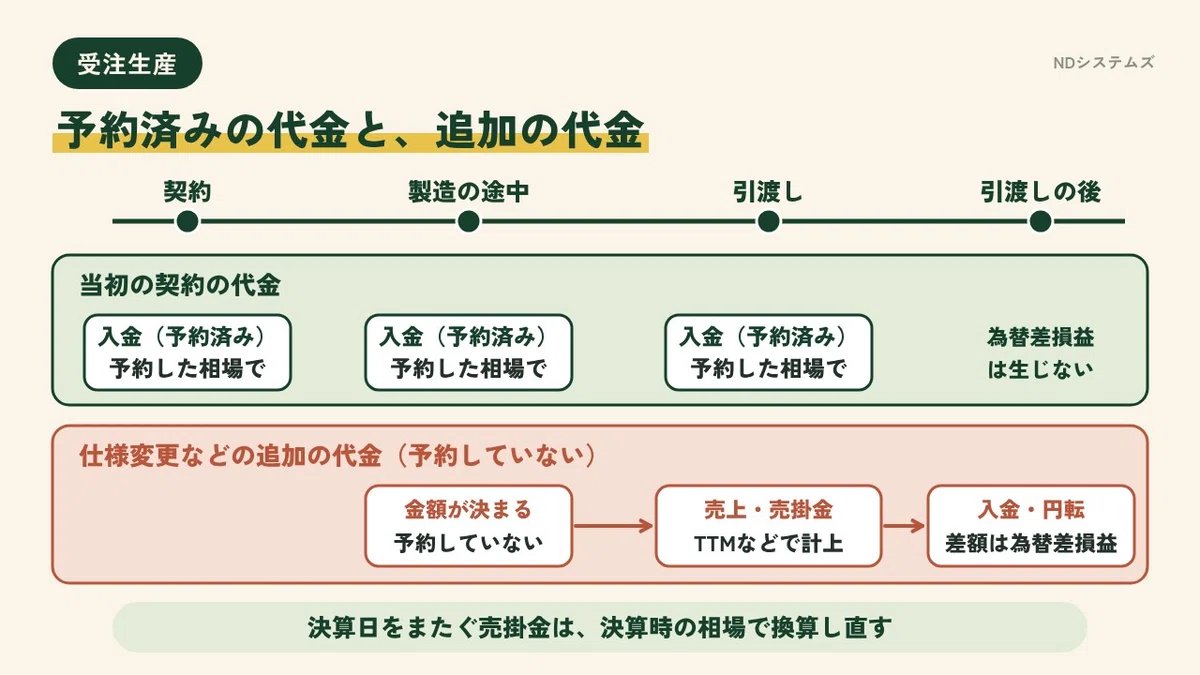
For additional payments, the amount recorded at the TTM rate may look like a “provisional amount,” but the sales amount is fixed at that point. What changes until payment is not the sales, but the foreign exchange gain or loss side.
What I found out through research
-
A forward exchange contract is a transaction that promises the exchange of foreign currency and yen in the future at a fixed rate and, in principle, cannot be canceled.
-
Forward rates incorporate interest rate differentials between currencies and bank margins. Fees are not deducted separately; the longer the period, the greater the impact of the interest rate differential.
-
Forward exchange contracts are credit transactions for banks, and limits may be set on the amount and period that can be hedged. What the bank undertakes is the risk of loss if the counterparty does not keep their promise.
-
The reason for not hedging all at once during periods of yen depreciation can be summarized as being due to interest rate differentials, credit limits, and preparations for changes in payments, and because the purpose of hedging is to fix profitability rather than to speculate on exchange rates.
-
In accounting, sales are determined by the rate on the date of recording, and subsequent fluctuations in the rate are treated as foreign exchange gains or losses. For hedged portions, sales can be recorded at the hedged rate through allocation processing.
-
Forward exchange contracts are a type of derivative and are, in principle, valued at fair market value. Hedge accounting (in principle, deferred hedge) and allocation processing are methods for aligning the timing and amount of profit and loss between the hedge and the sales/accounts receivable. The hedged item for fair value hedging is only other securities.
-
Unhedged additional payments are treated as accounts receivable at the rate on the date of recording (such as TTM), and the difference at the time of payment is treated as foreign exchange gain or loss.
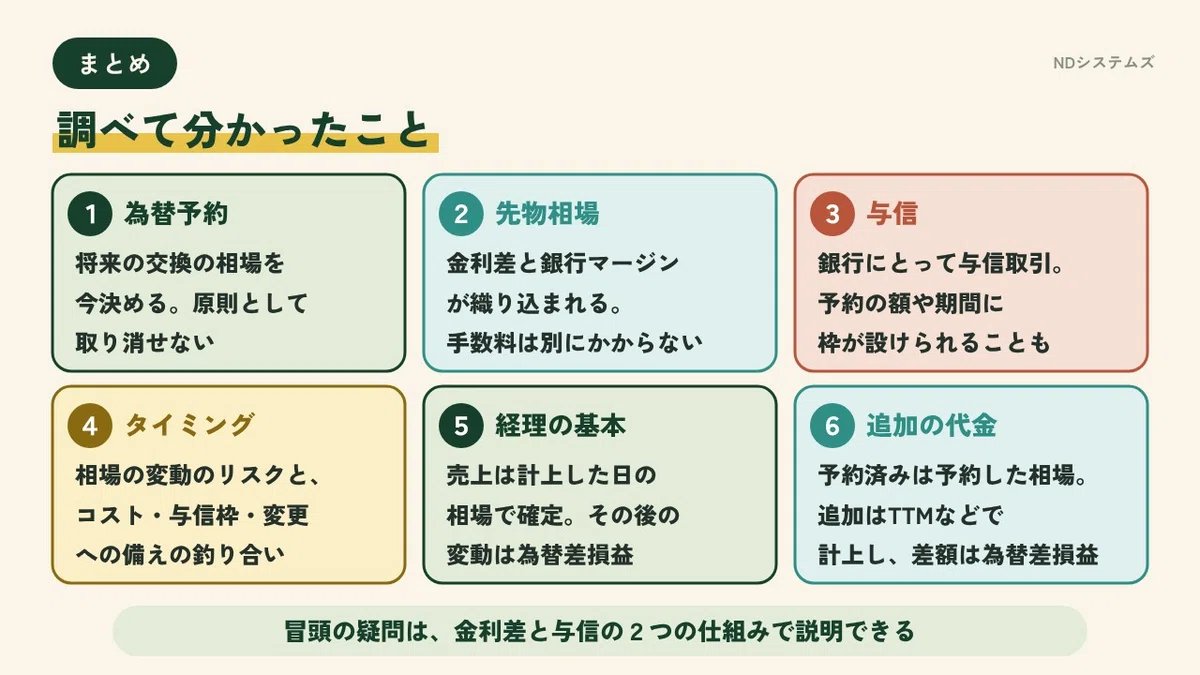
The question at the beginning can be explained by two mechanisms: the interest rate differential incorporated into the forward rate and bank credit. I was able to organize that the timing of hedging is determined by balancing these costs and the certainty of payment, rather than just by exchange rate forecasts.
Disclaimer
This article is a summary of information as of the time of writing, based on the author’s personal research and experience. It is not advice from legal, tax, accounting, or investment professionals. For the sake of clarity, some detailed conditions or exceptions may have been omitted. The figures are hypothetical for explanatory purposes.
Systems, product specifications, fees, facility operating hours, etc., are subject to change. For actual decisions and procedures, please check the latest information from sources or official information, and consult with professionals or relevant offices as necessary. We cannot be held responsible for any damages resulting from the use of the content of this article.
About ND Systems
ND Systems is based in Kurume City, Fukuoka Prefecture, and provides website production, development of business-specific administrative systems, and AI/DX support. Please feel free to contact us for a free consultation.