

If you buy mutual funds in Japanese yen and check their net asset value (NAV) in yen, does foreign exchange really have nothing to do with it? Even with products you can apply for in yen, if they invest in foreign-currency-denominated assets inside, foreign exchange rates when converting to yen will affect the results. It is necessary to look at the currency used to purchase the product and the currency exposure held by the investment targets separately. In this article, by using a hypothetical example where the asset value in foreign currency is fixed, I will verify how the yen-converted amount moves when only the exchange rate changes. I will also place the presence or absence of currency hedging in a separate check column, providing an explanation so that being able to buy in yen is not confused with being unaffected by foreign exchange.
1. Separating Buying in Yen from the Currency of Investment Targets
When purchasing a mutual fund in yen, if both the subscription amount and the NAV are displayed in yen, you may not be conscious of currency exchange. However, from the currency used on the screen alone, you cannot tell which currencies affect your investment targets.
A glossary from Daiwa Asset Management explains that even for funds that you apply for in yen and whose NAV is displayed in yen, when investing in foreign-currency-denominated securities, foreign exchange gains and losses are reflected in the NAV. Being able to buy in yen and holding no foreign-currency-denominated assets are distinct conditions.
For example, if a fund holds US dollar-denominated assets, the US dollar-to-yen exchange rate comes into play at the stage of evaluating that foreign-currency value in yen. Even if only yen appears on your own transaction screen, this relationship does not disappear.
However, this also does not mean that all yen-denominated mutual funds carry the same currency risk. You need to check what the product invests in, how much foreign-currency-denominated assets it holds, and how currency hedging against the yen is conducted.
Nor should you consider this condition fully understood based solely on country and regional allocations. By separately recording the classification of investment targets, asset currencies, and hedging policies, it becomes easier to track what lies behind the numbers displayed in yen.
How to read country and regional allocations itself was covered in the previous day’s article, “If You Hold Mutual Funds 50/50, Does the Allocation by Country Also Become 50/50?” (https://note.com/shisan_shuminote/n/n76c3421355ba). This time, we will focus specifically on checking currencies and hedging.
2. Fixing the Value at 100 US Dollars and Changing Only the Exchange Rate
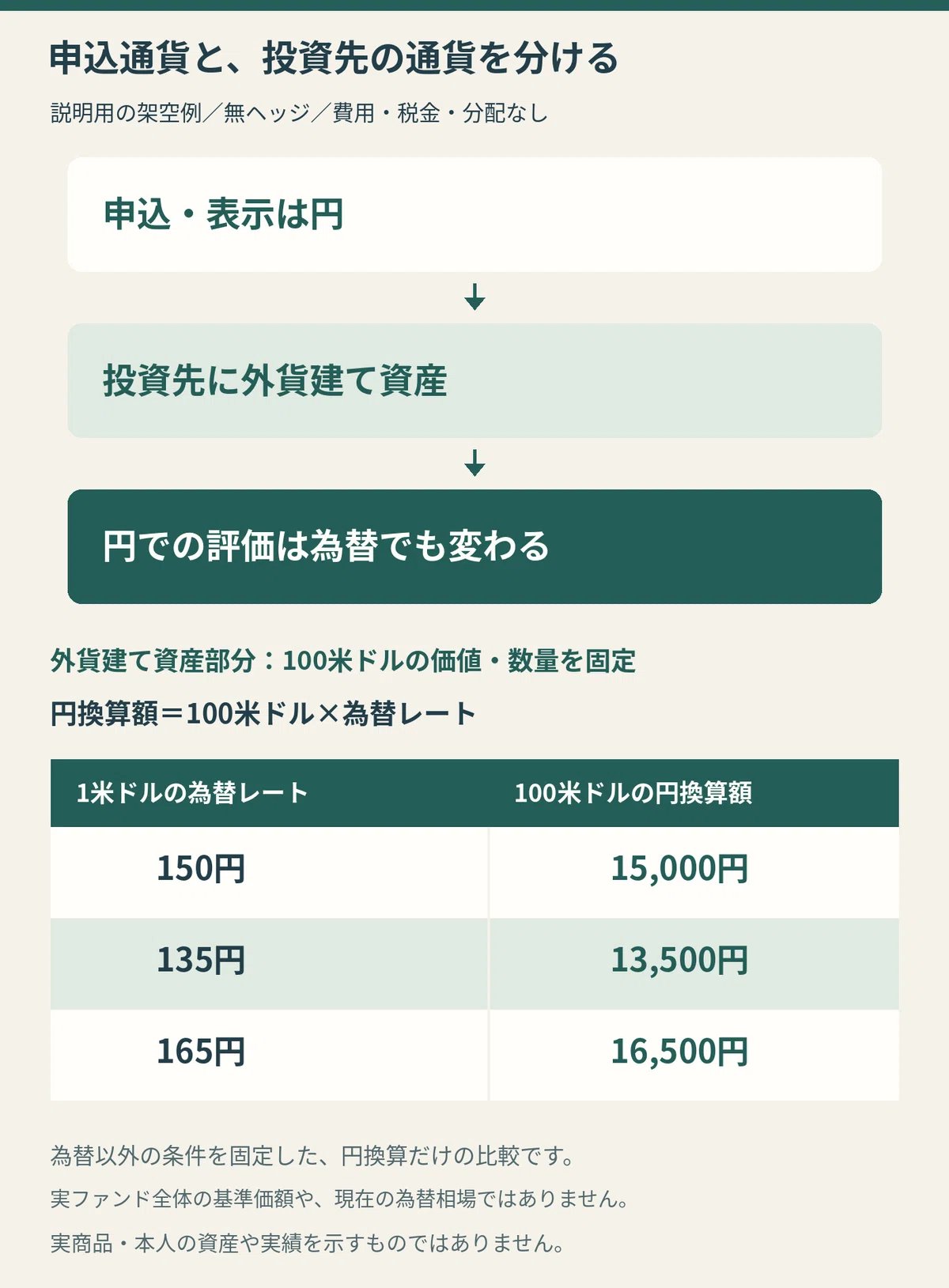
Here, we will use a hypothetical example where a portion of the foreign-currency-denominated assets is worth 100 US dollars. The quantity held and the value in foreign currency will remain unchanged, with no currency hedging, and no impact from fees, taxes, or distributions. We will alter only the exchange rate used for yen conversion.
Yen-converted amount = Foreign-currency-denominated asset value × Yen amount per 1 US dollar
Let the initial baseline for comparison be 1 US dollar = 150 yen.
100 US dollars × 150 yen / US dollar = 15,000 yen
Next, converting the same 100 US dollars to yen at 1 US dollar = 135 yen yields 13,500 yen. This represents a condition of a stronger yen and weaker US dollar, where the yen that can be exchanged for 1 US dollar decreases from 150 yen to 135 yen.
100 US dollars × 135 yen / US dollar = 13,500 yen
Even though the value in US dollars remains at 100, the yen-converted amount has decreased by 1,500 yen from 15,000 yen. Compared to the baseline of 15,000 yen, this is a decrease of 1,500 yen ÷ 15,000 yen = 10%.
Conversely, at 1 US dollar = 165 yen, the yen-converted amount of the same asset is 16,500 yen. Compared to 150 yen, this becomes a condition of a weaker yen and stronger US dollar.
100 US dollars × 165 yen / US dollar = 16,500 yen
Here, it increases by 1,500 yen from 15,000 yen, representing a 10% increase relative to the baseline. 135 yen and 165 yen are separate conditions compared from 150 yen, respectively, and are not a sequential historical market record.
The only thing altered in this calculation was the exchange rate. This should be distinguished from examples where the yen-converted amount changes because asset prices in US dollars drop or holding quantities decrease. In reality, foreign-currency prices and exchange rates can move simultaneously, so these results cannot be directly applied as the return rate of a product.
Figures such as 15,000 yen are the yen-converted values of the specified asset portion. They do not represent the actual net asset value of the entire fund or a stated amount per specific number of units. In addition, 150 yen, 135 yen, and 165 yen are neither current foreign exchange rates nor future forecasts.
3. Read “With Hedging” as a Different Set of Conditions
Section 2 was an example without currency hedging. When looking at products labeled “with currency hedging,” you should not assume that they will produce the exact same calculation results; rather, you must verify the hedging policy.
Currency hedging against the yen is designed to reduce the impact of foreign exchange fluctuations. The FAQ of Mitsubishi UFJ Asset Management also explains that while it makes the fund less susceptible to currency movements, it cannot completely eliminate foreign exchange risk.
Furthermore, mitigating currency impacts is separate from whether the prices of invested stocks or bonds remain unchanged. Do not stretch the label of “with hedging” to mean that the net asset value will not decline or that the principal is guaranteed.
You should also check the cost terms. The same FAQ notes that when yen interest rates are lower than the interest rates of the hedged currency, a hedging cost equivalent to the interest rate differential is incurred. It also explains that depending on conditions in the foreign exchange market, the cost may exceed the interest rate differential.
For this reason, hedging costs should never be assumed to be a fixed amount or rate at all times. Read the expenses and hedge scope described in the product materials, and leave anything that cannot be verified as unconfirmed. Do not reverse-calculate the current costs of a specific product from general explanations.
You cannot decide which product to buy simply by looking at whether the name says “hedged” or “unhedged.” The priority is to verify what impact the policy aims to mitigate and what price fluctuations remain. The yen conversion examples in this article do not serve as historical performance data for comparing the advantages or disadvantages of hedging.
4. Separate Currency, Investment Target, and Hedging into Different Columns
When reading product descriptions, do not stop once you have checked the subscription and display currency; proceed to the descriptions of the investment target and hedging. Compile and record the following three items as a set from the prospectus or the asset management company’s informational materials:
-
Subscription/Display Currency: The currency used to subscribe and the currency in which the net asset value is displayed: ____
-
Investment Targets and Foreign-Currency-Denominated Assets: Major investment targets, asset currencies, and verified portfolio allocation status: ____
-
Yen-Hedging Policy: Statement of whether hedging is applied, scope of coverage, and cost explanations: ____
For each of the three columns, also include the document title, relevant page number, document date, and verification date. Distinguish between documents explaining policies and documents showing actual portfolio holdings on a specific date when reading them. Do not treat old monthly reports as reflecting the current composition as-is.
For instance, even if you can write “Subscription/display in yen” in the first column, if you do not know whether there are foreign-currency-denominated assets or yen-hedging, the remaining two columns remain “Unconfirmed.” Avoid filling blanks with guesswork, such as assuming “Hedging is unnecessary because it is in yen” or “There is no hedging because no mention could be found.”
Using Section 2 as an example entry, you would record in the investment target column: “Illustrative foreign-currency-denominated asset portion of 100 USD, with quantity and foreign currency value fixed,” and in the hedging column: “None.” The comparative exchange rate conditions are 150 yen, 135 yen, and 165 yen, and the yen-converted amounts are 15,000 yen, 13,500 yen, and 16,500 yen.
In this example, no real-world subscription/display currency or document publication date is specified. There is no need to add fictional sales conditions to the first column; it can simply be left as “Unset for this product.” Neither the calculation for an entire actual fund nor the investment performance with hedging can be derived from this example.
By separating what has been confirmed from the sections requiring additional review, you can avoid basing your judgment solely on the single piece of information that a fund can be bought in yen. When reading yen-converted figures, trace back to verify the distinct conditions: the original foreign currency value, exchange rates, and hedging.
References
Accessed on November 26, 2026.