Image © Adobe Images
The U.S. dollar is tipped to extend its rally into 2027 as the Federal Reserve keeps raising interest rates and investors add to their holdings of the currency, says Bank of America.
Bank of America has raised its U.S. dollar forecasts against most major currencies, particularly for the first half of 2027, after it moved its Federal Reserve call to three back-to-back interest rate rises.
“No time to fade USD rally. US resilience is increasingly priced, but we forecast three back-to-back Fed hikes and positioning still lags,” says a new FX market analysis from Bank of America.
“We retreated from our bullish USD view in September, as Fed hikes and US resilience seemed better priced… This proved untimely with sticky inflation leading us to revise our Fed call to three back-to-back hikes by March 2027 and rate differentials boosting the dollar. But with positioning lagging the USD rally, fading the move is premature in our view,” the U.S. investment bank adds.
Bank of America’s FX and Rates Sentiment Survey shows “long-term positioning is still underweight”. Positioning measures how much of a currency investors already hold. Investors who buy dollars to close that gap would lift the currency further.
The institution expects the Fed to raise interest rates further than money markets do: “a December hike is nearly a lock and additional moves in January and March 2027 should be the base case,” the bank said after Monday’s rally in U.S. shares. Money markets, where investors put odds on future rate moves through interest rate contracts, price 26 basis points of Fed tightening by the 9 December meeting, 43 by 27 January and 58 by 17 March, short of the 75 basis points that three quarter-point hikes would deliver. A basis point is one hundredth of a percentage point.
Higher expected Fed interest rates lift the yields on two-year U.S. government bonds, which track where investors expect Fed rates to be over the next two years, and draw in foreign buyers who need dollars to buy them.
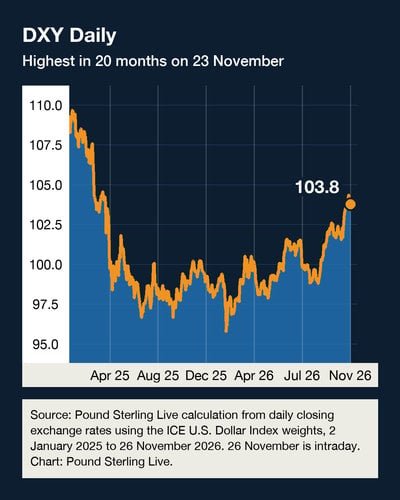
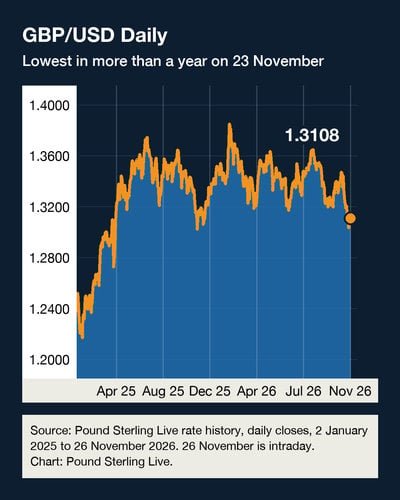
The U.S. dollar index, a measure of the dollar against six major currencies, rose 5.8% from 98.84 on 8 September, when Bank of America stepped back from its bullish call, to a 2026 high of 104.53 on Monday, as Pound Sterling Live reported. Since 8 September the pound-to-dollar exchange rate has fallen to 1.3112 from 1.3545, and the euro-to-dollar exchange rate to 1.0979 from 1.1627.
Bank of America’s Forecasts Back the Dollar Until Mid-2027
“We revise up our USD forecasts against most currencies, especially for 1H ’27,” says Bank of America.
Bank of America sees the dollar strongest in the first half of 2027 and weaker by the year’s end:
1. EUR/USD “at or below 1.10 through 1H”, with 1.09 on a six-month view, 0.7% below spot at 1.0979.
2. EUR/USD at 1.15 by the end of 2027, 4.7% above spot.
3. GBP/USD at 1.40 by the end of 2027, 6.8% above spot at 1.3112.
4. The dollar index at 98.5 by the end of 2027, 5.8% below Monday’s high.
“By 2H, peak Fed, slower AI capex and cheaper energy can turn the tide against USD,” says Bank of America. Peak Fed means U.S. interest rates at their high point. AI capex is company spending on AI infrastructure.
Dollar Rally Reaches Near-term Limits
Wednesday’s October PCE figures showed core inflation, the Fed’s preferred measure of underlying price pressures, rising to 3.3% from 3.1%, above the 3.2% economists expected, but the dollar barely moved: GBP/USD was at 1.3067 some 20 minutes after the release, against 1.3070 just before it.
Pound Sterling Live said on Wednesday that the dollar’s muted response is a case of diminishing returns on hot U.S. data; it looks vulnerable to a meaningful reversal because bets on a January Fed hike are exposed to softer figures, well inside Bank of America’s first-half horizon.
Karl Schamotta, Chief Market Strategist at Corpay, says rising U.S. interest rates leave the outlook for the dollar on “remarkably-shaky ground”, because the currency now trades as a proxy for U.S. technology shares. Higher rates raise the cost of financing the AI build-out, and if that erodes the AI story behind U.S. share prices, “the dollar’s appeal to foreign investors could diminish,” he adds.
Bank of America says betting against the dollar gives poor protection against an AI sell-off, because the dollar held firm through November’s technology sell-off as rate differentials, the gap between U.S. and other countries’ interest rates, dominated.
“The dollar should stay supported by strong US growth, high inflation and a Fed threatening to tighten before weakening next spring as inflation falls,” says ING, the Dutch investment bank, in a recent update.
Bank of America is not alone in expecting the dollar to stay supported into the new year. J.P. Morgan also forecasts three consecutive Fed hikes, as Pound Sterling Live reported. ING sees the dollar turning lower in the second quarter of 2027, and Bank of America in the second half.
Pound Sterling Live holds that AI drives U.S. outperformance and the dollar through Fed expectations and two-year yields. The dollar would resist a reversal if the Fed raises interest rates in January and March, as Bank of America expects.
Bank of America’s technical analysts see the dollar index rallying to 104.59-105 in the first quarter of 2027, the top of its downtrend channel. The channel is the falling range the index has traded within over the longer run, and sellers would be expected to halt rises at its top. That level sits just above Monday’s 2026 high of 104.53. A breakout above it would support a run towards 120, they say. Should the index top out there, they see a pullback towards 95-97.