

- Pound Sterling Rises vs Euro and US Dollar After Surprise Drop in UK Unemployment
- UK economists at Pantheon see firmer UK employment supporting a November rate rise, but ING and Lloyds question how much further tightening the GBP can count on.
- Revisions weaken the case for a deteriorating jobs market
- Pay offers reassurance, but recent momentum worries Pantheon
- A November rise does not settle the 2027 outlook
- Pound Sterling, UK Economy FAQ

Pound Sterling Rises vs Euro and US Dollar After Surprise Drop in UK Unemployment
UK economists at Pantheon see firmer UK employment supporting a November rate rise, but ING and Lloyds question how much further tightening the GBP can count on.
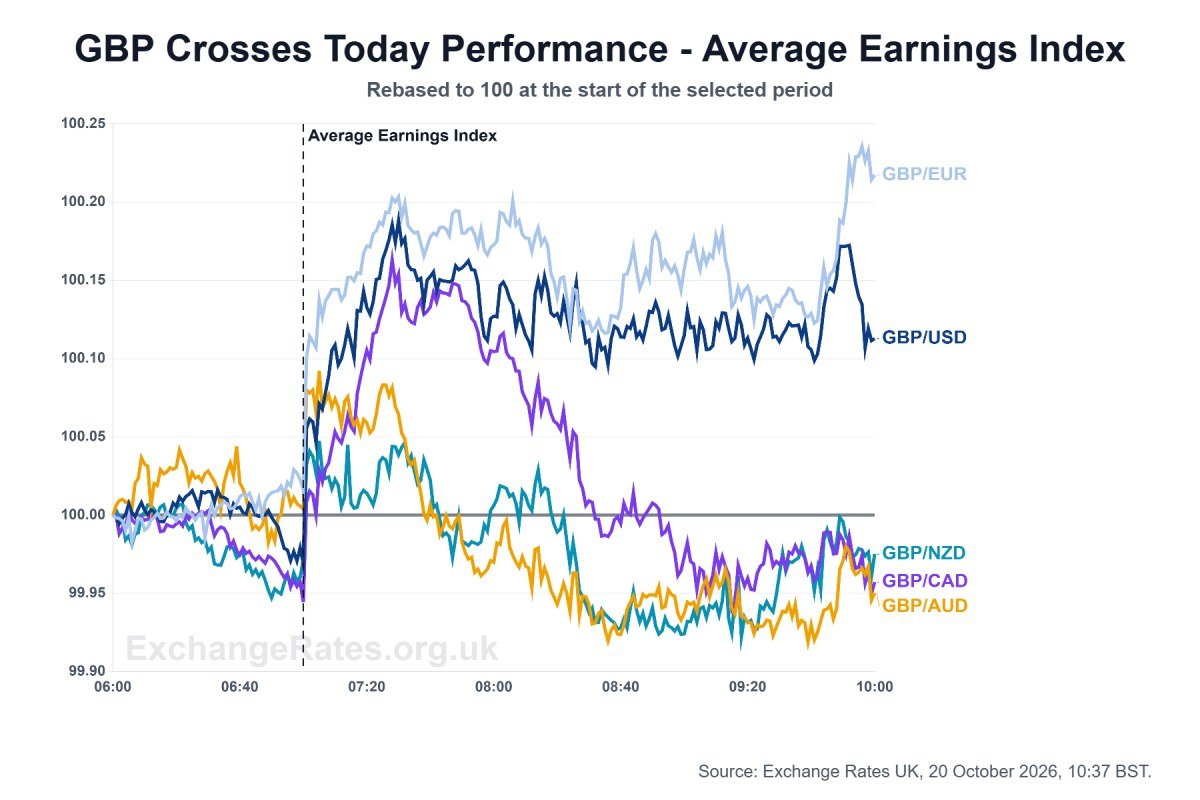
The Pound-to-Dollar exchange rate rose to $1.3348 on Tuesday morning, up 0.29% on the day, after stronger UK employment figures reinforced expectations of a Bank of England interest-rate increase.
Pound Sterling was also trading at €1.1897 against the Euro, up 0.24%, after briefly reaching €1.1905, its highest level this year.
Pound to Dollar (GBP/USD): 1.334745 (+0.29%)
Euro to Dollar (EUR/USD): 1.121657 (+0.02%)
Unemployment unexpectedly fell to 4.7% in the three months to August from 4.9%, while payroll employment increased in September and August’s reported decline was revised away.
Pantheon Macroeconomics expects increases in November 2026 and February 2027, with the risk of further tightening rising.
ING also anticipates a November increase and tentatively another in February, but sees little evidence that an improving jobs market is generating an inflation problem.
Lloyds puts the market-implied probability of a November hike at around 90% in its post-release assessment, leaving more room for subsequent decisions to change the currency’s interest-rate support.
Revisions weaken the case for a deteriorating jobs market
September’s 13,000 payroll increase was accompanied by a particularly important correction: August’s previously reported 26,000 decline became a 1,000 rise.
Pantheon calculates that revisions across the earlier data leave employment 41,000 higher than previously thought.
That gives the improvement more substance than the unemployment figure alone, which comes from a Labour Force Survey still troubled by sampling problems.
ING economist James Smith also notes that part of the fall in unemployment reflects higher inactivity, meaning more people are outside the labour force rather than necessarily finding work.
Pantheon argues that lower net immigration means fewer new jobs are needed to keep unemployment from rising:
“Jobs are stagnant or rising slowly at best and private pay growth still sits at inflation-target-consistent rates. But we estimate that much weaker net immigration means the run-rate of job growth is close to zero in any case, helping to keep a lid on the emergence of labour-market slack.”
Employers therefore need not embark on a recruitment boom for the pool of available workers to stop growing.
Yet vacancies remain weak, falling to 691,000 in the three months to September, and Lloyds notes that payroll employment is still below its end-2025 level.
Its senior UK economist Nikesh Sawjani writes: “The recent improvement therefore lends some support to the stronger LFS figures, but is not yet sufficient to establish a clear change in trend.”
Pay offers reassurance, but recent momentum worries Pantheon
Private-sector regular pay rose 3.0% year-on-year over the three months to August, only marginally faster than previously and at a pace Pantheon considers compatible with the inflation target.
Pantheon is watching faster recent pay momentum:
“Three-months-on-three-months annualised private-sector ex-bonus pay growth jumped to 4.3% in August, from 3.8% in July, and all other indicators we track suggest stronger pay growth than the private-sector ex-bonus measure does, and most stopped falling some time ago.”
That measures recent momentum rather than the annual increase and suggests the slowdown in pay may have stalled.
Pantheon writes: “Big picture, market pricing for rate hikes is about whether a loosening labour market can offset the impact of surging energy costs on wage growth and inflation. The data keep us sceptical that the market is loose enough or even easing any more.”
The BoE’s September decision rested partly on soft labour-market conditions restraining inflation, although policymakers had already identified some stabilisation.
The risk is that workers seek compensation for higher energy bills and firms raise prices to cover higher wages, making inflation persist beyond the original energy shock.
ING remains unconvinced that this process is taking hold.
Smith writes: “Crucially, though, a jobs market that is stabilising is not the same as a jobs market that’s heating up. And that matters for wage growth.”
He points to a separate, composition-adjusted private-sector pay measure running at 3.4%, which he regards as consistent with 2% inflation over the medium term.
A November rise does not settle the 2027 outlook
The disagreement over how many BoE increases Sterling can rely on therefore survives the stronger employment report.
Chief economist Huw Pill has also questioned whether four increases are necessary, reinforcing the distinction between acting now and embarking on a prolonged tightening cycle.
Sawjani’s conclusion is restrained: “As such, the release reinforces expectations of a November hike, rather than making a compelling case in itself for a more aggressive path thereafter.”
Wednesday’s inflation figures offer the next test before the BoE’s 5 November decision, particularly whether price pressure is spreading beyond energy.
Smith writes: “Instead, a November hike-together with the follow-up move we tentatively expect in February-will be entirely an insurance move.”
“That means that, assuming we don’t get big second-round effects emerging over the winter, the Bank should be in a position to start cutting rates again from late 2027, when the storm has passed.”
Pound Sterling, UK Economy FAQ
Why did the Pound rise after the UK jobs figures?
Lower unemployment and upward payroll revisions reinforced expectations of a November BoE rate increase.
Do ING, Lloyds and Pantheon expect an extended tightening cycle?
Pantheon sees growing risks of additional increases, ING regards its expected hikes as precautionary, and Lloyds says the jobs figures alone do not justify a more aggressive path.
What is the next important release for Sterling?
Wednesday’s UK inflation figures will help test whether price pressures are spreading beyond energy ahead of the 5 November BoE decision.