


Pound Sterling rises against the Dollar and Euro as stronger UK growth puts household spending and interest-rate restraint in focus.
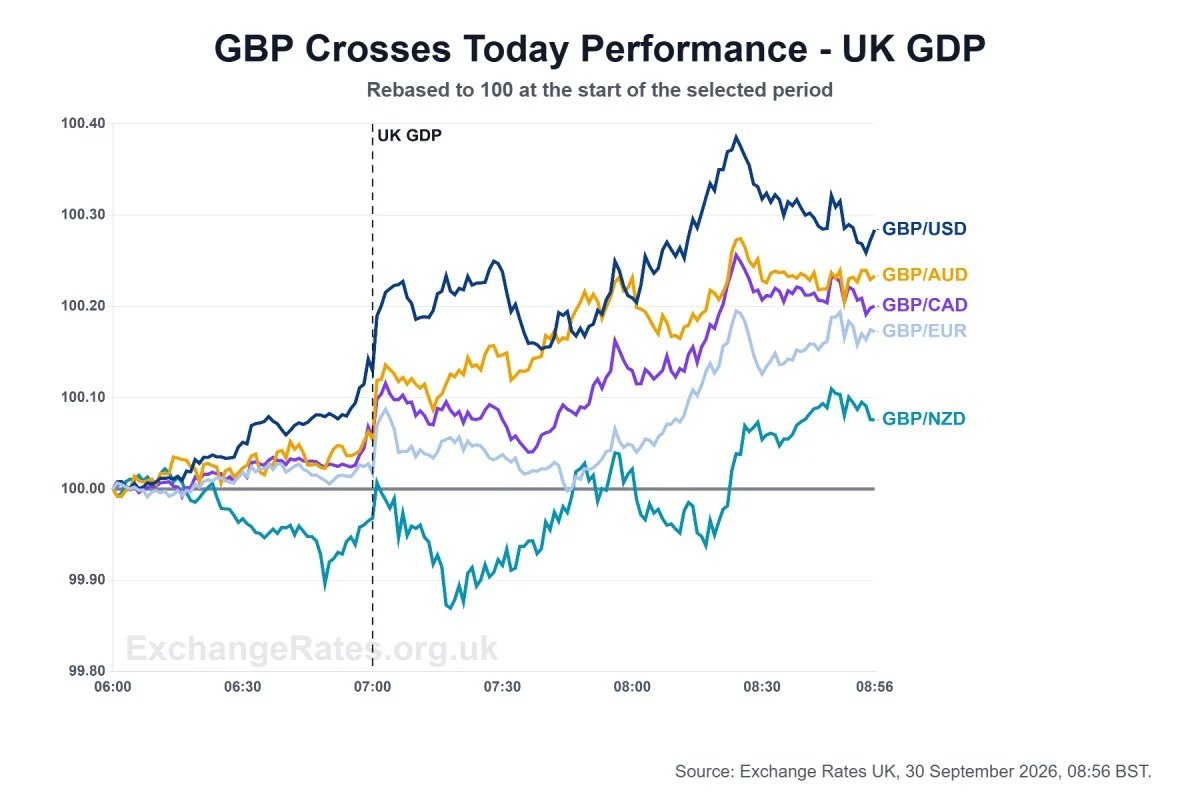
The British Pound strengthened on Wednesday morning as revised UK figures showed the economy grew 0.5% in the second quarter, up from an initial estimate of 0.4%.
The British Pound to US Dollar exchange rate (GBP/USD) traded at 1.3265, up 0.26% on the day, while the British Pound to Euro exchange rate (GBP/EUR) gained 0.23% to 1.1693.
Pound Sterling nevertheless remained around 2.1% lower against the US Dollar over September.
Pantheon Macroeconomics sees scope for households to sustain demand despite higher energy prices and borrowing costs.
“The pace of growth suggests consumers are doing more than simply smoothing through the shock; interest rates appear to be providing relatively little restraint.”
That assessment matters for Sterling because resilient spending could make it harder for the Bank of England to bring inflation under control, supporting the case for keeping policy restrictive.
Lloyds attributes the GDP upgrade primarily to stronger net trade, with export volumes rising 2.8% and imports flat.
Business investment increased 1.8%, while household consumption rose a more modest 0.3%.
The bank also notes that real household disposable income per head recovered 1.0%, reversing the previous quarter’s 0.8% decline.
“Taken together, the revisions suggest that growth in Q2 was somewhat stronger and more broadly supported than indicated by the preliminary estimate, leaving the economy on a firmer footing entering the second half of the year.”
The household saving rate edged up to 8.8% from a downwardly revised 8.6%, but Pantheon sees the longer-term trend continuing lower.
“It still has room to fall, remaining well above its 2015-to-19 average of 6.5%.”
Saving a smaller share of income would give consumers room to increase spending.
The external accounts offer less reassurance despite the current account deficit narrowing to £19.9bn.
Pantheon warns: “The bigger picture is that the current account will remain under pressure as higher-for-longer energy prices keep imports elevated.”
Our currency coverage draws on live market data, official economic releases and published bank research.