

- US Dollar (GBP/USD) – 1.346656 (+0.12%)
- Euro (GBP/EUR) – 1.166445 (+0.01%)
- Japanese Yen (GBP/JPY) – 212.265062 (+0.06%)
- Australian Dollar (GBP/AUD) – 1.910330 (+0.09%)
- Canadian Dollar (GBP/CAD) – 1.895229 (+0.17%)
- Swiss Franc (GBP/CHF) – 1.087768 (-0.06%)
- New Zealand Dollar (GBP/NZD) – 2.292570 (+0.12%)
- Chinese Yuan (GBP/CNY) – 9.089660 (+0.06%)
- Swedish Krona (GBP/SEK) – 12.801235 (-0.01%)
- Norwegian Krone (GBP/NOK) – 12.833761 (+0.03%)
- Singapore Dollar (GBP/SGD) – 1.725293 (+0.06%)
- Mexican Peso (GBP/MXN) – 23.211144 (-0.01%)
- South African Rand (GBP/ZAR) – 22.004058 (-0.17%)
- Indian Rupee (GBP/INR) – 128.069045 (+0.12%)

Pound Sterling opens Wednesday’s European session with a steadier tone, but the charts still show a currency struggling to regain clean momentum.
The wider FX backdrop is doing most of the work.
The US Dollar is near a six-week low, oil prices have extended their fall on hopes of progress in US-Iran negotiations, and the Yen is holding most of its intervention-driven recovery.
That mix is helping global risk appetite, but it is also keeping G10 currencies fragmented rather than creating a simple risk-on rally.
Lower oil prices have reduced some near-term inflation anxiety, pulling US yields lower and trimming expectations for another Federal Reserve rate increase.
That has helped GBP/USD rebuild ground, but the British Pound is still losing momentum against currencies where local stories are stronger.
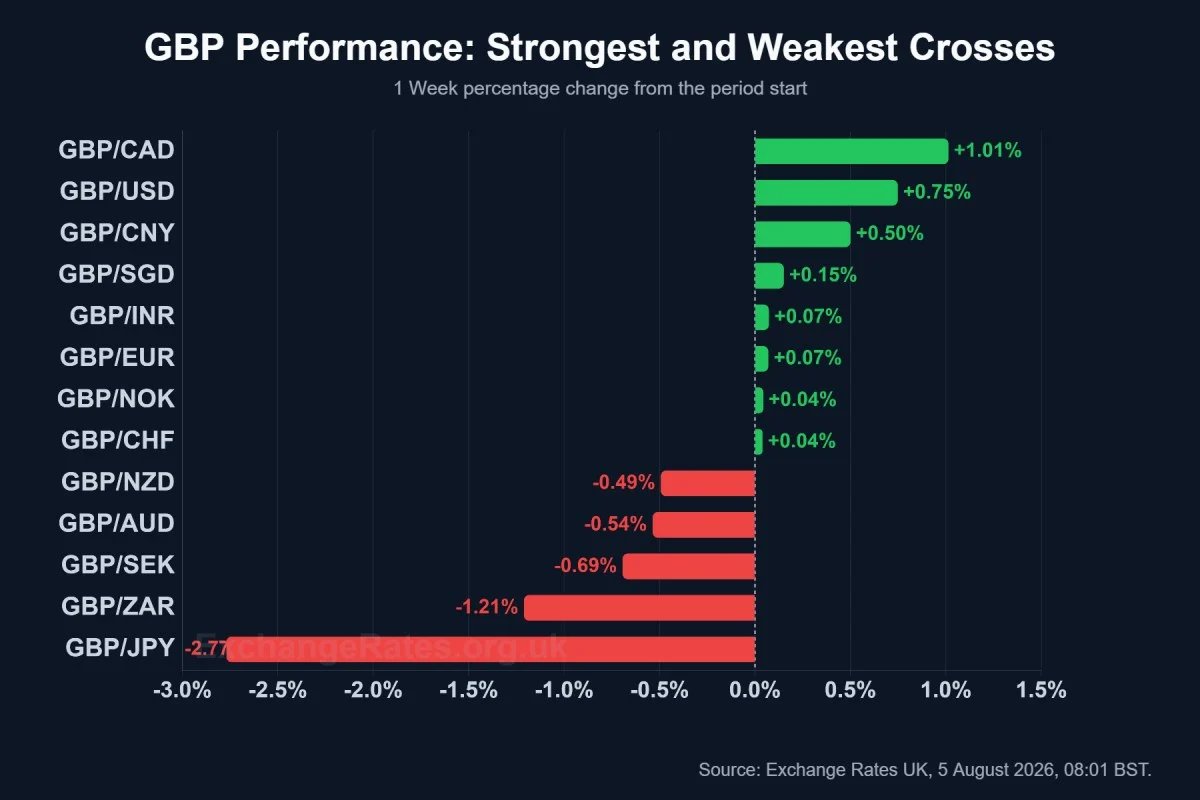
The one-week performance chart shows where Pound Sterling is still working and where the pressure remains.
GBP/CAD is the strongest cross over the week, up 1.01%, followed by GBP/USD at 0.75% and GBP/CNY at 0.50%.
The weakest crosses are far clearer, with GBP/JPY down 2.77%, GBP/ZAR down 1.21%, and GBP/SEK down 0.69%.
The weekly chart underlines the same point.
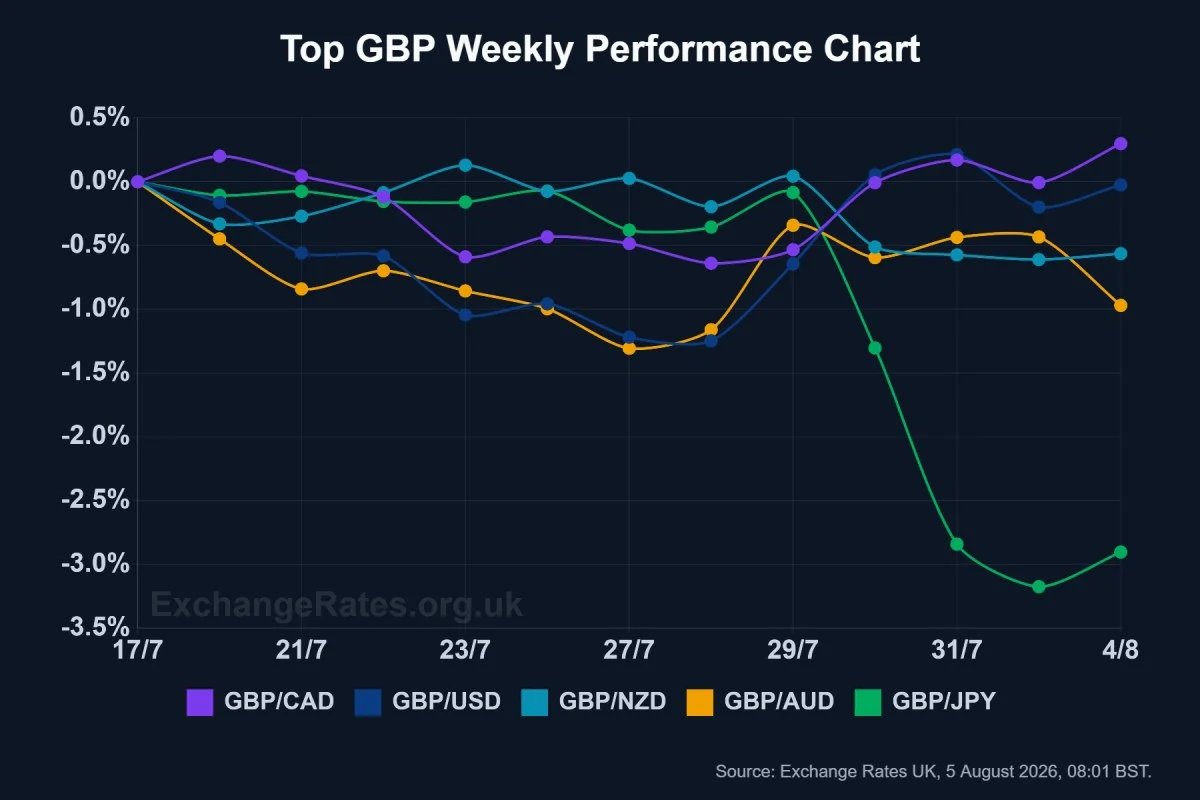
GBP/USD and GBP/CAD have rebuilt ground since late July, but GBP/JPY has suffered a decisive break after the coordinated Yen intervention.
GBP/AUD and GBP/NZD remain well below their mid-July levels.
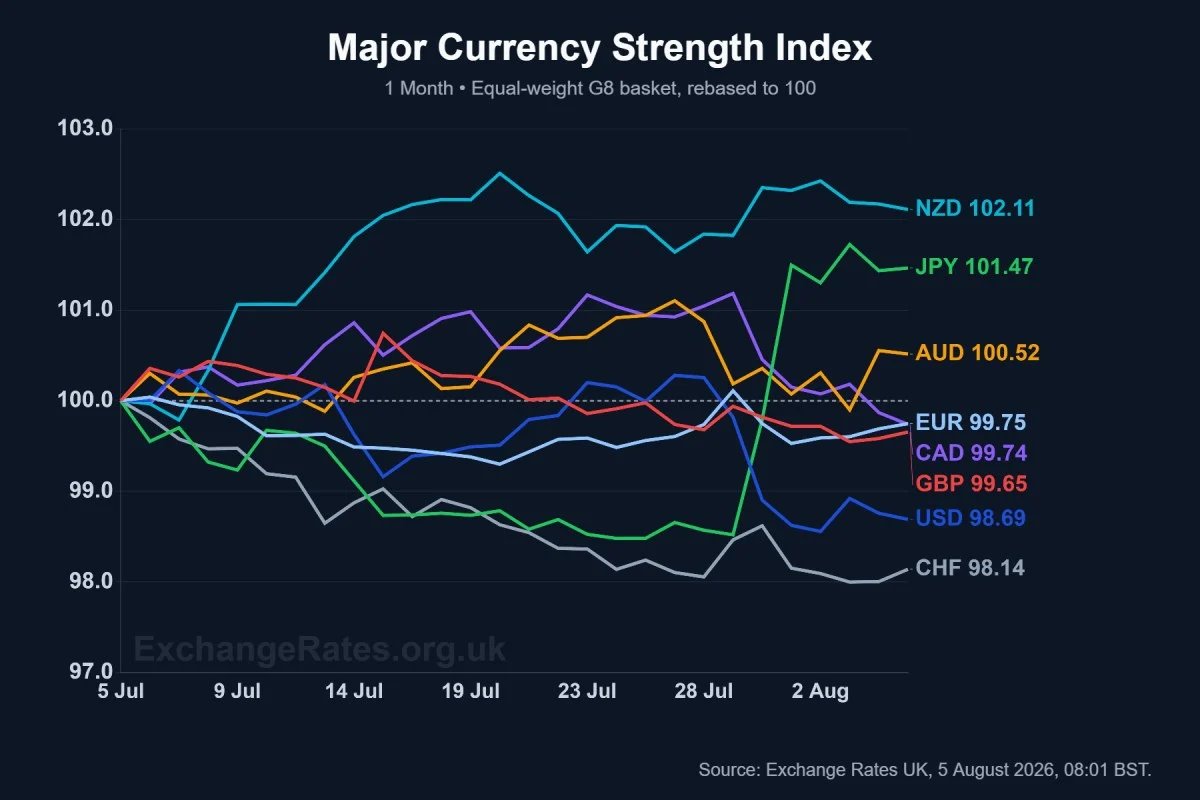
The broader currency strength index keeps the New Zealand Dollar and Japanese Yen at the top of the one-month G8 table.
The Pound sits below the Euro and Canadian Dollar, but above the US Dollar and Swiss Franc.
That is not a weak Pound Sterling story in isolation.
It is a rotation story, with markets rewarding currencies linked to intervention, local data surprises and changing rate expectations.
The live GBP snapshot shows Sterling’s strongest one-day gains against the Canadian Dollar, US Dollar, Hong Kong Dollar, Indian Rupee and New Zealand Dollar.
The South African Rand and Swiss Franc are the main outperformers against the Pound this morning.
US Dollar (GBP/USD) – 1.346656 (+0.12%)
The Pound to Dollar exchange rate is firmer near 1.3470 as the Dollar struggles to recover from its latest slide.
Lower oil prices have eased some inflation pressure, pulled Treasury yields lower and left the Dollar exposed before fresh US labour-market data.
The market focus is now on ADP employment, ISM Services and whether job openings confirm a softer labour backdrop.
A break above 1.3500 would improve Sterling’s technical tone, but a stronger US services print would quickly rebuild Dollar demand.
Euro (GBP/EUR) – 1.166445 (+0.01%)
GBP/EUR is almost unchanged as the Euro waits for a cleaner regional catalyst.
The single currency has found some support from the recent improvement in Eurozone manufacturing, but the recovery still looks uneven and demand conditions remain fragile.
That keeps ECB expectations finely balanced, with traders reluctant to chase Euro gains before final services data and the next US releases.
The 1.1660 area remains sticky, while 1.1700 is still the near-term level GBP bulls need to reclaim.
Japanese Yen (GBP/JPY) – 212.265062 (+0.06%)
GBP/JPY is slightly higher on the day, but the Yen remains the dominant story.
The Japanese currency is holding most of its intervention gains after coordinated action by Tokyo and Washington changed market psychology.
Yen shorts are no longer as easy to hold, particularly with investors now treating a September Bank of Japan rate move as a more realistic risk.
Japan’s services PMI also showed slower growth and persistent cost pressure, reinforcing the idea that the BoJ cannot ignore inflation even as activity momentum cools.
Australian Dollar (GBP/AUD) – 1.910330 (+0.09%)
GBP/AUD is modestly higher, with the Australian Dollar giving back some of Tuesday’s strength.
The Aussie had been supported by stronger household spending, after June outlays rose 0.8% and comfortably beat expectations.
Softer China services data has checked that momentum, as Australia-sensitive trades remain tied to the quality of Chinese demand.
The cross is still lower over the week, so the broader picture remains more constructive for AUD than today’s small Sterling bounce suggests.
Canadian Dollar (GBP/CAD) – 1.895229 (+0.17%)
GBP/CAD is the strongest Sterling move in the snapshot, even though Canada’s latest trade data were solid.
Canada’s June trade surplus reached C$3.86bn, the highest in more than four years, helped by record exports and a weaker Canadian Dollar.
That would normally support CAD, but the fall in oil is cutting across the trade story.
With Brent sliding toward $79, the Loonie is struggling to draw its usual commodity support.
Unless crude stabilises, GBP/CAD can stay bid near the 1.8950 area.
Swiss Franc (GBP/CHF) – 1.087768 (-0.06%)
The Swiss Franc is slightly firmer, helped by lower global yields and a market still alert to geopolitical risk.
CHF is not getting the full safe-haven bid that would usually follow Middle East uncertainty, because equities are stronger and oil prices are falling.
Even so, the Franc tends to find demand when investors are unsure whether a risk rally is durable.
GBP/CHF remains close to recent highs, but the cross may struggle to extend unless US data lift yields again.
New Zealand Dollar (GBP/NZD) – 2.292570 (+0.12%)
The New Zealand Dollar is softer today after labour-market data weakened the RBNZ support story.
NZD remains the strongest G8 currency over one month, but that leadership is being tested after unemployment rose to a decade-high 5.6%.
Softer jobs data make it harder for traders to price a more aggressive Reserve Bank of New Zealand stance, even with inflation still a concern.
GBP/NZD is bouncing from recent lows, although the cross remains well below its July peak.
Chinese Yuan (GBP/CNY) – 9.089660 (+0.06%)
The Yuan is slightly softer after China’s private services PMI slowed sharply.
The RatingDog services PMI fell to 50.4 in July from 54.1, the weakest expansion since September 2024.
That keeps pressure on Beijing to support domestic demand, particularly after recent manufacturing numbers also showed softer momentum.
The Yuan is being cushioned by the weaker Dollar, but the local growth signal is not strong enough to drive GBP/CNY meaningfully lower.
Swedish Krona (GBP/SEK) – 12.801235 (-0.01%)
The Swedish Krona is little changed, tracking the wider European currency complex rather than a domestic catalyst.
SEK has benefited from the improvement in European manufacturing sentiment, but the recovery remains uneven and energy uncertainty continues to matter for Nordic FX.
The Krona needs a stronger European growth story to extend gains, while the latest data mix still suggests recovery rather than acceleration.
GBP/SEK therefore looks more rangebound than directional at current levels.
Norwegian Krone (GBP/NOK) – 12.833761 (+0.03%)
The Norwegian Krone is slightly weaker as the oil pullback continues.
Brent’s slide below $80 has removed some of the immediate support that helped NOK outperform earlier in the month.
The market is still watching US-Iran negotiations and the Strait of Hormuz, but lower crude prices reduce Norway’s terms-of-trade advantage and leave the Krone more exposed to global risk swings.
GBP/NOK remains down heavily year-to-date, but today’s oil move gives the cross a short-term floor.
Singapore Dollar (GBP/SGD) – 1.725293 (+0.06%)
The Singapore Dollar is slightly softer despite a generally firmer Asian equity session.
Regional risk appetite has improved as technology shares rallied and oil prices fell, but the SGD is also exposed to the weaker China services data.
Singapore’s currency tends to be resilient when Asian markets are orderly, but it is less likely to outperform when China-linked growth signals disappoint.
GBP/SGD is holding above 1.72, with US data and Asian risk sentiment likely to set the next move.
Mexican Peso (GBP/MXN) – 23.211144 (-0.01%)
The Mexican Peso is marginally firmer, helped by the softer Dollar and a still-supportive carry backdrop.
Lower US yields reduce the pressure on high-yielding emerging-market currencies, while the absence of a fresh oil shock has kept global risk appetite intact.
The Peso’s near-term risk is the US data calendar.
A stronger ISM Services or jobs reading would lift Treasury yields and could quickly pull capital back toward the Dollar.
For now, GBP/MXN remains close to recent highs but lacks upward momentum.
South African Rand (GBP/ZAR) – 22.004058 (-0.17%)
The Rand is the strongest performer against Sterling this morning.
Lower oil prices are helpful for South Africa’s inflation and current-account outlook, while the weaker Dollar is improving risk appetite toward emerging-market FX.
Local business activity is also in focus, with investors looking for signs that the private-sector recovery can hold above the 50 mark.
The Rand’s recovery has already pulled GBP/ZAR back from last week’s highs, although the cross remains one of Sterling’s strongest 30-day performers.
Indian Rupee (GBP/INR) – 128.069045 (+0.12%)
The Rupee remains supported by lower crude prices, even as GBP/INR edges higher on the snapshot.
The Reserve Bank of India left the repo rate unchanged at 5.25%, retained a neutral stance and signalled it wanted clearer evidence before changing course.
That keeps INR supported without turning the policy story aggressively hawkish.
The Rupee’s next move is likely to be driven less by domestic rate expectations and more by whether oil continues to fall and whether the RBI leans against currency volatility.
Today’s Key Events: August 5, 2026
- UK final Services PMI is due this morning and could shape Bank of England rate expectations if it materially revises the earlier flash reading.
- Eurozone final Services PMI is due this morning and will test whether the recent improvement in regional data is broadening beyond manufacturing.
- US ADP employment is due at 08:15 ET ahead of Friday’s non-farm payrolls.
- US ISM Services PMI is due at 10:00 ET and is the main Dollar event of the session.
- US EIA crude inventories are due after API data showed a build in stockpiles.
- The Reserve Bank of India has held rates at 5.25%, keeping markets focused on oil, inflation and RBI currency management.
- South Africa business activity data is in focus for GBP/ZAR after the Rand strengthened on improved risk appetite.
- Markets continue to assess Yen intervention risk and the chance of a September Bank of Japan rate move.
- Oil remains sensitive to US-Iran negotiation headlines and Strait of Hormuz traffic.