


The British Pound gave back its early gains against the US Dollar, but Pantheon says stronger retail sales could help UK growth beat forecasts in the fourth quarter.
The pound to euro exchange rate reached €1.1949 on Friday morning after British retail sales rose 0.7% in October. Economists had expected no change. Shortly after 9am, sterling was at its strongest against the euro that morning, up 0.15% from Thursday’s close.
Pound to Euro (GBP/EUR): 1.195414 (+0.19%)
Pound to Dollar (GBP/USD): 1.310431 (+0.15%)
Sterling also rose against the dollar just after the 7am release, but that gain had faded by 9am. At $1.3103, the pound to dollar exchange rate was still 0.13% above Thursday’s close.

The Office for National Statistics revised September’s fall in sales volumes from 0.4% to 0.6%. October more than recovered that loss. Excluding petrol, shoppers bought 0.9% more than in September, well ahead of the 0.1% increase economists had forecast.
For Pantheon Macroeconomics, the quarterly comparison matters. October’s sales volumes excluding petrol were already 0.5% above the third-quarter average. Even if volumes held steady in November and December, fourth-quarter sales on that measure would still rise by about 0.5%.
“Retail sales bounced back in October, adding to evidence that consumers are weathering the energy-price shock better than feared,” Pantheon said.

Some of October’s purchases may have been brought forward. Supermarkets sold more tinned food and long-life milk after the government launched its ‘Be Ready’ campaign on 22 October. Online clothing retailers, meanwhile, said the turn in the weather helped them sell autumn ranges that had struggled during an unusually warm September.

Pantheon points to signs of stronger spending beyond the shops. Private new car registrations rose 12.1% in the first ten months of 2026 compared with a year earlier. The hospitality groups tracked by NIQ and RSM recorded 6.2% annual growth in September sales, including takings from newly opened venues.
Across goods and services, Pantheon estimates that consumer spending has grown by an average of 0.5% a quarter this year, up from 0.1% in 2025. September had already delivered a fifth consecutive month in which UK GDP beat forecasts.
The British Retail Consortium offers a reason for caution. Its members reported 1.5% annual growth in the value of October sales. After adjusting for shop-price inflation, Pantheon estimates that sales fell 0.6% in real terms. The official figures showed volumes excluding fuel rising 2.5% over the same year.
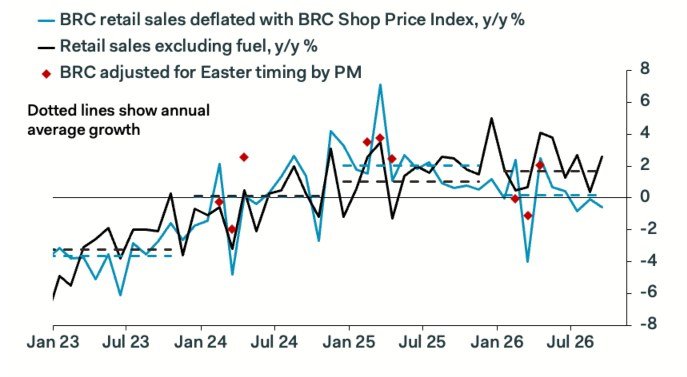
“The BRC is only a cross-check, but its weakness points to some chance of downward revisions to official sales,” Pantheon said. Its economists still expect inflation to slow household spending. October’s figures suggest that slowdown may come too late to prevent another quarter of stronger-than-expected UK growth.
Our currency coverage draws on live market data, official economic releases and published bank research.