
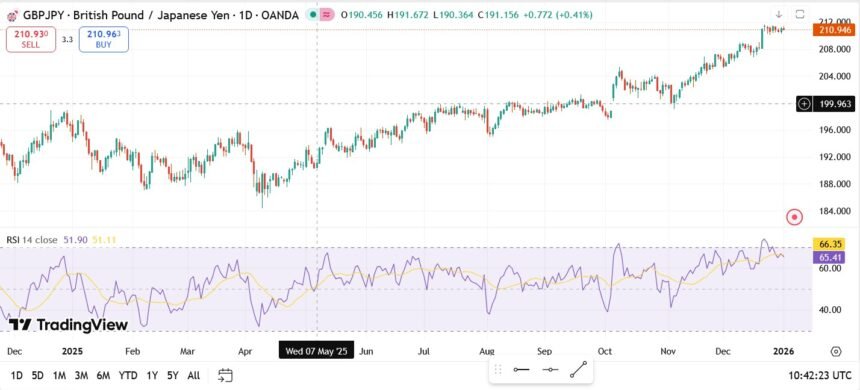
- GBP/JPY trades near ¥210 as persistent yen weakness and carry-trade demand keep the cross elevated
- Strength is driven more by Japanese policy dynamics than UK outperformance
- Technical structure remains bullish while momentum stays controlled
The GBP/JPY exchange rate is holding near ¥210.00 in early 2026, keeping the pair close to its highest levels in decades as the Japanese yen continues to lag behind major peers. While sterling has remained relatively stable, the strength in GBP/JPY reflects sustained structural pressure on the yen rather than an aggressive rally in the pound.
Price action remains orderly, with the pair consolidating near recent highs after an extended uptrend through the second half of 2025.
GBP/JPY Rises as Yen Weakness Dominates Price Action
The primary driver behind GBP/JPY strength is ongoing yen underperformance. Despite incremental shifts in Bank of Japan policy last year, interest rate differentials continue to heavily favour higher-yielding currencies such as the pound.
Japan’s monetary framework remains far more accommodative than those of other major economies, keeping the yen vulnerable in carry-trade environments. As global risk sentiment stays relatively stable, investors continue to favour funding trades in yen, supporting crosses like GBP/JPY.
This dynamic explains why GBP/JPY remains elevated even in periods when UK economic data has been mixed.
Why GBP/JPY Is Not Being Driven by Sterling Strength
Unlike GBP/USD, where UK fiscal policy and relative rate expectations play a larger role, GBP/JPY price action is largely detached from domestic UK fundamentals.
Sterling has not experienced a broad-based surge. Instead, GBP/JPY gains reflect the yen’s inability to mount a sustained recovery as yield spreads remain wide and Japanese capital continues to flow offshore in search of returns.
This distinction is important. It suggests that downside risk in GBP/JPY is likely to remain limited unless there is a meaningful shift in Japan’s policy stance.
Japanese Policy Outlook Continues to Pressure the Yen
While the Bank of Japan has taken steps toward policy normalisation, markets remain unconvinced that tightening will be aggressive enough to materially support the currency.
Japan’s policymakers continue to prioritise financial stability and wage growth, tolerating currency weakness as long as inflation remains manageable. This approach has kept the yen structurally weak, particularly against higher-yielding currencies such as the pound.
As long as this policy framework remains intact, yen strength is likely to be corrective rather than trend-changing.
GBP/JPY Technical Outlook: Bullish Structure Remains Intact
On the daily chart, GBP/JPY continues to post higher highs and higher lows, confirming the broader bullish trend. The pair recently traded around ¥210.90, consolidating just below resistance after a strong run-up from mid-2025.
Momentum indicators support the trend without flashing extreme conditions. The 14-day RSI is hovering in the mid-60s, suggesting healthy upside momentum while leaving room for further gains.
Key Levels to Watch:
- Resistance: ¥212.00 (near-term), ¥215.00 (extension zone)
- Support: ¥208.00 (initial), ¥205.00 (trend support)
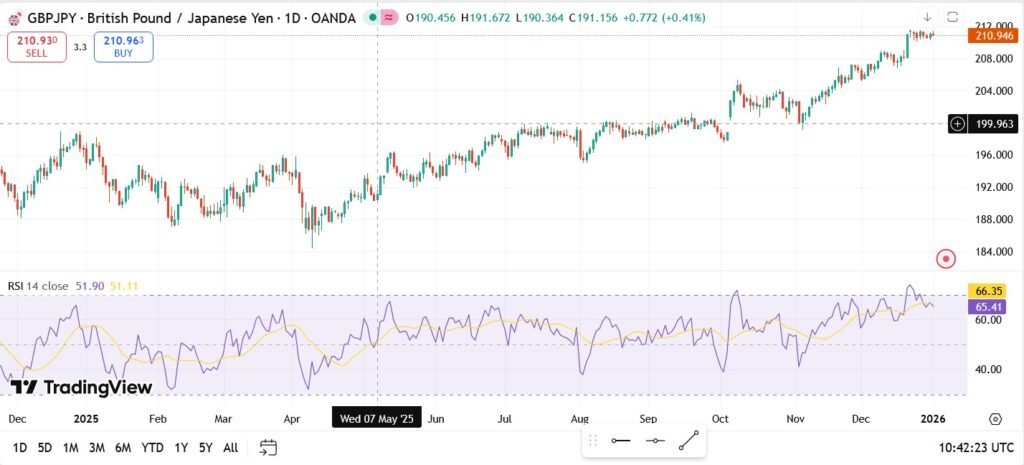
As long as GBP/JPY holds above the ¥208.00 area, pullbacks are likely to be viewed as corrective rather than a reversal signal.
GBP/JPY Outlook: Policy Divergence Remains the Core Theme
Looking ahead, GBP/JPY direction will continue to hinge on Japan’s monetary policy rather than UK-specific developments. Unless the Bank of Japan signals a sharper tightening path or actively intervenes to support the yen, the structural bias remains tilted higher.
In the near term, the cross is likely to remain elevated, trading in wide ranges while maintaining an upward drift rather than experiencing a sharp reversal.
GBP/JPY is elevated because the Japanese yen remains weak due to low interest rates and carry-trade demand, not because the pound is surging.
A sharp decline is unlikely without a significant shift in Bank of Japan policy or a sudden deterioration in global risk sentiment.
GBP/JPY is mainly driven by interest rate differentials, yen funding flows, and changes in Bank of Japan policy expectations.