

Pound Sterling has jumped against the Dollar, but the sharp move in GBP/USD was driven by the US rates market rather than this morning’s UK inflation release.
The decisive lift in GBP/USD came as long-dated US Treasury yields fell sharply after the US Treasury doubled the size of some longer-dated buyback operations to at least $4bn per operation.
That eased pressure in the long end of the bond market, pulled the Dollar lower and helped push GBP/USD to a fresh August high.
UK inflation was still important, but it was more of a background Bank of England story than the direct intraday trigger.
CPI inflation rose to 2.9% in July from 2.6% in June, broadly in line with expectations, while core inflation held at 2.6% and services inflation eased to 3.4%.
That mix kept Bank of England rate-cut expectations contained without delivering the kind of upside surprise that would normally explain a sharp Sterling move by itself.
The labour-market backdrop remains softer, with unemployment holding at 4.9%, vacancies falling to 707,000 and private-sector regular pay growth easing to its weakest pace since 2020.
That is why Pound Sterling’s rally is not uniform across the board.
The British Pound is breaking higher against the Dollar, Chinese Yuan and Indian Rupee, but it is still under pressure against the Euro, New Zealand Dollar and Swiss Franc.
Latest Exchange Rates UK pricing shows GBP/USD at 1.362006, GBP/EUR at 1.167400, GBP/AUD at 1.912744, GBP/CAD at 1.881346 and GBP/NZD at 2.297935.
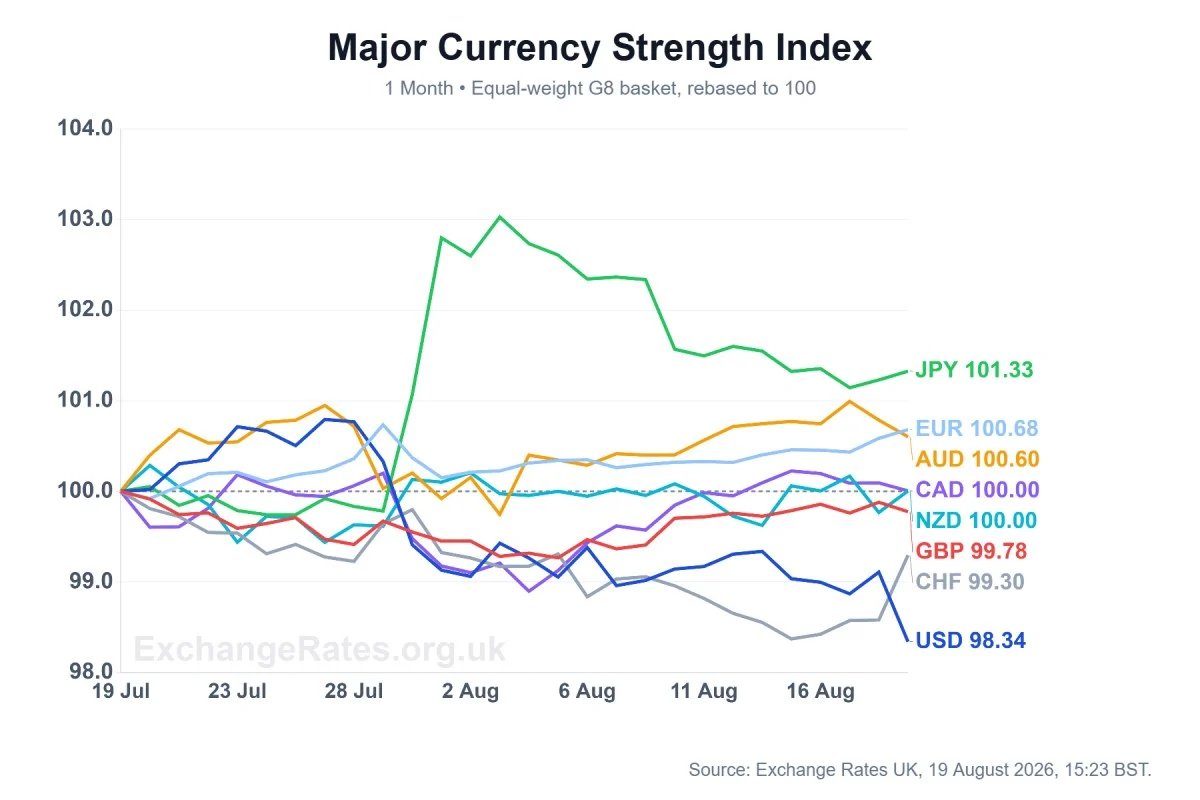
The one-month G8 strength chart shows the Japanese Yen still leading, followed by the Euro and Australian Dollar.
The British Pound remains below the midline, while the US Dollar is the clear underperformer.
That explains why GBP/USD has been able to break higher while GBP/EUR has fallen on the day.
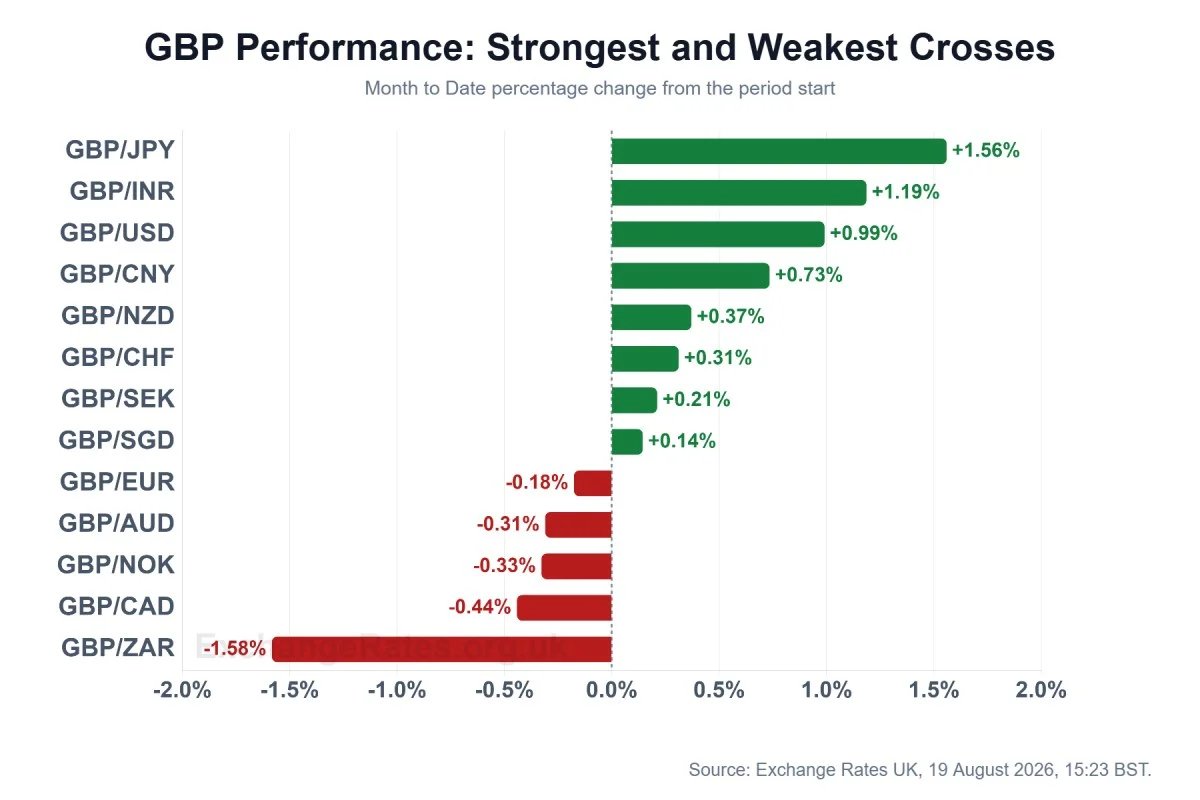
The month-to-date chart shows Pound Sterling’s strongest gains against the Yen, Rupee, US Dollar and Yuan.
The weakest crosses remain GBP/ZAR, GBP/CAD, GBP/NOK and GBP/AUD.
That split shows this is not a broad Pound rally, even after today’s strong move in Cable.
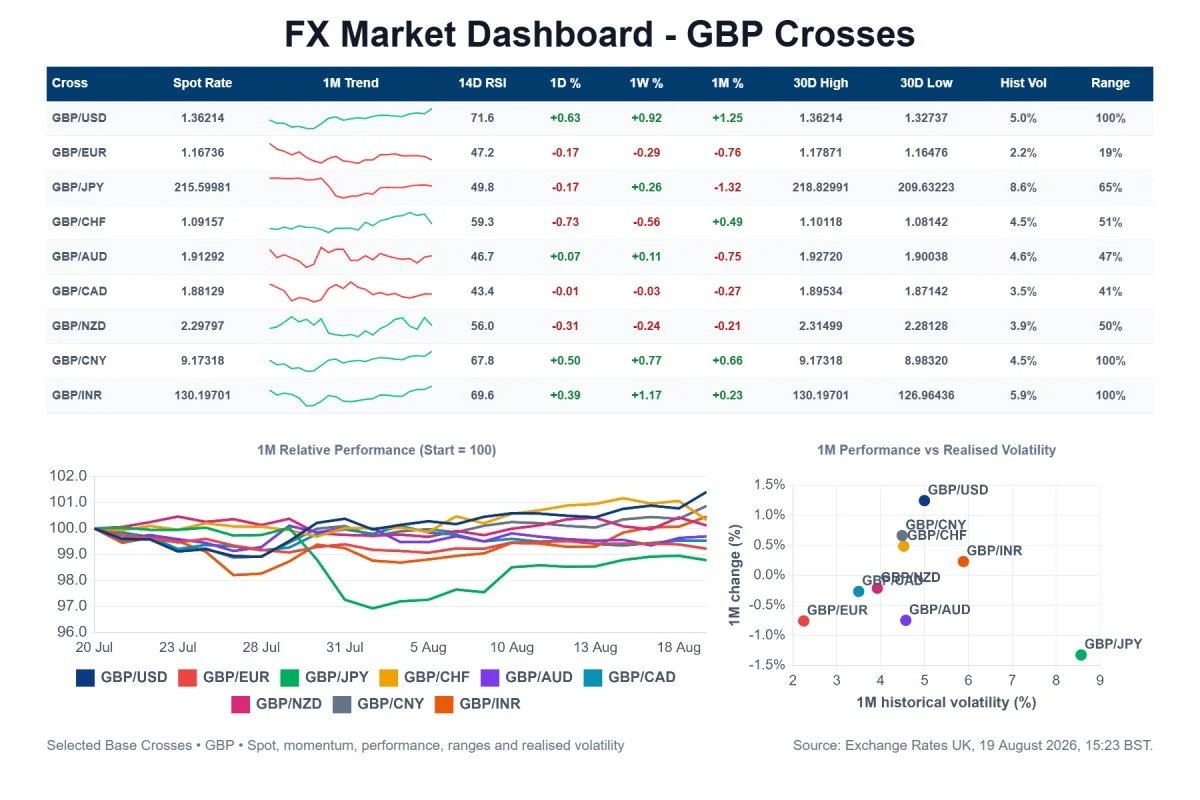
The ERUK dashboard shows GBP/USD at the top of its 30-day range, with the 14-day RSI above 70.
GBP/CNY and GBP/INR are also at their 30-day highs, while GBP/EUR remains close to the lower end of its range.
That is the clearest warning in the charts: Sterling momentum is concentrated in Dollar-linked and Asia-linked crosses, not against the Euro or commodity currencies.
US Dollar (GBP/USD) – 1.362006 (+0.62%)
The Pound to Dollar exchange rate has broken to a fresh August high after a sharp fall in long-dated US Treasury yields pulled the Dollar lower.
The US Treasury’s decision to increase longer-dated buybacks helped steady the bond market after a heavy selloff, cutting the 30-year yield and weakening the greenback.
The Fed minutes are still due later in the session, so traders will be watching whether officials push back against the market’s reduced expectations for another near-term rate increase.
GBP/USD now looks stretched on the dashboard, so the pair may need a dovish Fed readout to hold above 1.36.
Euro (GBP/EUR) – 1.167400 (-0.16%)
The Euro is outperforming the Pound, leaving GBP/EUR under pressure despite the UK inflation release.
The single currency is benefiting from the fact that today’s move is mainly a Dollar story, not a broad Sterling story.
UK CPI was close enough to expectations to avoid a major BoE repricing, while softer UK labour-market data earlier in the week still caps the case for a more hawkish UK rates outlook.
That leaves GBP/EUR close to the lower end of its 30-day range.
The 1.1640-1.1650 area is the next support zone if the Euro keeps outperforming.
Japanese Yen (GBP/JPY) – 215.59981 (-0.17%)
The Yen is firmer on the day and remains the strongest major currency over the one-month window.
Japan’s next major test is Friday’s CPI release, with core inflation expected to rise to 1.8% from 1.6%.
Bond-market pressure is also part of the Yen story, with Japanese yields near multi-decade highs as inflation and fiscal concerns build.
That keeps Bank of Japan rate-hike speculation alive, even if the Yen has already recovered a lot of ground since late July.
GBP/JPY is still positive month-to-date, but fresh upside above 216 looks harder unless global yields rise again.
Australian Dollar (GBP/AUD) – 1.912744 (+0.06%)
The Australian Dollar remains well supported, even though GBP/AUD is fractionally higher on the day.
RBA Deputy Governor Andrew Hauser warned that higher rates may still be needed if inflation risks materialise, citing the Middle East conflict, AI-linked demand and weak productivity growth.
That keeps the Australian Dollar underpinned by a more hawkish local rates story than some other G10 currencies.
GBP/AUD remains negative month-to-date and deeply negative year-to-date.
A decisive move above 1.92 would be needed before the Pound could claim a cleaner recovery against the Aussie.
Canadian Dollar (GBP/CAD) – 1.881346 (-0.00%)
The Canadian Dollar is steady as oil support offsets the broader Dollar-negative backdrop.
Canada’s July inflation rate rose to 3.0%, slightly above expectations, while underlying measures were more contained.
That gives CAD some domestic support without forcing a major Bank of Canada repricing.
Oil also remains important because Middle East tension has kept energy prices elevated, which normally helps the Loonie through the terms-of-trade channel.
GBP/CAD remains down month-to-date and still looks capped below the 1.89 area.
Swiss Franc (GBP/CHF) – 1.09157 (-0.73%)
The Swiss Franc has recovered strongly after a sustained run lower.
The earlier move against CHF had been supported by carry demand and the search for low-yielding funding currencies, but today’s fall in global yields has made that trade less attractive.
The Franc also tends to regain support when markets become less comfortable with risk, even if there is no full safe-haven rush.
GBP/CHF is still positive month-to-date, but today’s drop has pulled the cross back from the top of its 30-day range.
Further Dollar weakness or a softer Fed minutes release would make it harder for GBP/CHF to recover quickly.
New Zealand Dollar (GBP/NZD) – 2.297935 (-0.31%)
The New Zealand Dollar is outperforming as risk-sensitive currencies recover from recent pressure.
There is no single domestic New Zealand catalyst dominating the session, so NZD is trading mainly off global risk appetite, Dollar weakness and broader G8 rotation.
The currency-strength chart shows NZD almost exactly flat over one month, which fits the recent two-way price action.
GBP/NZD has slipped back below 2.30, but the cross remains positive month-to-date.
A stronger Dollar after the Fed minutes would be the main near-term risk to the Kiwi’s recovery.
Chinese Yuan (GBP/CNY) – 9.17318 (+0.50%)
The Yuan is weaker as China’s growth story remains under pressure.
China is expected to leave benchmark loan prime rates unchanged on Thursday, despite signs of weaker domestic demand and soft credit conditions.
July lending data have already shown record weakness, with outstanding yuan loan growth falling to a record low and private-sector borrowing still subdued.
That makes it harder for CNY to benefit fully from a softer US Dollar.
GBP/CNY is now at the top of its 30-day range, which shows how little support the Yuan is getting from the broader Dollar selloff.
Indian Rupee (GBP/INR) – 130.19701 (+0.39%)
The Rupee remains under pressure from oil and corporate Dollar demand.
Brent crude has moved close to $92, and India’s reliance on imported energy keeps INR vulnerable whenever Middle East tension rises.
The Reserve Bank of India has been active in smoothing currency weakness, which has helped prevent a more disorderly move.
RBI minutes also showed policymakers keeping a hawkish bias if inflation risks intensify, even after holding the repo rate at 5.25%.
GBP/INR has moved to the top of its 30-day range, but further gains may be slower if the RBI continues to lean against volatility.
Key Events Ahead: August 19-22, 2026
- Wednesday: Federal Reserve minutes are due later in the session and will test whether markets are right to price a lower chance of further US tightening.
- Thursday: China loan prime rates are due, with markets expecting no change to the one-year rate at 3.00% and the five-year rate at 3.50%.
- Friday: UK retail sales for July are due at 07:00 BST, following a 1.0% rise in June volumes.
- Friday: Japan CPI is due, with core inflation expected to rise to 1.8% from 1.6%.
- Friday: Global flash PMIs will give the next read on whether softer US data are spreading into business activity.
- Oil prices remain a key cross-market driver for CAD, NOK, INR, ZAR and central-bank inflation expectations.
- UK markets will continue to digest the contrast between today’s higher CPI reading and Tuesday’s softer labour-market data.