For most Libyans, the foreign-exchange problem is experienced through one number: the price of the dollar on the parallel market. But the exchange rate is only where a much wider set of pressures becomes visible.
When demand for foreign currency remains high despite substantial foreign-exchange sales and wider access through formal channels, the question cannot simply be how many dollars are being supplied.
The more important question is: Where is the demand coming from?
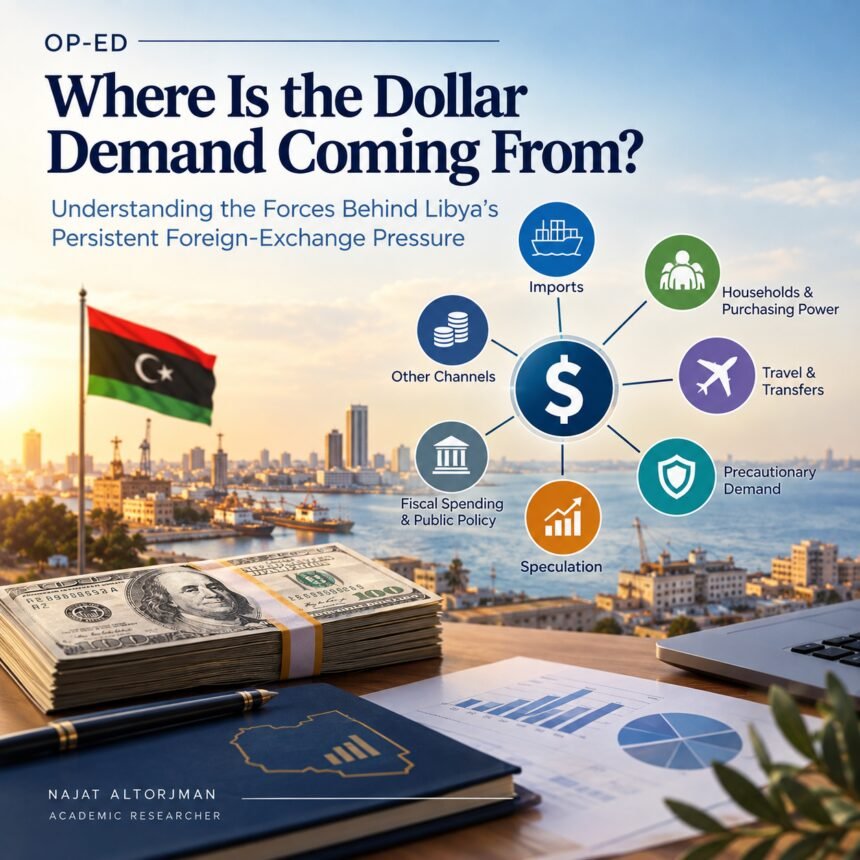
This matters because foreign-currency demand is not a single phenomenon. It reflects different economic needs, behaviours and expectations, and each has different implications for policy.
Some demand is linked to imports and legitimate business activity. Some comes from households and businesses seeking foreign currency for travel, transfers or other personal needs. Some may reflect precautionary behaviour as people try to protect their savings from further loss of purchasing power. Other demand may be associated with speculation or activity outside formal financial channels.
If all of these pressures are treated as one block, it becomes difficult to understand what is actually driving the persistent pressure on the dinar. The demand is not one single block
The available data from the Central Bank of Libya already show that foreign-exchange demand enters the formal financial system through several channels. During the first four months of 2026, these included letters of credit, personal purposes, transfers and merchants’ cards. Letters of Credit accounted for the largest share, followed by personal uses and transfers. This tells us where foreign currency is being allocated. It does not necessarily tell us why people are demanding it.
A dollar purchased through a formal channel may finance a genuine import, support travel, facilitate a transfer, or simply be held as a store of value because the purchaser expects the dinar to lose further purchasing power. The transaction may look similar.
The economic motivation behind it may be completely different. That distinction is essential if policy is to address the source of pressure rather than simply respond to its symptoms.
Import demand is real, but it is not the whole story
Libya’s dependence on imported goods and services creates a structural demand for foreign currency. Businesses need access to foreign exchange to finance imports. Importers rely on letters of credit and other banking facilities, while consumers indirectly generate foreign-currency demand through their reliance on imported goods. This demand cannot simply be described as a problem. It is part of the way the Libyan economy currently functions.
The more difficult question is whether the scale and composition of import demand are consistent with the country’s productive capacity, fiscal position and available foreign-exchange resources.
This is where fiscal policy becomes relevant.
When public expenditure expands domestic demand while domestic production remains unable to respond sufficiently, part of that additional demand can be directed towards imported goods. In this way, public spending can generate foreign-exchange pressure indirectly, even when the original expenditure is entirely in dinars.
The issue is therefore not only the size of public spending. It is also the economic capacity that spending creates.
Purchasing power changes behaviour
The foreign-exchange market cannot be separated from what is happening to household purchasing power.
When prices rise and savings held in dinars lose value, households naturally look for ways to protect what they have accumulated.
Some may purchase foreign currency. Others may hold cash, buy durable goods or reduce their exposure to the dinar in other ways.
This behaviour should not automatically be classified as speculation. For many households, it may simply be a response to uncertainty.
This creates an important feedback mechanism.
When people expect further depreciation, they may seek foreign currency before they actually need it. That precautionary demand adds to current pressure, which can reinforce expectations of further depreciation.
The cycle can therefore become:
exchange-rate uncertainty → precautionary demand → additional FX pressure → greater uncertainty.
Breaking that cycle requires more than increasing the supply of dollars. It also requires a more predictable economic environment and greater confidence in the purchasing power of the domestic currency.
What about speculation?
Speculation is often used as a simple explanation for pressure in the parallel market. It may certainly be part of the picture.
But it should not become a substitute for analysis.
Without sufficiently detailed information, it is difficult to distinguish speculative activity from precautionary behaviour or legitimate private demand.
A person buying dollars because they expect the exchange rate to rise may be seeking profit.
Another person may make the same purchase because they are trying to protect their savings.
The transaction is similar, the motivation is not.
This is why the composition of foreign-exchange demand matters.
If we cannot distinguish between different sources of demand, it becomes difficult to determine which pressures can be addressed through monetary intervention, which require fiscal adjustment, and which reflect deeper structural or institutional weaknesses.
The fiscal connection
Foreign-exchange pressure cannot be separated from the way public resources are generated and spent. Large fiscal imbalances can increase domestic demand without a corresponding expansion in domestic productive capacity. The resulting pressure can appear through several channels: higher imports, increased liquidity, inflation and greater demand for foreign currency.
But there is another question that is often overlooked:
What is public spending actually expected to achieve?
If expenditure is not connected to clearly defined and measurable economic objectives, it becomes difficult to determine whether it is building productive capacity, reducing import dependence, improving infrastructure or simply increasing demand within an economy whose supply remains constrained. The absence of measurable objectives also creates a governance problem.
Without meaningful performance indicators, results are difficult to evaluate. When results cannot be evaluated, it becomes harder to determine responsibility and establish whether public resources are producing the outcomes for which they were intended.
This matters to the foreign-exchange market because ineffective spending does not necessarily disappear as a fiscal problem.
Its effects can reappear as:
higher demand → higher imports → greater foreign-exchange requirements → pressure on the dinar.
In other words, foreign-exchange pressure may sometimes be one of the places where weaknesses in public-spending effectiveness become visible.
More dollars do not necessarily mean less pressure
The Central Bank of Libya has taken several measures to increase the availability of foreign currency through formal channels, including allocations for personal purposes and financing for imports through letters of credit. It has also continued working with commercial banks to improve access to foreign currency and banking services. These measures can help address genuine shortages in formal access. But they also lead to a more difficult question:
If access expands and substantial amounts of foreign currency continue to enter the market, why does excess demand remain persistent?
This is not an argument against foreign-exchange intervention.
It is an argument for understanding what that intervention is actually addressing. If the underlying drivers of demand remain unchanged, increasing supply may relieve pressure for a period without removing the forces that recreate it.
The IMF’s 2026 assessment similarly points to the broader fiscal imbalance as an important source of pressure on the exchange rate and reserves, and stresses that exchange-rate measures cannot substitute for fiscal adjustment.
Perhaps the missing piece is information
This brings us to a question that is less visible in the public debate.
We often ask: How many dollars entered the market?
But we should also be asking:
What happened to the demand once those dollars were supplied?
How much financed genuine imports?
Which sectors generated the greatest demand?
How much was associated with personal transactions and transfers?
How much demand was recurring?
What changed after exchange-rate adjustments?
Did import volumes change?
Did domestic prices respond?
Did the demand disappear, or was it simply displaced from one channel to another?
These are not merely statistical questions. They are questions of institutional capacity and governance.
The Central Bank has information on foreign-exchange use. Commercial banks generate transactional data. Customs records imports. Public institutions hold information on spending and fiscal flows. Digital-payment systems generate another layer of information about economic activity.
Each source tells part of the story.
The challenge is whether these pieces can be connected and interpreted together.
From foreign-exchange data to financial intelligence
This is where the debate can move beyond the familiar question of whether the dollar is too expensive or whether the Central Bank should sell more foreign currency.
The deeper question is whether institutions have sufficient financial intelligence to understand the pressures they are trying to manage.
Foreign-exchange data can show how much currency was used.
Import data can show what entered the country.
Customs information can help identify declared trade flows.
Banking data can reveal how transactions move through formal channels.
Digital-payment data can provide additional visibility into domestic activity.
Public-spending data can show where fiscal demand is being generated.
When these sources remain fragmented, each institution sees only part of the system.
When they are connected, interpreted and translated into institutional intelligence, they may provide a much clearer picture of where pressure originates and how it moves through the economy.
Better data alone will not solve Libya’s foreign-exchange problem.
But without better information, it is difficult to know whether a policy is changing the underlying dynamics or simply responding to their consequences.
The question for the next stage
Libya’s foreign-exchange pressure cannot be reduced to a simple shortage of dollars. It reflects an interaction between fiscal spending, imports, household behaviour, expectations, banking channels, domestic production, inflation and institutional confidence. Some of these pressures fall within the Central Bank’s sphere of influence.
Others require action across the wider economic and institutional system.
That distinction matters.
The objective should therefore Not to attribute all pressure in the foreign-exchange market to one institution or one group.
It should be to understand how the different parts of the system interact.
And this brings us back to the central question:
Can Libya move from simply supplying foreign currency to understanding, measuring and managing the forces that generate demand for it?
The real challenge is not just to provide more dollars.
It is to understand why the economy keeps asking for them.
Dr Najat Altorjman is a Corporate Governance Researcher, founder of Financial Integrity and Public Spending Logic (FISL) and Banking Governance & Financial Integrity in Libya, of the Sunderland Business School at the University of Sunderland.
Libya’s Persistent Exchange Rate Gap: Symptoms and Root Causes
Strengthening the Libyan Dinar: Beyond Exchange Rate Intervention