
Abstract
Global use of the Chinese renminbi (RMB) has increased gradually since it became available to
non-residents in 2009. Chinese policymakers continue to balance the push for greater international RMB
use, while only incrementally liberalising the capital account to maintain exchange rate stability and
limit external influence on Chinas financial system. Use of the RMB in trade settlement and
financing continues to rise, but it does not yet represent a leading share of international currency use.
RMB use in Australia has remained stable over the past decade. There is room for further expansion in the
use of the currency, but progress is likely to remain gradual as policymakers continue to sequence reform
carefully.
Introduction
An international currency is one that is used frequently in international trade and investment
transactions between residents and non-residents, and in transactions that involve only non-residents
(Kenen 2011). The Chinese renminbi (RMB) has been gradually internationalising for almost two decades,
and senior Chinese officials have consistently communicated their desire for greater international use of
the currency. More recently, speculation from some market participants that the US dollar could lose
its pre-eminent position as the worlds global currency – a phenomenon known as
de-dollarisation – has sometimes been accompanied by the idea that the RMB could rise
to become a more prominent currency globally.
However, Chinese policymakers have taken a cautious approach in working towards their goal. They have
encouraged greater use of the currency while maintaining a large degree of control over the capital
account. This approach aims to prevent any broad disruption associated with financial reforms, enables
greater control over the exchange rate and limits external influence on Chinas financial system.
However, it still allows some benefits of greater RMB use. These include:
- Reduced foreign exchange risks for Chinese exporters and importers whose trade may be invoiced in
other currencies, but whose other costs and revenue are mostly in local currency. - Increased global financial influence and deepening the global importance of Chinas domestic
institutions. President Xi Jinping has said that RMB internationalisation is a key pillar to develop
China as a strong financial power (Xi 2023). - Greater robustness of the Chinese financial system and trade to the financial and geopolitical risks
associated with reliance on the US dollar.
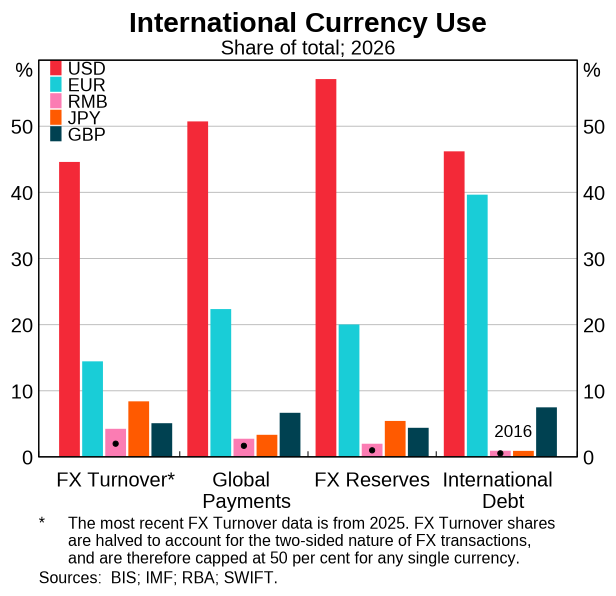
While the approach has been incremental, the RMB has progressed in most common measures of international
use. In particular, RMB trade settlement, international debt financing and foreign exchange turnover have
increased over the past decade. However, its share of global official sector foreign exchange reserves
remains similar to a decade ago. It remains much less prominent than the US dollar and euro, and its
global use slightly trails other major currencies, the yen and the pound. But it is consistently used
more than the Australian dollar and other smaller advanced economy currencies (Graph 1).
This article examines trends in the international use of the RMB, including in Australia, and how Chinese
policymakers are continuing to work toward the goal of internationalisation.
Graph 1
Global foreign exchange reserves
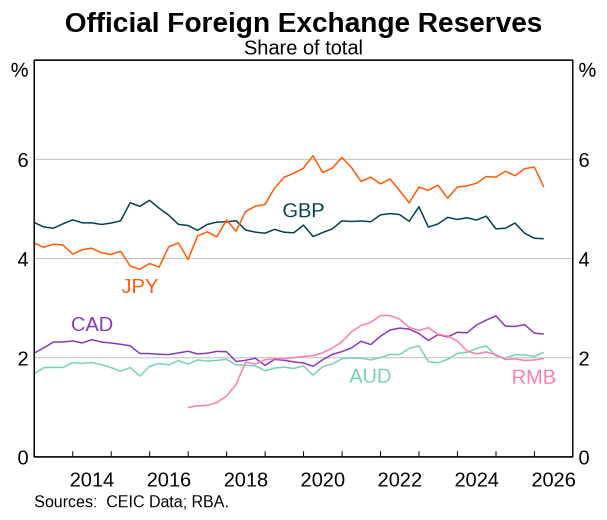
The RMBs share of global foreign exchange reserves has not increased significantly over the past
decade (Graph 2). Global reserve holdings are an important measure of international currency use as
they reflect systemic reliance on that currency as a safe and liquid store of value in the global
monetary system. The RMBs share of reserves increased from 1.1 per cent in 2016 to
2.8 per cent in 2022 but has since fallen below 2 per cent. This share has been
limited by capital controls, a less deep RMB financial market compared with other common reserve
currencies, and relatively low returns on Chinese assets in recent years.
Graph 2
RMB trade settlement
Chinese authorities have continued to emphasise trade as a key area to expand use of the currency. Exports
have been a particularly important source of growth for the domestic economy, and reducing risks
associated with foreign currency use in Chinese trade helps motivate RMB internationalisation. In
addition, global currencies have historically acquired international status first through trade invoicing
and settlement (Eichengreen, Mehl and Chiţu 2018). As China makes up over 20 per cent of global
trade, wider use in trade can strengthen the global status of the RMB.
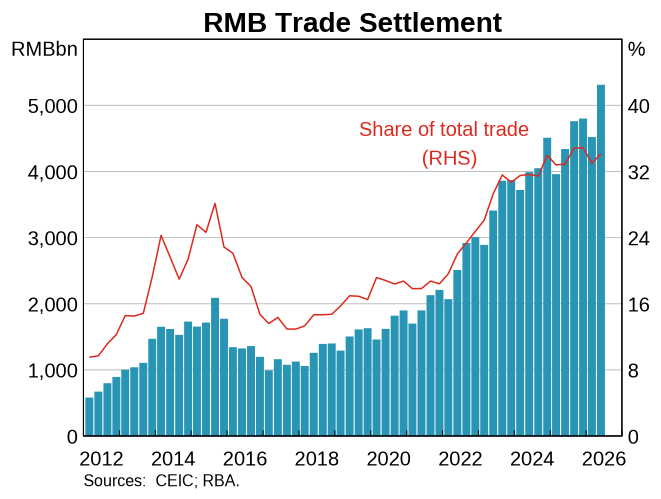
A growing share of Chinese trade has been settled in RMB over the past decade, although there remains
little evidence the RMB is used to settle trade that does not involve China. Since 2021, the share of
Chinese trade denominated in RMB has doubled from below 20 per cent to around
35 per cent (Graph 3). Data from Chinas State Administration of Foreign Exchange
(SAFE) indicates that the overall use of the RMB for Chinese cross-border payments has also increased
gradually, overtaking the US dollar in 2023 as the most common currency used for cross-border
transactions to or from China. Increased RMB trade settlement between Russia and China, particularly in
Russian oil exports, facilitated this increase initially in 2022, but this has likely since expanded more
broadly. However, the RMB has a smaller share of trade invoicing than settlement, which suggests the RMB
is less deeply integrated in global trade transactions than settlement data indicate (Liu, Wang and Woo
2025).
Graph 3
To promote use of the RMB for trade, the Peoples Bank of China (PBC) signed over 40 bilateral
swap lines, including with the RBA, and set up offshore clearing banks in the first half of the 2010s
(Hatzvi, Nixon and Wright 2014). Due to restrictions on the capital account and often constrained RMB
liquidity, these policies had a quantitatively positive effect on the RMBs use for cross-border
payments (Perez-Saiz and Zhang 2023). More recently, Chinese authorities have also made a series of
bilateral agreements to encourage trade settlement in RMB or the trading partners domestic
currency, rather than in US dollars, including with Russia, Argentina and Brazil.
The authorities have also made efforts to increase the share of global commodity trading invoiced and
settled in RMB. Commodities are a large share of Chinese imports and are generally priced using global
benchmarks and settled in US dollars. Chinese exchanges have developed their own RMB pricing benchmarks
in a range of commodity markets, including oil and iron ore, and since 2022, derivative contracts that
price using these benchmarks have become available to eligible foreign investors. The range of derivative
contracts available has expanded from fewer than 10 to over 100 in the past four years. This
suggests Chinese importers are encouraging the use of these benchmarks and RMB settlement when
negotiating contracts with overseas commodity exporters. However, there is little evidence of broad RMB
settlement in global commodity markets to date beyond bilateral trade with Russia and Iran.
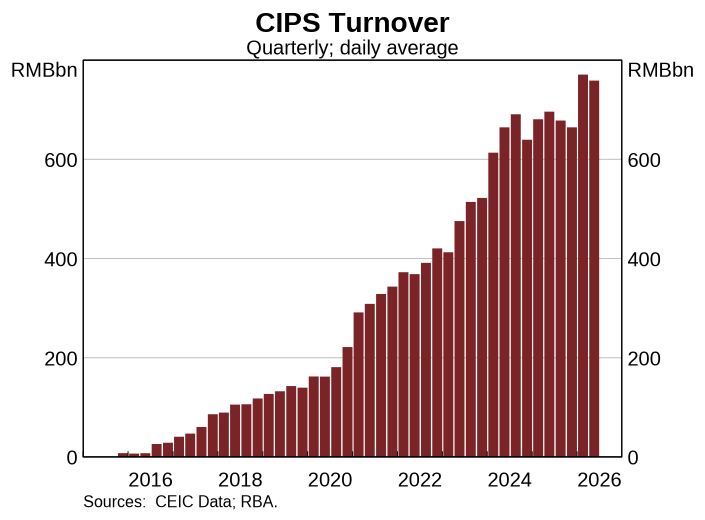
The development of new technologies has also accompanied the increase in RMB trade settlement over the
past five years. Chinas Cross-Border Interbank Payments System (CIPS) – an international
payment system first developed in 2015 – allows trade to be settled via a Chinese owned and created
system. Use of this platform has increased over 400 per cent since 2020, and although growth
slowed over 2024–2025, it has increased more recently since the onset
of the Middle East conflict (Graph 4). But use is still dwarfed by the primary international payment
systems, with the US-based payments system, CHIPS, processing over 20 times the payment volume in
2025.
Graph 4
RMB debt markets
One area in which RMB adoption has accelerated is in RMB-denominated international funding. Since China
began opening its capital account in 2009, Chinese government bond yields have mostly been higher than
sovereign bond yields in the United States and other advanced economies. However, while inflation
increased and has remained somewhat persistent across advanced economies over the past five years, China
has experienced deflationary pressures, prompting more accommodative monetary and fiscal policy. These
domestic economic conditions have contributed to Chinese yields falling below yields elsewhere, resulting
in RMB funding simultaneously being available to foreigners and nominally cheaper than US dollar
funding for the first time. This has enabled a large expansion in RMB-denominated
international debt.
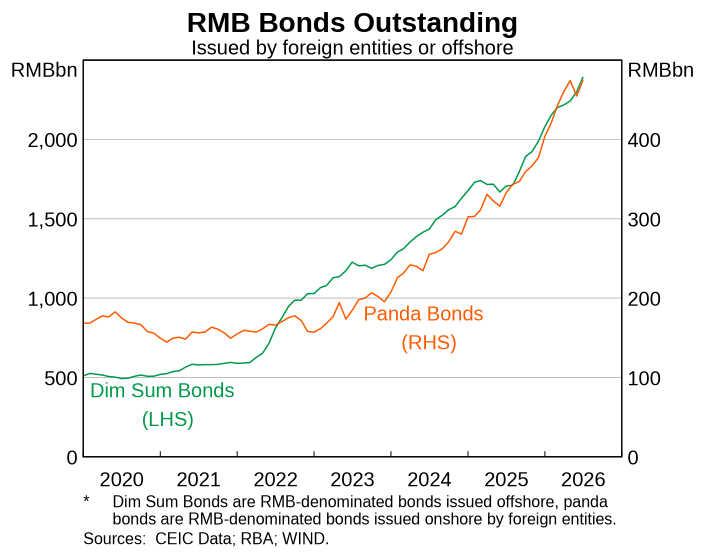
Foreign entities have been increasingly issuing RMB bonds (Graph 5). Total outstanding panda bonds,
representing RMB-denominated bonds issued onshore by foreign entities, have increased three-fold since
the beginning of 2022. In addition, dim sum bond issuance, which represents RMB bond issuance offshore
(mostly in Hong Kong), has also increased significantly. A large proportion of panda and dim sum bond
issuance is by Chinese-domiciled firms, but foreign attractiveness of this debt issuance has also
increased. In the first half of 2026, dim sum bond issuance by entities not domiciled in Hong Kong or
China already surpassed any previous calendar year. Several foreign governments have also issued
RMB-denominated sovereign bonds, including Indonesia, Russia, Hungary, Portugal and Slovenia. However,
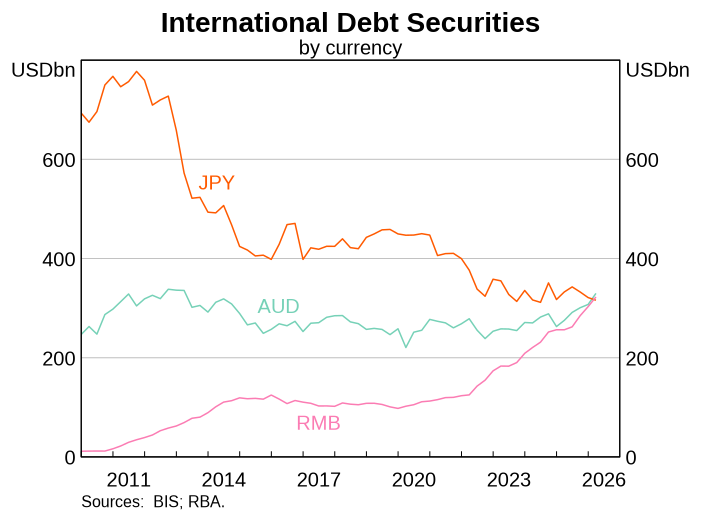
foreign RMB bond issuance remains a small share of the international bond market, with RMB-denominated
debt increasing to around 1 per cent of international debt securities, which is around the same
level as the yen and Australian dollar (Graph 6).
Graph 5
Graph 6
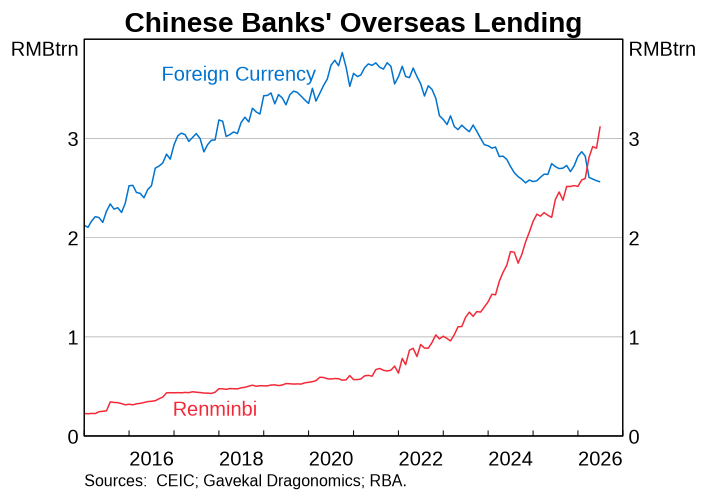
Chinese banks have also expanded their overseas lending denominated in RMB. It has increased from less
than 15 per cent of total overseas lending to over half in the past four years (Graph 7).
Most Chinese banks overseas lending has historically been denominated in US dollars. However, in
2022, Chinese policymakers introduced reforms to combine the regulation of RMB and foreign currency
lending. This regulation places a cap on banks total foreign lending, while adding a foreign
exchange risk factor to loans issued in US dollars or other foreign currencies. This means that
RMB-denominated loans effectively take up less space in this quota than foreign currency loans. This,
alongside lower RMB borrowing costs, has allowed overseas RMB lending to surge, to now make up over
50 per cent of Chinese banks overseas lending.
Graph 7
Chinas capital account
Chinese policymakers have opted to encourage greater global RMB use while maintaining control over the
capital account, which has limited wider global use of the currency. Restricting capital flows allows
Chinese authorities to limit volatility in the exchange rate and domestic asset prices, by removing the
possibility of sudden and large shifts in private capital (McCowage 2018). Stability of the exchange rate
remains a domestic priority alongside RMB internationalisation, presenting a significant policy trade-off
when considering capital account liberalisation.
As a result, reforms to the capital account have been gradual to retain control of capital flows. Recent
reforms have largely focused on encouraging international purchases of RMB assets, somewhat liberalising
capital inflows. Greater ease of access to onshore markets allows foreign RMB users to better manage
their RMB holdings, encouraging broader global use of the currency. The Qualified Foreign Institutional
Investor (QFII) and Connect schemes have allowed for foreign purchase of onshore RMB assets for over a
decade, with quotas now removed and the list of eligible assets continuing to expand. Access now includes
onshore interest rate swaps, Chinese Government Bond (CGB) futures and bond repurchase transactions. More
recently, the PBC has established an RMB repurchase agreement facility for foreign central banks and
other international financial institutions, to encourage greater foreign official sector investment in
RMB assets.
Despite increases in foreign investment over the 2010s alongside gradual liberalisation, restricted access
to hedging instruments and broader underdevelopment of Chinas financial markets continue to limit
foreign investors willingness to invest in onshore Chinese assets. Since 2021, low bond yields and
heightened geopolitical risks have further reduced foreign appetite for Chinese assets, and foreign
investment has been limited (Graph 8).
Graph 8
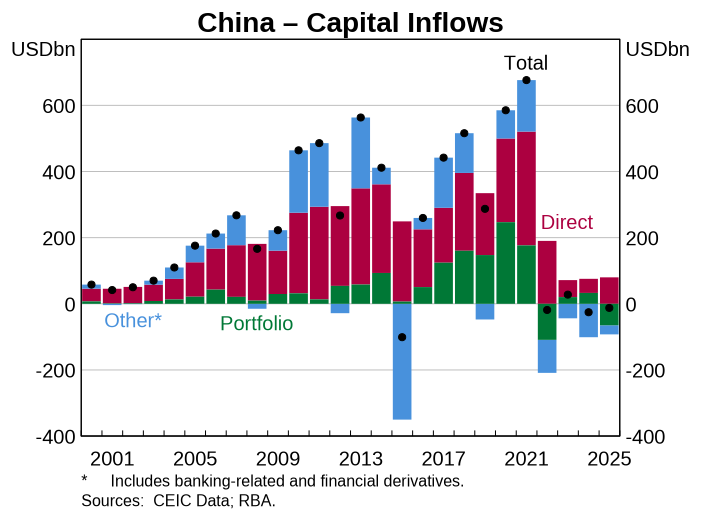
Historical episodes have contributed to a preference for caution when liberalising the capital account,
particularly capital outflows, due to the risk flows present to exchange rate stability. Between 2014 and
2016, Chinas growth outlook weakened and monetary policy was eased, contributing to an acceleration
of private capital outflows and a decline in asset prices. These developments, alongside moves to allow
the exchange rate to become more market determined, resulted in significant depreciation of the RMB (RBA
2015). Chinese policymakers intervened to prevent further declines in equity prices, while the PBC sold
over US$800 billion of foreign exchange reserves to defend the value of the currency. As a result,
further liberalisation of the capital account was halted, the focus on RMB internationalisation eased,
and any subsequent reform has been incremental and carefully sequenced to limit market volatility.
As a result, restrictions remain stronger for capital outflows than inflows. The quota for the Qualified
Domestic Institutional Investor (QDII) scheme, which allows domestic investors to make portfolio
investment abroad, remains restrictive. The Connect scheme, which allows mainland investors to purchase
some Hong Kong-listed bonds and equities, has seen strong uptake and quotas have been raised more
significantly. However, Connect flows do not have a strong effect on the exchange rate as assets mostly
remain in RMB, and as they expand the pool of investment available in the offshore RMB market, they
increase liquidity in offshore RMB assets.
The offshore RMB market
Offshore RMB centres, particularly Hong Kong, are integral to allow greater international use of the RMB
without broader liberalisation of capital flows (Cockerell and Shoory 2012). China operates a parallel
currency system where the onshore RMB (CNY) and offshore RMB (CNH) circulate simultaneously in different
markets. There are no restrictions on the use of the CNH in the offshore market, but controls exist in
the conversion of CNH to CNY. This system allows the RMB to be used freely internationally while capital
controls are maintained domestically. The establishment of offshore centres saw significant
growth in the stock of offshore RMB deposits from 2010 to 2015, with policies such as offshore clearing
banks and bilateral swaps helping to build offshore liquidity (Graph 9).
Graph 9
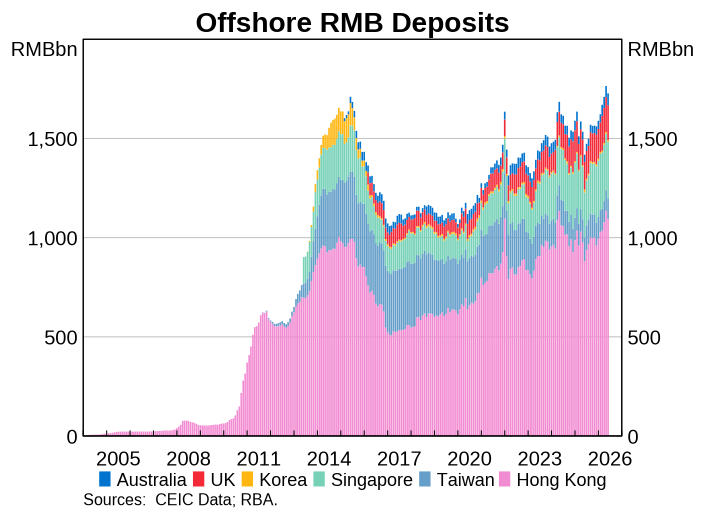
However, dislocations in the offshore RMB market can limit foreign willingness to use the RMB. During
periods of abrupt RMB depreciation in 2015–2016, Chinese authorities
restricted the flow of RMB between the onshore and offshore market to limit capital outflows. These
actions helped to maintain exchange rate stability but significantly squeezed CNH liquidity. As a
result, the offshore RMB overnight money market rate increased to over 70 per cent, reducing
confidence in the parallel currency system and contributing to fall in offshore RMB deposits by over
25 per cent from 2015 to 2017 (Bahaj and Reis 2024).
Improving liquidity conditions in the offshore RMB market has been a priority for Chinese policymakers in
recent years to promote the use of the currency by foreign participants. This has involved the PBC and
the Hong Kong Monetary Authority (HKMA) developing a range of policies to link onshore and offshore
funding conditions more closely to limit the differential between CNY and CNH exchange rates and reduce
volatility in CNH funding costs. Policies include:
- Foreign investors are now permitted to use onshore bond holdings as collateral to enter repurchase
agreement (repo) transactions in the CNH market and can enter onshore repo transactions and remit the
funds offshore to manage CNH liquidity. - A new medium-term RMB liquidity facility offered by the HKMA offers funding at onshore money market
rates, providing greater stability to offshore funding markets. The HKMA has gradually expanded its
size and scope since its introduction in early 2025. - Establishing the trading of offshore Chinese Government Bond (CGB) futures in Hong Kong – the
five-year tenor began trading on 3 August 2026, allowing foreign investors to more easily manage
risk in RMB holdings. - A pilot program permitting six major Chinese banks to undertake CNH trading directly from the
mainland within a quota. This should improve CNH liquidity while allowing onshore banks to better
arbitrage gaps between CNY and CNH pricing.
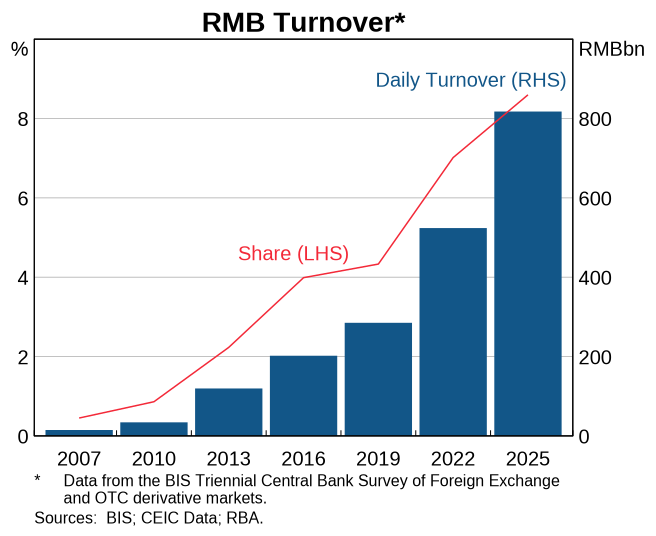
Although CNH deposits have not continued to rise, this has facilitated greater activity in the offshore
RMB market. CNH money market rates have stabilised over the past two years, while turnover has been
higher in RMB foreign exchange markets (Graph 10). According to the BIS Triennial Survey of Foreign
Exchange Markets, average daily RMB turnover increased 68 per cent from 2022 to 2025, to
8.5 per cent of global FX turnover (BIS 2025). Hong Kong remains the largest hub for RMB
trading, while the share of foreign exchange transactions in Hong Kong involving RMB increased from
27 per cent to 35 per cent, 95 per cent of which is in CNH (HKMA 2025).
Graph 10
Implications for Australia
Australia has significant trade linkages with China, and in 2015, Sydney was designated as an offshore RMB
hub with the establishment of an official RMB clearing bank. This set up the infrastructure to enable
greater use of the RMB in Australia. However, use of the RMB in Australia has remained low, due in part
to a large share of trade with China being commodities, which remain invoiced in US dollars. As in other
countries, restricted access to hedging instruments and limited offshore RMB market depth have also
contributed to RMB financial activity in Australia remaining modest.
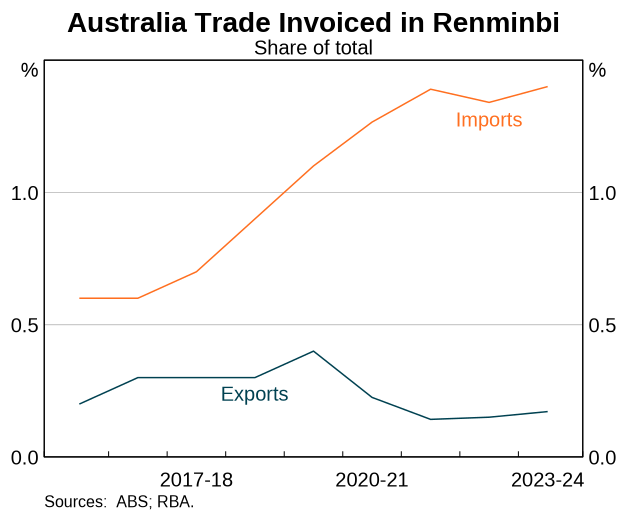
The share of RMB in Australian trade invoicing has remained small (Graph 11). Commodities, which are
mostly priced in US dollars, make up a large share of Australias exports to China, and so there has
been little need for greater RMB export invoicing. Conversely, Australias imports from China are
more heavily concentrated in manufactured goods that have greater scope for RMB invoicing. While the
share of Australian imports priced in RMB remains low, this share has increased over the past decade from
0.6 per cent to 1.4 per cent. Data from the Australian Bureau of Statistics have
suggested that 4.5 per cent of Chinese imports to Australia were invoiced in RMB in 2020–2021, with Australian dollar invoicing making up a larger share of
imports and exports with China (ABS 2021). Limited increases in total imports invoiced in RMB would
suggest this share has not significantly increased. While trade invoicing data offer a strong indication,
they do not necessarily reflect the final currency of settlement. There is little information on how RMB
trade settlement in Australia has developed over time, but it is quite likely that the share of trade
settled in RMB is higher than the invoicing share.
Graph 11
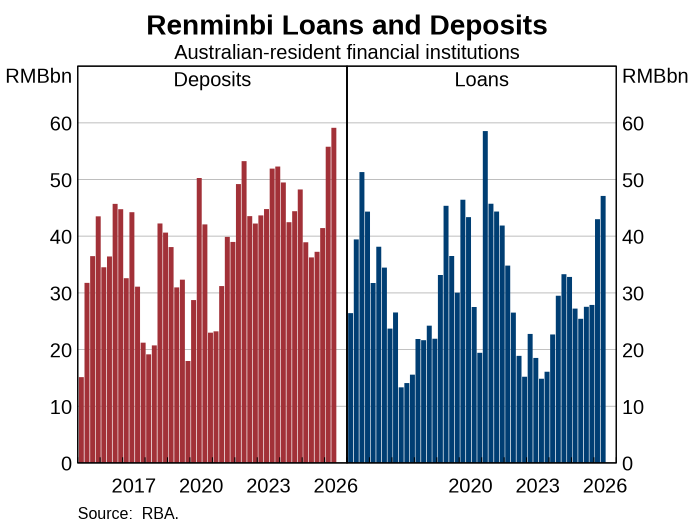
RMB deposits and loans in Australia have also seen limited growth over the past decade (Graph 12).
These data, collected by the RBA on a quarterly basis, indicate that there has been little change in RMB
activity on average in the Australian banking sector over the past decade. RMB business activity by
domestic banks in Australia has been modest, as most activity in RMB loans and deposits has been
facilitated by Australian subsidiaries and branches of Chinese banks. This is likely to support
Australian operations of Chinese firms. A notable exception is Fortescue, which secured a
14.2 billion yuan syndicated loan in 2025, reportedly funded by both Australian and Chinese lenders
(Fortescue 2025).
Graph 12
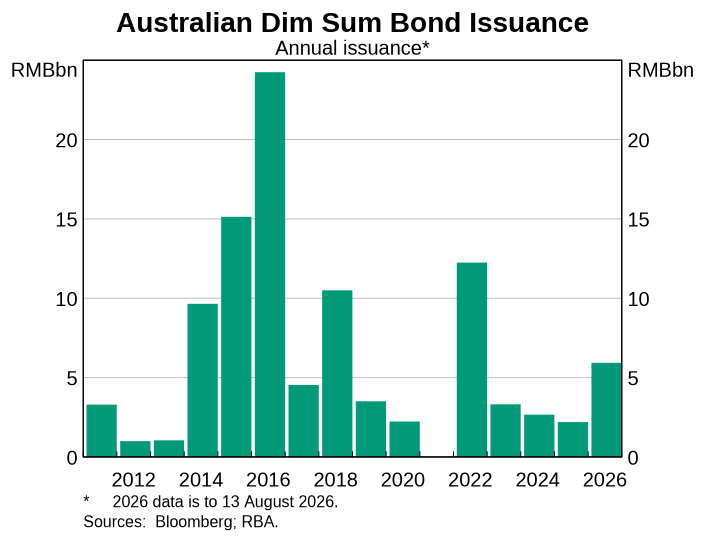
There has also been some RMB bond issuance by Australian entities, but this has not increased in recent
years as it has globally (Graph 13). Australian activity in this market was particularly strong in
the mid-2010s, which included the NSW government issuing a dim sum bond in 2014. Activity in dim sum bond
issuance by Australian firms has been largely concentrated to the banking sector, with very little
issuance in other sectors, while Australian firms have not issued bonds in the onshore Chinese market.
RMB foreign exchange turnover has increased in the Australian market over the last decade, alongside
increases globally. However, this largely reflects greater activity by financial counterparties, rather
than broad adoption of the currency.
Graph 13
Conclusion
The RMB has continued to internationalise gradually, although more recent progress has been incremental.
Chinese policymakers appear to be taking a cautious approach to reforming the Chinese financial system to
work toward this internationalisation goal, while limiting any potential spillovers that could cause
exchange rate volatility or disrupt Chinese financial or economic conditions. Growth in the use of the
RMB over the past decade has been limited in some areas, such as holdings in global foreign exchange
reserves, but has been somewhat more significant in others, such as trade settlement and foreign exchange
turnover. Still, the RMB continues to lag major international currencies, such as the US dollar and
the euro, in its use. The communications of Chinese officials suggest some potential for progress to
accelerate. However, it is likely to continue to be incremental in the absence of more aggressive capital
account liberalisation.
References
ABS (2021), Export and Import Invoice Currencies, 2020–21, November.
Bahaj S and R Reis (2024), The Anatomy of a Peg: Lessons from Chinas Parallel
Currencies, Centre for Macroeconomics Discussion Paper No 2401.
Ballantyne A, M Garner and M Wright (2014), Developments in Renminbi
Internationalisation, RBA Bulletin, June.
BIS (2021), Box A: What Constitutes an International Debt Security in BIS
Statistics?, Quarterly Review, June.
BIS (2025), OTC Foreign Exchange Turnover in April 2025, Triennial Central Bank
Survey, September.
Cockerell L and M Shoory (2012), Internationalising the Renminbi, RBA
Bulletin, June.
Eichengreen B, A Mehl and L Chiţu (2018), How Global Currencies Work: Past, Present, and
Future, Princeton University Press.
Fortescue (2025), Fortescue Secures Landmark RMB 14.2 billion Syndicated Term
Loan, ASX Release, August.
Hatzvi E, W Nixon and M Wright (2014), The
Offshore Renminbi Market and Australia, RBA Bulletin, December.
HKMA (2025), Results of 2025 BIS Triennial Survey of Foreign Exchange and OTC Derivatives
Market Turnover, Press Release, 30 September.
Kenen P (2011), Currency Internationalisation: An Overview, BIS Papers No 61.
Lien B and D Sunner (2019), Liberalisation
of Chinas Portfolio Flows and the Renminbi, RBA Bulletin, September.
Liu T, X Wang and WT Woo (2025), Invoicing Currency and Settlement Currency: An Empirical
Study and Implications for RMB Internationalization, China Economic Review, 94.
McCowage M (2018), Trends in
Chinas Capital Account, RBA Bulletin, June.
Perez-Saiz H and L Zhang (2023), Renminbi Usage in Cross-Border Payments: Regional Patterns
and the Role of Swap Lines and Offshore Clearing Banks, IMF Working Paper No 2023/077.
RBA (2015), Box B: Chinese
Capital Outflows, Statement on Monetary Policy, November.
Windsor C and D Halperin (2018), RMB
Internationalisation: Where to Next?, RBA Bulletin, September.
Xi J (2023), Follow the Path of Financial Development with Chinese Characteristics and Build
a Strong Financial Nation, Speech at the Central Financial Work Conference, Beijing, 30–31 October.
Underlying data
Underlying data for selected graphs.
Other data may be available upon request via our
general enquiry page.