
Bank of America remains short EUR/USD and forecasts a fall to 1.12 as US yield support and renewed energy pressures continue to favour the Dollar.
Foreign exchange analysts at Bank of America remain tactically short the Euro against the US Dollar, arguing that calm conditions across G10 foreign exchange markets are masking much larger risks stemming from monetary policy, geopolitics and fiscal developments.
The bank believes the US Dollar should continue to draw support from relatively high US yields and lingering uncertainty ahead of key policy decisions, leaving the EUR/USD exchange rate vulnerable in the near term despite the pair’s broader recovery over recent months.
According to Bank of America’s latest forecasts, EUR/USD is expected to weaken towards 1.12 during the third quarter of 2026 before recovering to 1.15 by year-end and strengthening further towards 1.20 during 2027 as the Dollar’s cyclical advantages gradually fade.
Reflecting that view, the bank is maintaining a tactical bearish position through a three-month 1.15/1.13 EUR put spread, looking for limited downside in the single currency over the coming months.
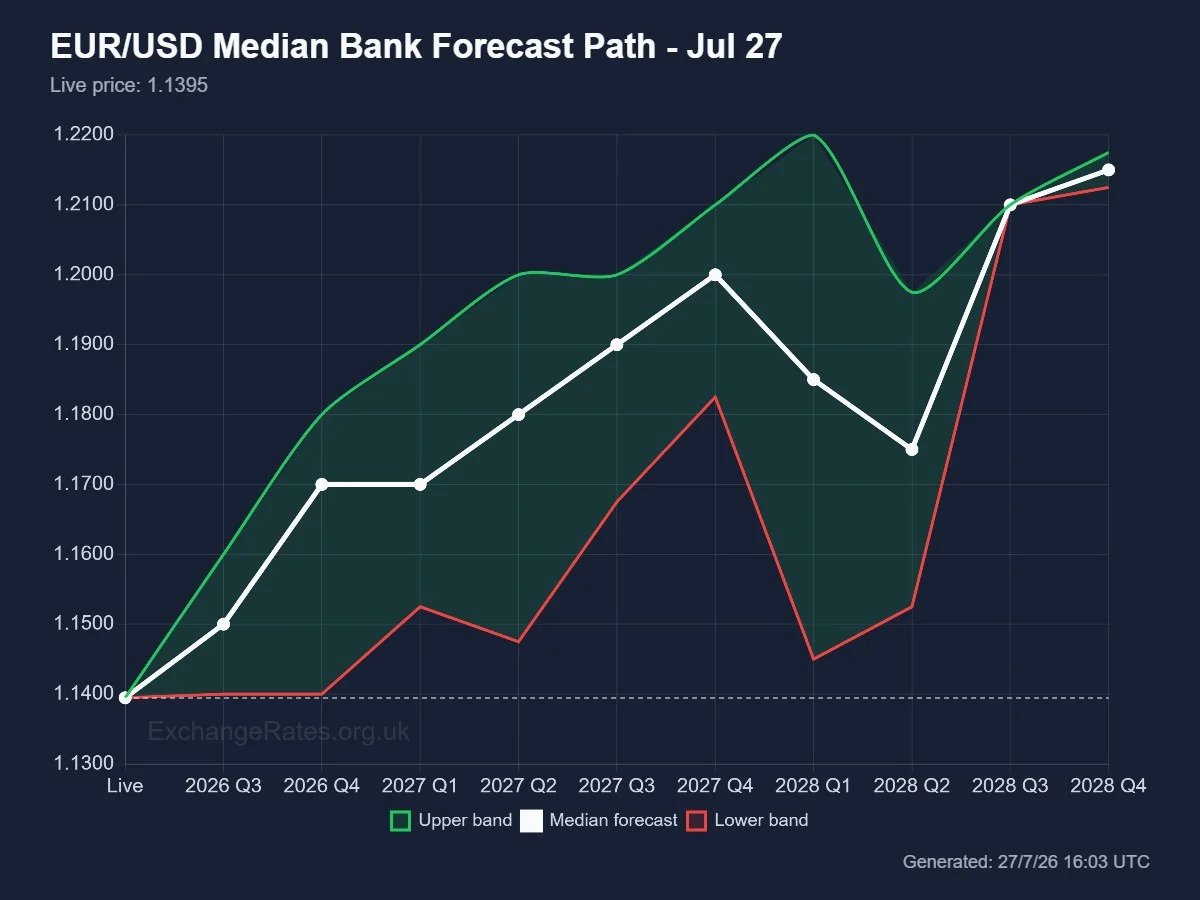
The latest Exchange Rates UK Research median bank forecast shows EUR/USD expected to strengthen over the medium term despite some banks retaining a cautious short-term outlook.
Bank of America argues that investors have become too comfortable with subdued volatility across major currencies even as significant policy risks continue to build.
“Quiet G10 FX markets are masking larger policy risks,” the bank argues, pointing to uncertainty surrounding the Federal Reserve, the Bank of Japan and UK fiscal policy.

While those themes extend beyond Europe, they reinforce the bank’s preference to remain positioned in favour of the Dollar against lower-yielding currencies.
Goldman Sachs shares the cautious near-term outlook for the Euro, arguing that the single currency remains caught between unfavourable interest-rate dynamics and renewed energy market pressures.
The bank said the Euro remains “stuck in the shadow” of the Dollar, with investors continuing to favour higher-yielding currencies while geopolitical tensions keep energy prices elevated.
Goldman added that higher oil prices have once again deteriorated Europe’s terms of trade, limiting the Euro’s ability to outperform even as the European Central Bank has largely completed its tightening cycle.
Dollar Yield Advantage Still Dominates Near-Term EUR/USD Outlook
Although both banks expect the Dollar’s strength to moderate over the longer term, they see little reason to abandon defensive positioning ahead of several important central bank meetings.
Higher US Treasury yields continue to provide an attractive return advantage over much of the developed world, while uncertainty over Federal Reserve policy is encouraging investors to retain Dollar exposure.
Bank of America’s longer-term projections nevertheless suggest the Dollar’s yield advantage should gradually erode, allowing EUR/USD to recover from an expected third-quarter low near 1.12 to around 1.20 during 2027.
For now, however, both Bank of America and Goldman Sachs believe the balance of risks remains tilted towards a stronger Dollar, with energy prices, yield differentials and global policy uncertainty continuing to favour the greenback over the Euro.
Our currency coverage draws on live market data, official economic releases and published bank research.