
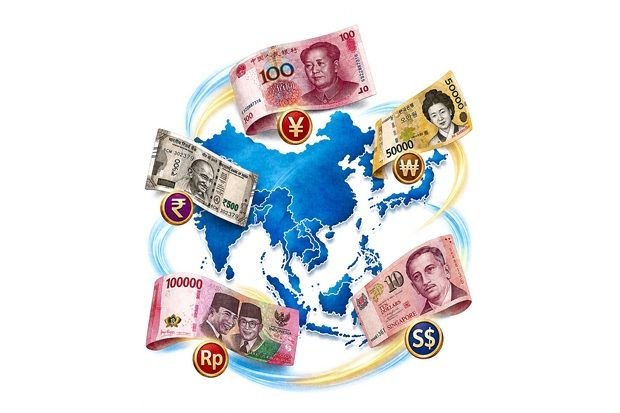
WITH softer oil prices and a weaker US dollar providing a more favourable backdrop for foreign-exchange markets, Asian currencies are expected to see a shift in performance next year.
Currencies backed by strong current account surpluses and resilient capital flows are likely to outperform, with technology-linked economies expected to retain their advantage despite an emerging rotation towards South Asia.
ING Bank regional head of research Deepali Bhargava says interest-rate differentials are becoming less important in determining currency performance, as most Asian central banks approach the end of their tightening cycles and prepare for potential monetary easing next year.
“Rate differentials are becoming less supportive of emerging market (EM) Asia. Most Asian central banks are nearing the end of their tightening cycles and are likely to prepare for policy easing.
“Interest-rate support for Asian currencies should gradually diminish, particularly for rate sensitive currencies like the Indonesian rupiah,” she explains.
Instead, external balances and capital movements are expected to play a bigger role in determining which currencies gain ground, particularly as the region navigates changes in global investment flows.
Asian currencies have delivered mixed performances in 2026, with those linked to artificial intelligence (AI), including the South Korean won, Chinese yuan, Singapore dollar and ringgit, generally outperforming their regional peers.
The Indian rupee, rupiah and Philippine peso, however, have weakened amid softer growth, higher energy prices and domestic challenges.
One exception is the Taiwanese dollar, which has depreciated by about 5% despite strong current account balances, following a technology-sector selloff that triggered equity outflows in recent months.
From north to south
Bhargava notes the yuan and won have been among the strongest performers since the US-Iran conflict in February 2026, appreciating even as the US dollar index remained relatively resilient.
This suggests domestic fundamentals are increasingly outweighing broad movements in the US dollar.
“We remain bullish on the won, Singapore dollar and Taiwanese dollar. The AI cycle may be plateauing, but activity remains high. Strong AI-related exports should continue to support current account surpluses, while exporter foreign-exchange conversion should help offset capital outflows,” she argues.
In South Korea, sizeable equity outflows since September have not prevented the won from appreciating, highlighting the importance of exporters converting their foreign currency earnings and repatriating capital.
Measures to encourage domestic investment and improve shareholder returns could provide further support for the won in 2027. Similar efforts in Japan to improve domestic returns and shareholder distributions could also gradually slow capital outflows.
As such, currencies supported by large current account surpluses, particularly the won, Taiwanese dollar and yuan, are expected to remain relatively resilient even as interest-rate support fades.
However, a sharper-than-expected slowdown in the AI cycle could weaken export earnings and undermine this support.
At the same time, a rotation from North Asian to South Asian currencies is already emerging following the US mid-term elections, with the technology-sector selloff and lower oil prices improving valuations across parts of South Asia.
Falling energy prices should benefit oil-importing economies such as India, Indonesia and the Philippines by reducing import costs and easing pressure on their external balances.
However, Bhargava says the benefits are unlikely to be distributed evenly, particularly as tighter global financial conditions make investors more selective about where they deploy capital.
“We remain more constructive on the rupee, as growth should remain relatively resilient, supported by supply-chain diversification and continued foreign direct investment (FDI) inflows.
“By contrast, political uncertainty and weaker capital inflows leave the rupiah and peso more vulnerable,” she points out.
FDI and resilient domestic growth are expected to help the rupee outperform some of its regional peers, although increasing overseas investment by Indian companies remains a constraint.
Asset demand
Real interest rates could also provide some support for Asian currencies as inflation eases faster than central banks reduce borrowing costs.
This is expected to keep real policy rates elevated through much of 2027, particularly in economies where monetary easing is gradual.
The peso could be the biggest beneficiary, as disinflation is expected to outpace policy easing and improve its real interest-rate differentials.
Nevertheless, Bhargava believes external balances and capital flows will remain more influential in determining currency performance.
Another challenge for the region is the growing appetite among domestic investors and companies for overseas assets, which limits the extent to which stronger current account surpluses translate into sustained currency appreciation.
“Demand for foreign assets remains a key reason why stronger external balances aren’t translating into sustained Asian foreign-exchange appreciation,” Bhargava says.
She points to two structural forces behind this trend: rising demand for foreign assets among retail and institutional investors, as well as corporates seeking diversification and higher returns; and elevated outbound direct investment as companies reposition supply chains and expand overseas operations.
Taiwan offers a clear example, with companies continuing to diversify production outside China and directing more investment towards the United States and South-East Asia.
The sharp increase in outward direct investment in 2026 reflects longer-term supply-chain repositioning, which has weighed on the Taiwanese dollar.
Japan is another major source of regional capital outflows. Domestic institutional investors, including pension funds and investment trusts, continue to buy foreign assets as part of their long-term portfolio diversification strategies.
Although some life insurers reduce unhedged foreign bond holdings when the yen appreciates, the broader trend of overseas allocation remains intact.
Concerns over Japan’s fiscal outlook and government bond supply have also dampened the appetite for large-scale capital repatriation.
South Korea, however, demonstrates how strong export earnings can offset substantial overseas investment.
Residents, including retail investors and the National Pension Scheme, continue to invest heavily abroad, with equity outflows annualising at about US$100bil.
Corporates are also accumulating overseas assets through trade credit and offshore foreign-currency deposits.
Nevertheless, the country’s largely AI-driven current account surplus and strong exporter currency conversion are expected to provide sufficient support for the won.
India is also becoming a growing source of capital outflows, with annual outward FDI more than doubling since 2024 as companies deploy more capital overseas rather than domestically.
Although the pace of growth in outward investment is beginning to plateau, these outflows continue to offset some of the country’s otherwise strong capital inflows, limiting support for the rupee.
“Taken together, resident demand for foreign assets is likely to remain a structural constraint on Asian foreign exchange appreciation in 2027.
“Strong current account balances can still support currencies, particularly in economies such as South Korea and Taiwan.
“But persistent outbound investment and portfolio diversification will likely continue to limit appreciation across much of the region,” Bhargava argues.