
- The pound risks a sharp fall against the euro if stock markets suffer a mini-crash and investors unwind the carry trades that favour sterling.
- GBP/EUR Falls Hardest When Markets Panic
- Carry Trades Leave the Pound Exposed
- The Pound Has Weathered the AI Sell-Off So Far
- What a Mini-Crash Would Mean for GBP/EUR
Image © Adobe Images
The pound risks a sharp fall against the euro if stock markets suffer a mini-crash and investors unwind the carry trades that favour sterling.
The pound-to-euro exchange rate would fall sharply if global stock markets suffered a ‘mini’ crash of the kind one Swiss private bank now says cannot be ruled out.
“If the liquidity contraction currently weighing on capital markets were to intensify in the coming weeks, markets would become vulnerable to a climax of the current correction, potentially involving a waterfall-like decline. A mini-crash can no longer be completely ruled out,” says Yves Bonzon, Group Chief Investment Officer at Julius Baer.
“When Kevin Warsh was appointed, we noted that every new Fed Chair is eventually tested by the market. Alan Greenspan was tested in 1987, and Jerome Powell was tested in 2018. We may now be witnessing Kevin Warsh’s own market test,” he adds.
Bonzon says investors are focused on the wrong story, because the Federal Reserve’s drive under Warsh to drain liquidity, the supply of cheap money that supports asset prices, matters more to markets than the turmoil at Nvidia.
Julius Baer estimates a 25% fall in US stocks would destroy wealth worth about 55% of US economic output, almost double the losses of the 2006 to 2008 housing crash, and would likely force the Fed into emergency rate cuts.
GBP/EUR has fallen hard in the sudden stock market panics of the past 30 years, hitting its all-time low of 1.02 in December 2008, at the height of the financial crisis.
GBP/EUR Falls Hardest When Markets Panic
The pair fell about 20% from August 2008 to that low as banks failed and investors fled to safety.
It fell about 10% to 1.07 in March 2020 as the Covid crash hit, and about 5% to 1.15 in April 2025 after the US ‘Liberation Day’ tariffs shook markets.
In October 1998, when Russia’s debt default and the collapse of the hedge fund Long-Term Capital Management rocked markets, the pound fell about 9% to 1.40, measured before the euro’s launch through the Deutsche mark at its fixed conversion rate.
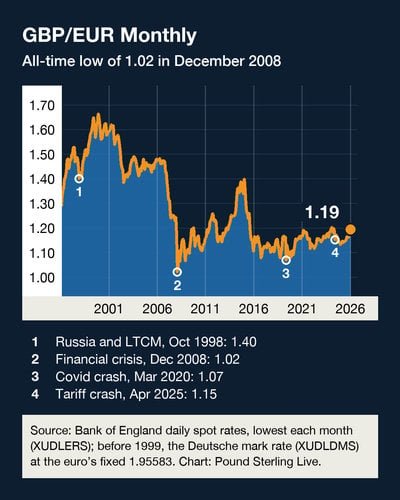
Above: GBP/EUR at monthly intervals since December 1996, with the lows of four stock market crashes marked. Before 1999 the rate is the Deutsche mark at its fixed euro conversion rate. Source: Bank of England.
GBP/EUR barely moved in the August 2011 sell-off, when the turmoil centred on the eurozone debt crisis and hit the euro too.
The slower stock market slide of late 2018 did far less damage, with GBP/EUR down only about 1%.
Carry Trades Leave the Pound Exposed
The pound is exposed to a sudden panic as one of the market’s favoured high-yielding currencies: “Higher-yielding currencies such as the GBP could be hit by the forced liquidation of carry trades,” says Lee Hardman, Senior Currency Analyst at MUFG.
A carry trade borrows in a low-yielding currency to buy a higher-yielding one, such as the pound, and pockets the interest gap. Investors close those positions in a hurry when markets fall, selling the currency they bought.
In the August 2024 carry trade unwind, GBP/EUR fell about 2.5% in eight sessions, from 1.1886 on 29 July to 1.1594 on 8 August.
“At the same time, UK yields would likely move lower as the market priced in a reduced likelihood of the BoE delivering the three to four rate hikes currently discounted into the UK curve,” Hardman adds.
Lower expected Bank of England rates mean lower returns on UK government bonds, and so less foreign demand for the pounds needed to buy them.
The euro sits on the other side of the trade: “We expect French-specific risks to sustain the EUR as the market’s preferred funder for a while,” says Barclays in a recent update.
A funding currency is the one investors borrow to finance carry trades, so a rush to close them means buying euros back, which lifts the euro.
The Pound Has Weathered the AI Sell-Off So Far
However, the pound has held up against the euro through the latest sell-off, gaining about 1.2% since US technology stocks peaked on 6 October even as it lost about 1.8% against the dollar, MUFG calculates.
“We like sterling over the coming months on the view that Bank of England tightening expectations prove more resilient than those of the ECB,” says ING in a recent update, and it forecasts EUR/GBP at 0.83 by year-end (GBP/EUR 1.2048).
Pound Sterling Live continues to hold a constructive medium-term view on the pound against the euro and forecasts GBP/EUR above 1.20 in 2027.
What a Mini-Crash Would Mean for GBP/EUR
GBP/EUR rallied 3.5% from 1.1611 on 25 September to a 2026 high of 1.2020 on 18 November as Bank of England rate expectations held up and French fiscal risk weighed on the euro, as Pound Sterling Live has reported, but it has since pulled back to 1.1950.
A daily close beneath 1.1850 would turn Pound Sterling Live’s near-term view from bullish to neutral, as our Week Ahead Forecast set out on Monday. That level brings into view the rising 100-day average, the pair’s average price over roughly the past five months, which tends to attract buyers in an uptrend.
GBP/EUR would head towards 1.1350 on a fall the size of April 2025’s 5% and a repeat of the Covid crash’s 10% fall would take the pair towards 1.0750.