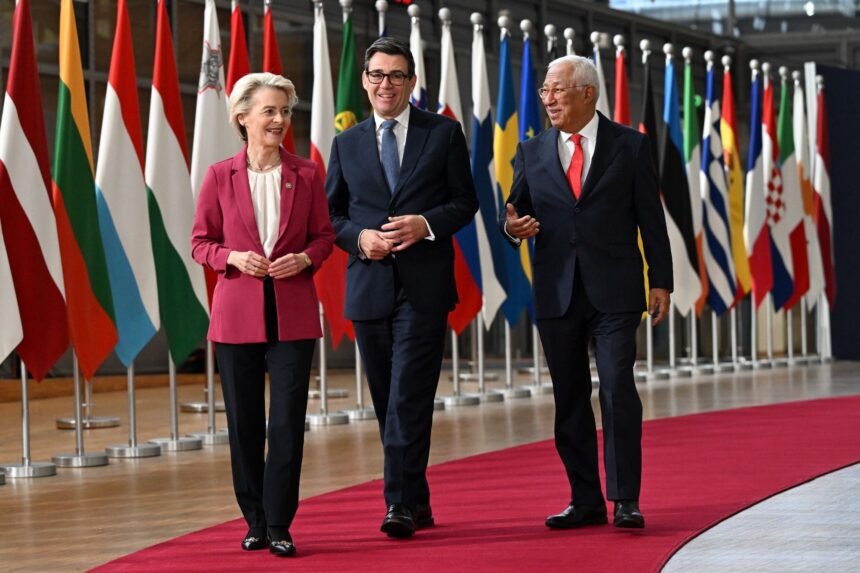

António COSTA, President of the European Council, and Ursula VON DER LEYEN, President of the European Commission, meet with Andy BURNHAM, Prime Minister of the United Kingdom, on 20 November 2026 in Brussels. Copyright: European Union.
Benefits to pound sterling from today’s EU-UK agreement would only be realised over the long-term, at best.
The UK and EU have today agreed a number of deals to ease the trade in food, energy and youth mobility.
Although touted by Prime Minister Andy Burnham as a reset that will lower food prices and boost the economy to the tune of £17BN, economists are more cautious.
“We won’t do a formal modelling exercise on the impact of the changes on GDP because the impact is likely to be very small,” says Andrew Goodwin, Chief UK Economist at Oxford Economics.
The currency market, the true arbiter of any debate around the costs and benefits of this exercise, hasn’t been enthusiastic, as sterling squanders today’s attempted recovery against the euro and is to end the week notably lower against both the Eurozone’s single currency and the dollar.
“For the UK to make further progress in reducing trade barriers, it will likely need to give ground in other areas,” says Goodwin. “We think the Prime Minister will now switch his focus to making the case for a closer relationship after the next election, with a view to making it a new manifesto commitment.”
Despite dour short-term price action in sterling, there are some analysts that argue the direction of travel regarding the EU-UK relationship is consistent with a smaller risk premium on UK assets as Britain’s trade with its largest market runs more smoothly; the premium is the extra return investors require when they worry about a country’s prospects.
A smaller premium draws foreign money into UK assets, and those purchases require pounds.
“EU reconvergence prospects should support the GBP, while French risks weigh on the EUR,” says Barclays in its year-ahead currency outlook, published on Tuesday.
Ahead of the summit, Burnham told business leaders in Brussels that Treasury analysis shows the deal adds up to 0.5% to UK GDP, calling it “the single biggest growth intervention in this parliament.”

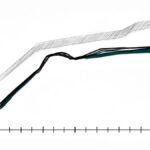
Above: GBP/EUR at weekly intervals.
The Three Agreements
Food and farm trade (SPS Agreement): The EU and the UK have concluded a common area for food and plant safety standards, which would let most animals, animal products, plants and plant products move between Great Britain and the EU without the certificates and border checks required today. The same benefits would extend to goods moving between Great Britain and Northern Ireland, and both sides aim to apply the agreement from 1 March 2028.
Carbon pricing (ETS agreement): The EU and the UK will link their emissions trading systems, the markets where companies buy permits to cover their carbon emissions, so that permits issued by each side are recognised by the other. Linking would also exempt EU and UK goods from each other’s carbon border taxes, the levies charged on imports from countries with weaker carbon pricing, and both sides aim to apply it from 2028.
Youth mobility (Youth Experience Scheme): The scheme will allow 100,000 young people from the EU and from the UK to live in the other’s territory for up to three years to work, study, volunteer or travel. Both sides aim to apply it no later than 2028, with places available to young people by January 2030 at the latest.
Analysts See Support for the Pound Over Time
Deutsche Bank expects the near-term GDP gains from the deals to be marginal, and analysts frame the reset as support for the pound over a longer horizon.
“Closer UK-EU economic ties should be modestly supportive of GBP over time by reducing trade frictions and improving the investment outlook,” says Commonwealth Bank of Australia, which adds that any path to EU membership would be long.
Analysts at KBC say plans to improve relations with the EU help lower the risk premium on UK assets.
“If the UK were to agree a materially closer relationship with the EU down the line, the annual cost of closer market access would likely be more than offset from a sterling perspective by fresh investment flows and the overall long-term boost to growth. Nevertheless, it may require an initial downpayment, in the form of a rewidening of the UK’s current account,” says Deutsche Bank’s Shreyas Gopal.
The current account measures the money flowing in and out of the UK through trade, investment income and transfers. A wider deficit leaves Britain more reliant on foreign capital, which tends to weigh on the pound.
CIBC Looks Near-term EUR Recovery
The pound has lost ground against the euro this week: the pound-to-euro exchange rate rallied 3.5% from late September to a 2026 high of 1.2020 on 18 November and has since pulled back 0.6% to 1.1949, putting it on course for its first weekly loss in eight weeks, as Pound Sterling Live has reported.
“Since the OAT/Bund spread widened on French fiscal concerns, EUR/GBP has fallen some 2.7%, and we are seeing a rebound in recent days. There could be some weak technical resistance around the 0.8375 area, though we expect the pair to rise on an unwind of EU pessimism, and on positive news on the US/Russia/China trilateral talks,” says CIBC.
The OAT/Bund spread is the gap between French and German ten-year borrowing costs, and a wider gap signals stress over France’s public finances that weighs on the euro. A narrowing gap lets the euro recover.
Resistance is a level where sellers have previously halted a rise, and CIBC’s EUR/GBP level equates to support at 1.1940 in GBP/EUR, which the pair dipped beneath on Friday before recovering.
Pound Sterling Live continues to hold a constructive medium-term view on the pound, with resilient UK growth, elevated inflation and France’s fiscal and political troubles meaning the current dip against the euro should prove shallow.
A daily close beneath 1.1940 would signal that the euro rebound CIBC expects is under way.