

- Pound Sterling Gains Against Euro, US Dollar and Australian Dollar After September UK GDP Beats Expectations
- September’s UK growth surprise puts a December rate rise in play for Pantheon, while ING expects the Bank of England to wait until February before acting.
- Consumers picked up where computer firms left off
- Could the Bank of England raise rates again in December?
- What this means for pound sterling in the near-term outlook

Pound Sterling Gains Against Euro, US Dollar and Australian Dollar After September UK GDP Beats Expectations
September’s UK growth surprise puts a December rate rise in play for Pantheon, while ING expects the Bank of England to wait until February before acting.
The Pound Sterling rose against the Euro and US dollars on Thursday after UK output grew 0.2% in September, beating expectations of a flat month.
Pound to Dollar (GBP/USD): 1.327422 (-0.01%)
Euro to Dollar (EUR/USD): 1.109304 (-0.02%)
The quarterly result held less surprise.
Britain’s economy grew 0.7% in the three months to September, up from 0.5% in the spring and in line with forecasts.
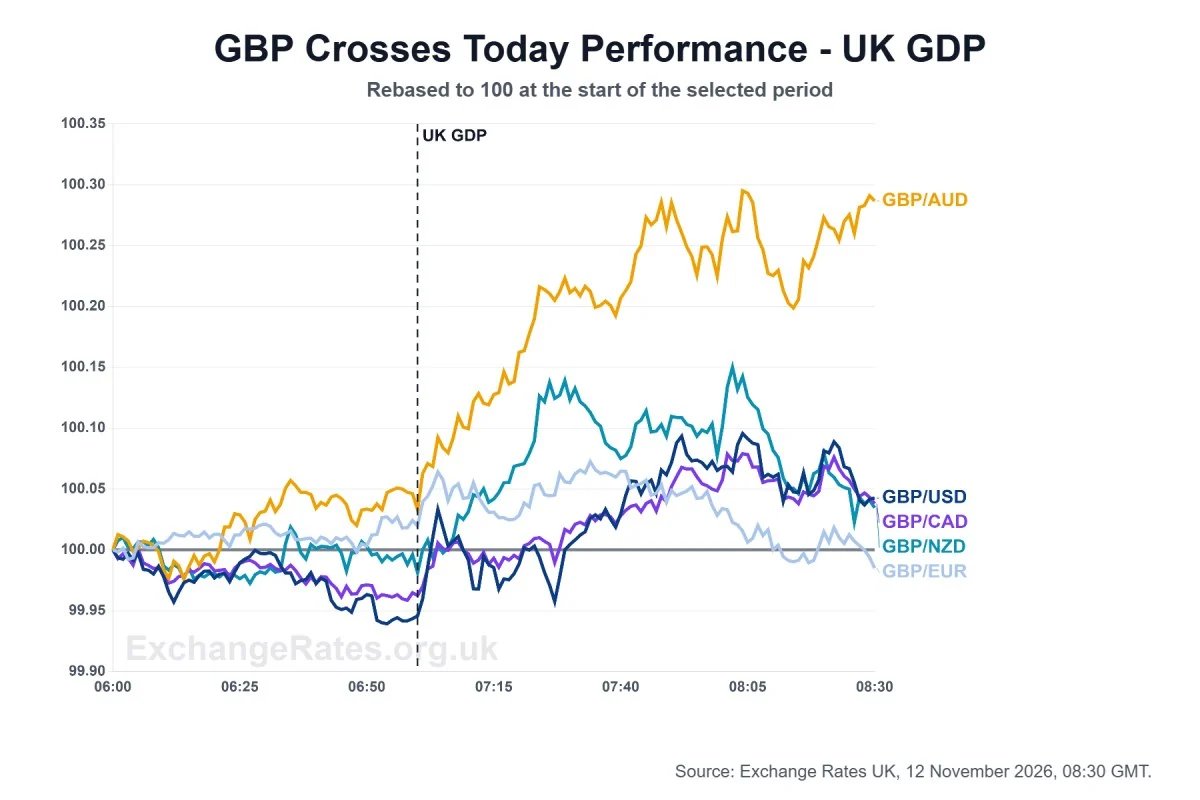
The Australian dollar saw the clearest move of the five sterling crosses tracked by Exchange Rates UK.
Over the 90 minutes after the release, the pound gained about 0.25% against the Australian dollar to A$1.9452.
Pound Sterling also recovered against the US dollar to $1.3267, though that still left it 0.07% below Wednesday’s close. Its early gain against the euro faded, leaving a pound worth €1.1965.
For Pantheon Macroeconomics, what stood out was how often forecasters have underestimated British growth.
“Something is stirring: monthly GDP beat consensus for the fifth straight month and the seventh in eight. With growth and inflation both strong, we are comfortable expecting at least two more MPC hikes.”
Consumers picked up where computer firms left off
The ONS first estimate puts quarterly growth at 0.6%, 0.5% and 0.7% over the first nine months of 2026, despite the energy shock.
Computer programming and consultancy grew 4.4% in the third quarter.
Many firms reporting the largest turnover gains worked in AI or cloud computing.
James Smith, UK economist at ING, pointed to the outsized contribution of IT and professional services.
“Still, in year-on-year terms, these two sectors are contributing half of growth in UK activity, despite only making up 14% of output.”
The connection with AI is harder to establish in some of the industries Smith identified, among them solicitors, advertising firms and accountants.
The monthly figures showed where the next source of growth might come from.
August’s 0.1% expansion was revised to zero. In September, output rose even as the computer firms that had led the summer expansion lost ground.
“Computer programming, consultancy and related output fell by 1.9% month-to-month in September, having made the largest contribution to three-month growth in each of the previous seven months,” Pantheon wrote.
“Crucially, consumer-facing services took over the baton, gaining 0.6% month-to-month, and challenging fears that consumers are throwing in the towel.”
Over the quarter, Lloyds analysts estimated that private household consumption accounted for half the increase in GDP.
Pantheon economists put the improvement in spending in perspective.
“Consumer spending has shifted up a gear: growth reached 0.6% quarter-to-quarter in Q3, after averaging 0.5% in H1, compared with just 0.05% per quarter through 2025.”
September also gave the economy a head start going into winter.
The UK economists added, “Output will rise by almost 0.2% quarter-to-quarter in Q4—matching the MPC’s forecast—even if it fails to grow at all month-to-month in October, November and December.”
Could the Bank of England raise rates again in December?
The Bank of England already expected 0.7% quarterly growth when it raised Bank Rate to 4% last week.
Pantheon thinks the persistence of that growth gives policymakers room to act again sooner.
“Strong growth gives the MPC less reason to look through inflation remaining well above target. We expect the MPC to have to hike twice more in February and April, although we are close to bringing those forward to December and February.”
ING also expects a February rise, but Smith sees evidence that borrowing costs are already holding back investment.
“Construction work on new projects is down more than 7% since mid-2025. Private housebuilding is down 30% from its 2022 high and is continuing to fall. This is a sector that is highly sensitive to interest rates.”
Household bills are another reason for caution.
“Yet we saw in the 2022 energy crisis that the pressure on spending didn’t properly show through until early 2023. The strong spike in natural gas prices is relatively recent,” Smith wrote.
ING expects utility bills to rise by around a quarter in January. If inflation eases by next summer, Smith expects the Bank to return to cuts by early 2028 at the latest.
What this means for pound sterling in the near-term outlook
Pound Sterling’s rise against the Australian dollar showed little sign of fading through Thursday’s early London trading.
Against the euro, the pound had given up its gains even after a fifth consecutive upside surprise in monthly GDP.
Lloyds sees a reason why sterling traders may wait for next week’s figures before taking a stronger view on December.
“However, in the short-term the market sensitivity is likely to continue to be felt much more directly in the form of surprises to incoming inflation data than activity news.”
UK pay figures are due on 17 November. October’s consumer price index follows on 18 November, the first inflation report since the Bank voted to raise rates.