
‘If the interest rate is higher than a yen deposit, is a foreign currency deposit more profitable?’ Should you compare only the interest rate figures? The interest you receive is denominated in foreign currency. You must verify the exchange rates and fees for converting back to yen, as well as the protection available if the bank fails, separately from the advertised interest rate.
[Table of Contents]
1. High interest rates do not guarantee profit in yen
2. Consider exchange fees as a round-trip cost
3. What it means to be excluded from deposit insurance
4. Things to check before applying
[1. High interest rates do not guarantee profit in yen]
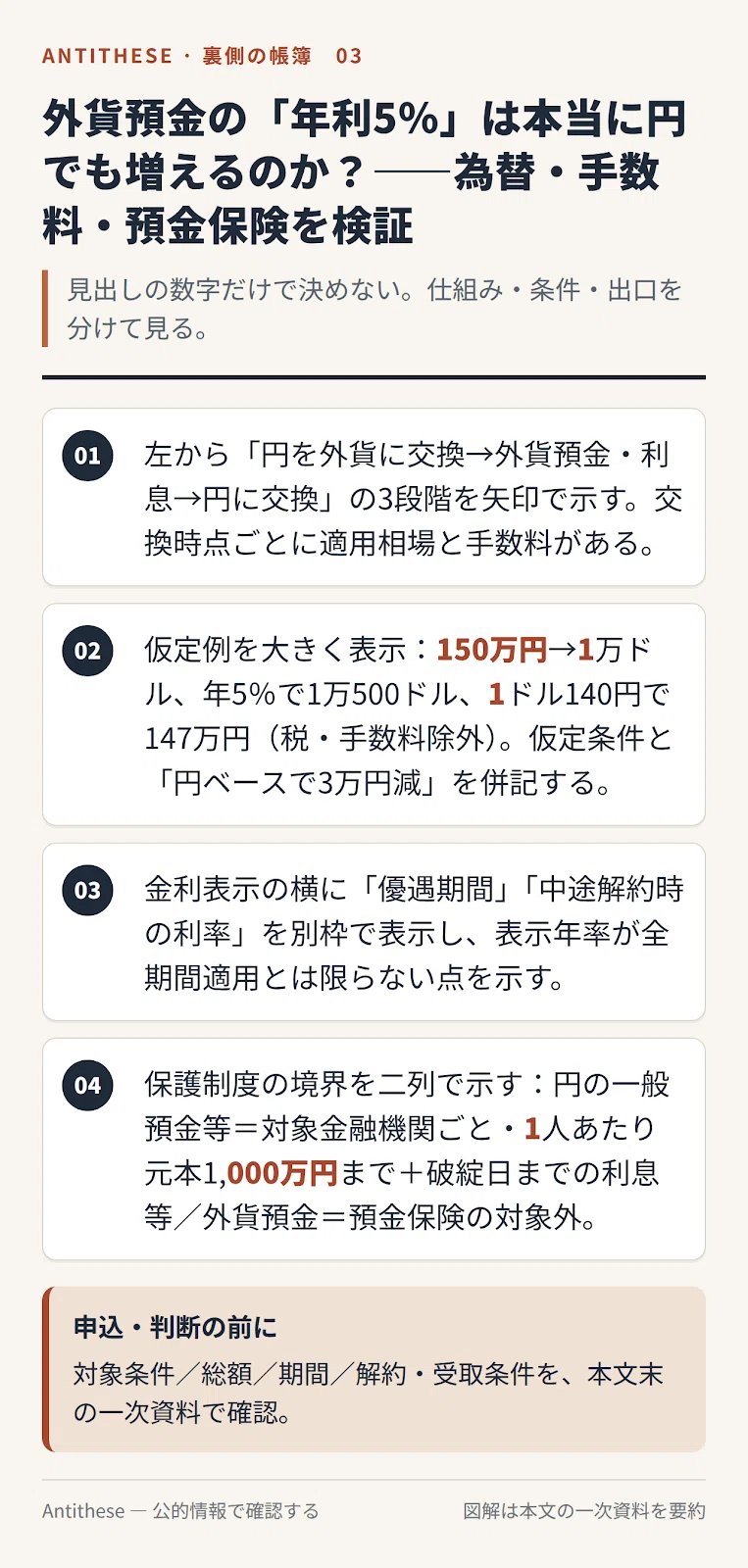
The interest rate on a foreign currency deposit is a figure applied to the foreign currency you have deposited. Your profit or loss in yen is not determined solely by the interest received. If the exchange rate when you buy the foreign currency differs from the rate when you convert it back to yen, the yen-equivalent amount will also change.
The Financial Services Agency advises that exchange losses can occur if the exchange rate at the time of withdrawal is stronger in yen than at the time of deposit, that there are limits to the application period for promotional interest rates, and that the initial interest rate is often not applied in the event of early termination. Even if the displayed interest rate is an annual rate, that rate may not necessarily continue for the actual duration of your deposit.
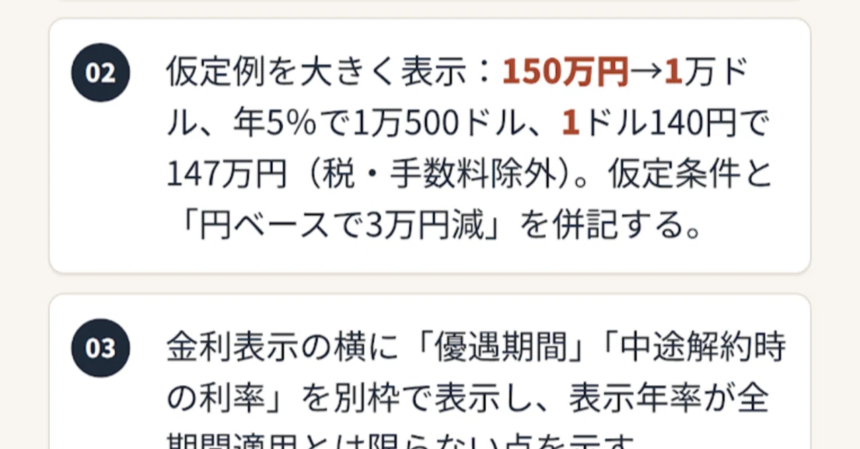
Hypothetical example: Suppose you deposit $10,000 when the rate is 150 yen to the dollar, and you receive your principal plus 5% interest one year later. Even excluding taxes and fees, if the exchange rate when converting back to yen is 140 yen, you would have $10,500 × 140 yen = 1.47 million yen. This is 30,000 yen less than the 1.5 million yen at the time of deposit. Even if the interest rate is positive, the profit or loss in yen terms can be negative.
[2. Consider exchange fees as a round-trip cost]
According to the Financial Services Agency, exchange fees are usually charged for depositing from yen to foreign currency and for withdrawing from foreign currency to yen. In other words, you need to check not only the ‘buying’ rate but also the ‘selling’ rate. The fee structure and amounts vary by financial institution, currency, and transaction method, so they cannot be represented by a uniform figure here.
Before comparing interest rates, please calculate the expected receipt amount in yen, including the applicable exchange rate and round-trip costs. If you plan to use the funds in the foreign currency, the meaning of the yen-conversion cost changes, but if you intend to convert back to yen in the future, the impact of exchange rate fluctuations remains.
[3. What it means to be excluded from deposit insurance]
Within the scope of the Deposit Insurance Corporation, foreign currency deposits are not covered. While general yen deposits and similar products are protected up to 10 million yen in principal per depositor at each covered financial institution, plus interest up to the date of failure, foreign currency deposits do not fall under this coverage. It is not a system where the principal and interest of foreign currency deposits are guaranteed to be returned in the event of a bank failure.
This is a risk separate from exchange rate losses. Even if the market does not move, there is a recovery risk associated with a bank failure, and even if the bank survives, exchange losses can occur if the yen strengthens. The Financial Services Agency explains that overseas branches and Japanese branches of foreign banks are also excluded from deposit insurance. Whether they are protected by foreign systems cannot be determined from this document alone, so separate confirmation is required.
[4. Things to check before applying]
On the application screen or in the pre-contract document, check: (1) the interest rate application period and treatment at maturity, (2) the interest rate and conditions for early termination, (3) the applicable exchange rates and fees for converting from yen to foreign currency and vice versa, and (4) whether the product is a foreign currency deposit and which financial institution or branch is handling it.
Then, set multiple hypothetical exchange rates and compare the expected receipt amount in yen, including interest. Think first not only about whether your exchange rate forecast will be correct, but also whether you can secure the necessary funds even if the yen strengthens. While high interest rates are attractive to some, you cannot decide that it is ‘profitable’ based on that figure alone.
[Sources/Primary Materials]
-
Financial Services Agency ‘Consultation Cases and Advice Regarding Deposits, Loans, etc.’ — Explanations of foreign exchange losses, fees, preferential interest rate periods, early termination, and exclusion from deposit insurance for foreign currency time deposits (Verified November 2, 2026): https://www.fsa.go.jp/receipt/soudansitu/advice01.html
-
Deposit Insurance Corporation of Japan ‘(4) Scope of Protected Deposits, etc.’ — Exclusion of foreign currency deposits, protection limits for general yen deposits, and handling in the event of bankruptcy (Verified November 2, 2026): http://www.dic.go.jp/yokinsha/page_000109.html
-
Deposit Insurance Corporation of Japan ‘(3) Eligible Financial Institutions’ — Scope of eligible financial institutions, handling of overseas branches and branches of foreign banks in Japan (Verified November 2, 2026): https://www.dic.go.jp/yokinsha/page_000108.html
[Related Articles and Columns]
Can You Really ‘Make Big Money with Small Amounts’ in FX? — The Magnitude of Losses Changed by 25x Leverage — This is a different product that deals with exchange rate risk. It does not mean that FX margin and loss-cut conditions apply to foreign currency deposits.
https://note.com/722_na_na_ni_ni/n/n32a12c2a1dbe
Are Investment Trusts Really Cheap if They Have ‘Zero Purchase Fees’? — Don’t Overlook Costs During Holding — Related article on a different point: While foreign exchange costs for foreign currency deposits and holding costs for investment trusts are different, you can compare the perspectives of looking at costs other than the displayed interest rate.