

Rabobank expects renewed pressure on Pound exchange rates as concerns over Prime Minister Andy Burnham’s spending plans unsettle the gilt market.
The British Pound concluded this trading week facing a difficult combination of political uncertainty, elevated UK bond yields and doubts over how the new government intends to fund its policy agenda.
UK economists at Rabobank say the initial market response to Burnham’s cabinet and early policy announcements has been notably cautious.
The UK 10-year gilt yield has moved above 5.0%, while Pound Sterling has ranked as the weakest G10 currency over the latest one-day period.
Although the appointment of an experienced Chancellor has offered some reassurance, the bank warns that uncertainty surrounding the government’s fiscal strategy could keep both gilts and the Pound under pressure.
Rabobank analysts expect EUR/GBP to rise to 0.8650 over the next three months and sees scope for GBP/USD to fall back towards 1.3200.
At current rates, those forecasts imply a weaker Pound against both the Euro and the US Dollar.
Rabobank Warns Burnham’s Honeymoon Could Be Brief
Rabobank says the appointment of Healey as Chancellor is a stabilising factor because the country’s finances have been placed in the hands of an experienced politician with previous Treasury exposure and respect across Parliament.
However, the larger question is how Burnham plans to finance his agenda.
The Prime Minister has said he intends to use “flexibility” within the fiscal rules, which Rabobank says could point towards placing some infrastructure-related debt on the balance sheets of public financial institutions.
Although such borrowing might sit outside the most closely watched fiscal measures, it would still need to be absorbed by the bond market.
“The market will be wary about whether this constitutes ‘back door’ funding,” Rabobank says.
The government’s first cost-of-living measure is a reduction in VAT on household electricity bills from October.
Officials have indicated that the measure will be funded by cancelling the previous government’s digital identity programme, although reports have raised doubts over whether that scheme was fully funded in the first place.
Rabobank notes that use of greater flexibility within the fiscal rules could potentially mobilise an additional £16 billion for infrastructure projects over the remainder of the decade.
Infrastructure investment could improve productivity in parts of the UK outside London and the South East, but those benefits may take years to materialise.
Burnam, by contrast, faces a general election in less than three years.
That leaves the government under pressure to deliver visible improvements quickly, increasing the risk that spending commitments expand before the economic benefits become apparent.
“The market is now bracing itself for a list of further announcements,” Rabobank says.
“This suggests that funding issues will remain at the fore of the market’s mind and hints that Burnham’s honeymoon may be short-lived.”
Gilt Market Particularly Sensitive
The latest UK borrowing figures were slightly better than expected for June, but borrowing over the first three months of the fiscal year remains above projections from the Office for Budget Responsibility.
At an early stage of the financial year, that overshoot might ordinarily attract limited attention.
Rabobank argues that the political backdrop makes investors more sensitive than usual.
Burnham is associated with the softer left of the Labour Party and has said he wants government to become less reliant on what he described as the “imperial” Treasury.
Against this backdrop, the bond market is likely to demand clear reassurance that new spending plans will remain compatible with the fiscal rules.
Rabobank also highlights structural vulnerabilities in the UK economy.
The country has a low household savings ratio and a substantial current-account deficit, increasing its dependence on overseas capital.
These characteristics can amplify market reactions when confidence deteriorates.
“The UK may not have the largest debt-to-GDP ratio in the developed world, but arguably it has one of the most sensitive debt markets,” Rabobank says.
Lower BoE Expectations Are Another Pound Risk
The reduction in VAT on household electricity bills should mechanically lower inflation.
Rabobank also expects headline UK CPI inflation to ease to 2.7% year on year, offering some short-term reassurance to the gilt market.
The inflation outlook remains complicated by higher spot energy prices following the escalation in the US-Iran conflict, but Rabobank believes current Bank of England pricing is too aggressive.
Markets are pricing approximately 43 basis points of BoE tightening over the next six months.
Rabobank expects the central bank to avoid raising rates this year.
“On our view, this is overdone and a reduction in market expectations for BoE policy tightening is another headwind for the pound,” the bank says.
This is important because elevated UK interest-rate expectations have provided Sterling with some protection against fiscal and political concerns.
Were investors to remove those expected rate increases, the Pound would lose part of its yield advantage at the same time as the gilt market remains uneasy about government borrowing.
GBP/USD Forecast: 1.3200 Comes Back Into View
GBP/USD ended the latest session around 1.3325, recording a modest daily gain after Thursday’s 0.47% decline.
The pair has nevertheless fallen by more than two cents from the 15 July close near 1.3540 and remains well below July’s high of 1.3558.
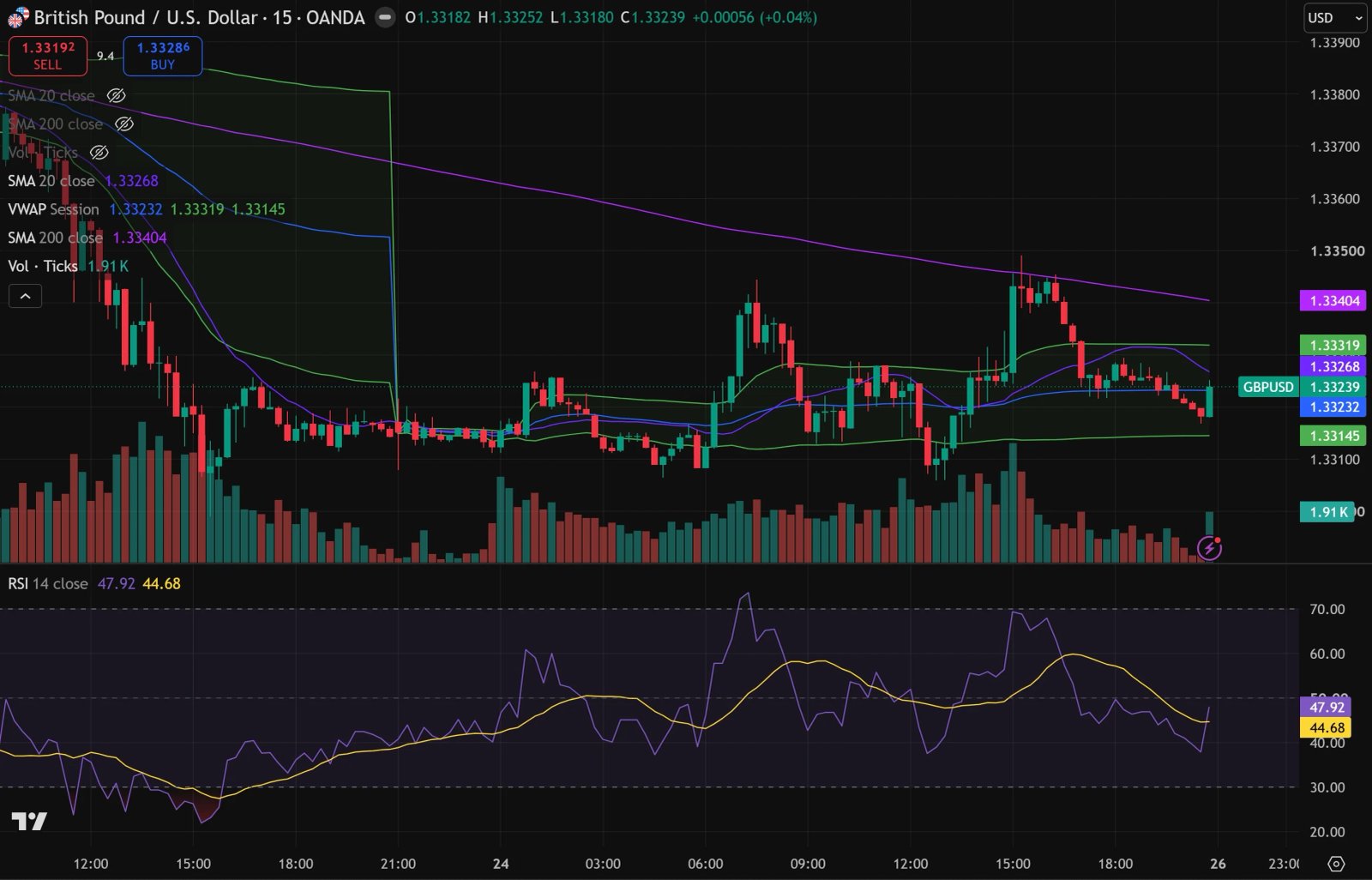
The short-term chart shows Sterling attempting to stabilise around 1.3320 after repeated failures to sustain advances above 1.3340.
GBP/USD is trading close to the 20-period moving average at 1.3327 and session VWAP near 1.3323.
That positioning suggests the pair is currently balanced around its immediate fair-value area rather than developing a strong recovery.
The 200-period moving average near 1.3340 remains the more important overhead barrier.
A recent rebound failed close to that level, confirming the 1.3340-1.3350 region as the first substantial resistance zone.
RSI has recovered to approximately 48 from below 40, showing that downside momentum has eased.
However, the indicator remains below 50 and does not yet signal that buyers have regained control.
Initial support is located around 1.3310, followed by 1.3290.
Rabobank’s 1.3200 objective would come into clearer view following a break below these levels, while July’s low at 1.3221 represents a significant intermediate support area.
On the upside, a sustained move above 1.3340 would reduce immediate downside pressure, although GBP/USD would still need to recover through 1.3400 to suggest the broader July correction has ended.
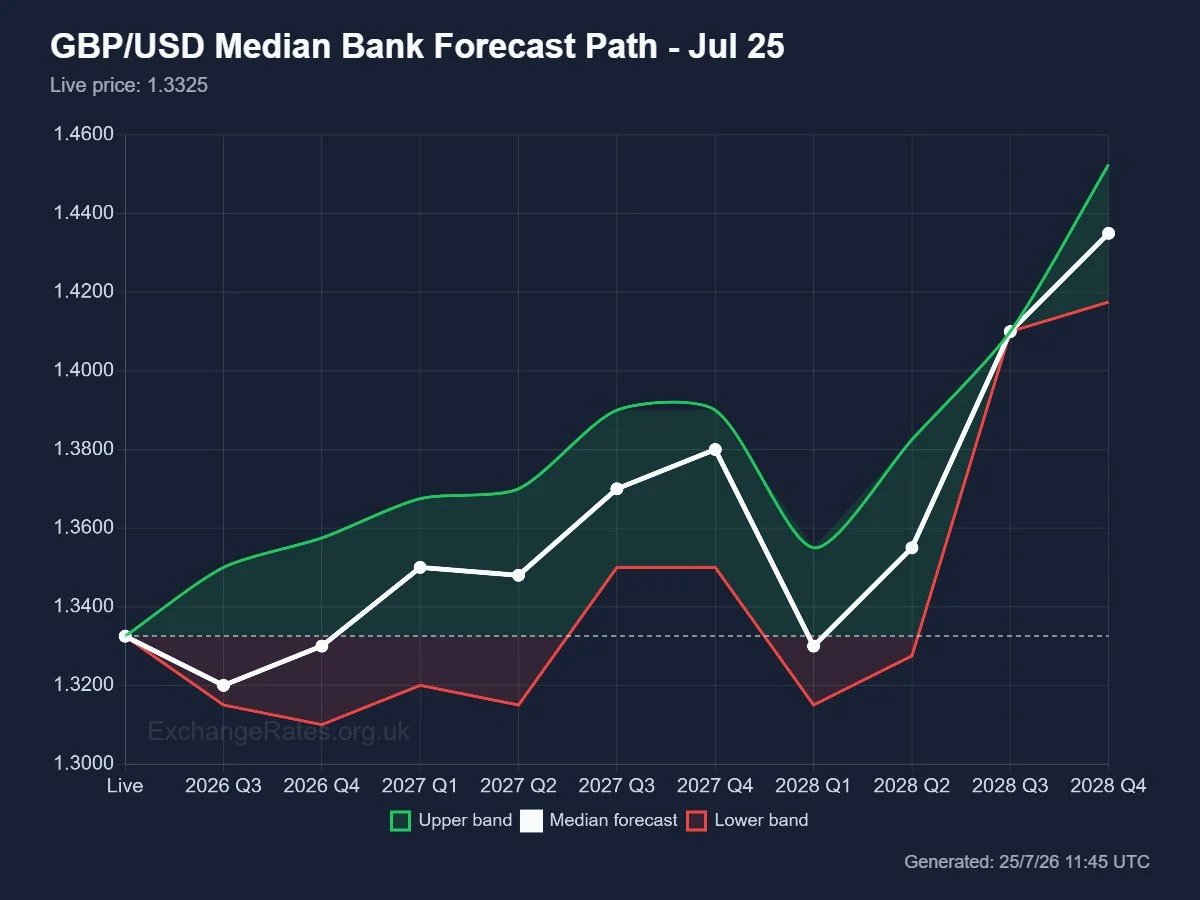
The median bank forecast path also points to near-term weakness before a later recovery.
The Q3 2026 median projection is close to 1.3200, broadly matching Rabobank’s three-month forecast, while the consensus path then rises towards 1.35 in early 2027 and approximately 1.38 by the end of that year.
Rabobank’s view is therefore consistent with the wider consensus in anticipating near-term pressure, although it does not rule out a longer-term recovery.

EUR/GBP Forecast: Rabobank Targets 0.8650
EUR/GBP closed around 0.8534 after falling 0.14% in the latest session.
The cross has recovered from July’s low near 0.8455, but remains almost 1% lower for the month and below the July opening level near 0.8614.
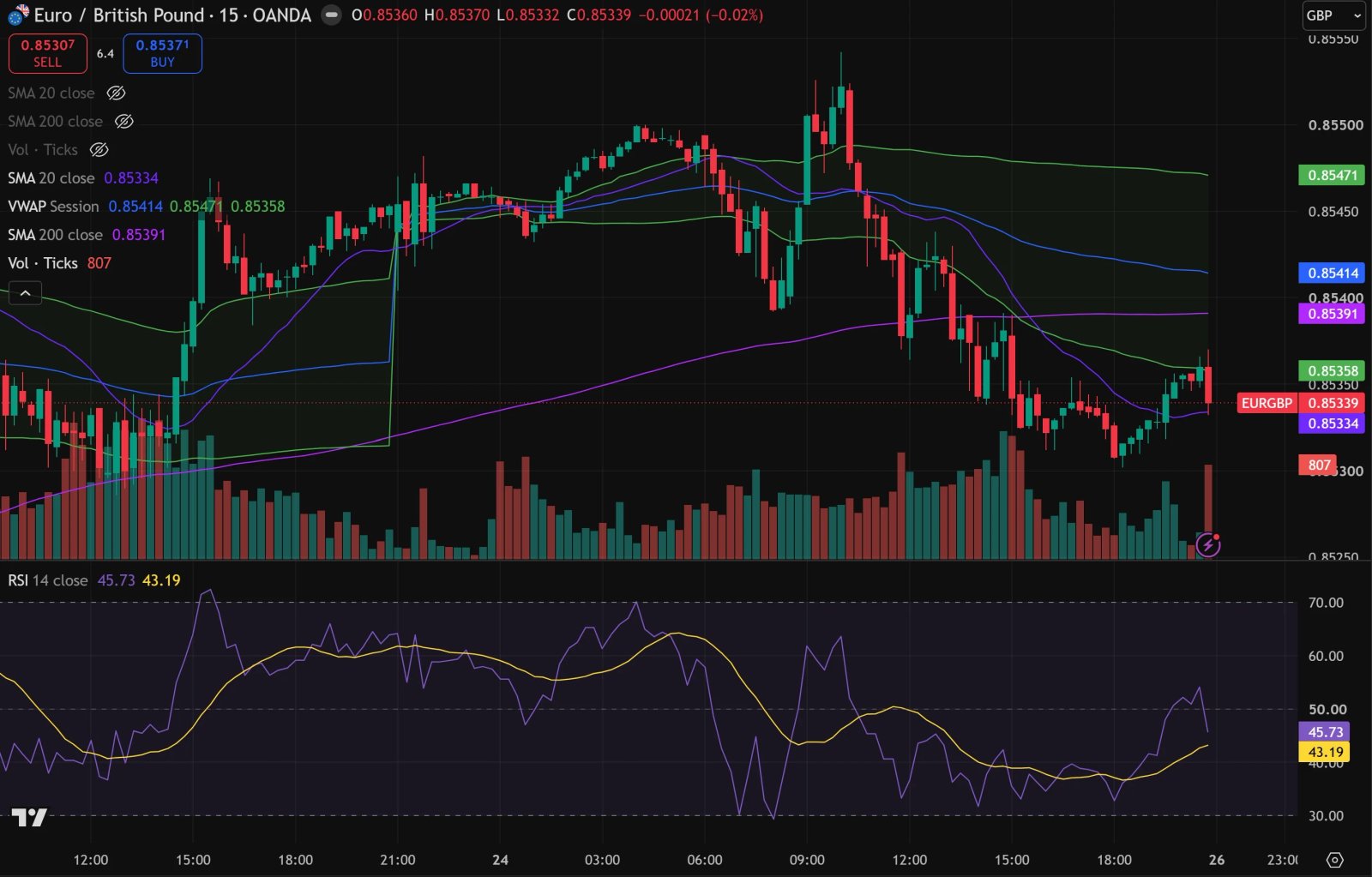
The 15-minute chart shows that EUR/GBP has surrendered part of its recent rebound after failing above 0.8550.
The cross is trading close to its 20-period moving average near 0.8533, but remains below session VWAP around 0.8541 and beneath the 200-period moving average near 0.8539.
This leaves the immediate technical picture mixed.
The latest recovery from below 0.8530 shows that selling pressure has moderated, while RSI near 46 has moved above its signal line.
However, the cross remains below the neutral 50 level and has yet to overcome the main intraday resistance cluster.
Initial resistance is located around 0.8539-0.8542, followed by 0.8547 and the recent highs around 0.8550-0.8555.
A break through that area would strengthen the case for a return towards 0.8600.
Rabobank’s 0.8650 forecast lies above the current technical range and would require a more decisive deterioration in Sterling sentiment.
On the downside, support is located around 0.8530, followed by 0.8525.
A break below these levels would weaken the immediate recovery and raise the risk of a renewed move towards 0.8500.
The wider bank consensus also leans towards a higher EUR/GBP rate over the coming quarters.
The median forecast stands close to 0.8700 from the third quarter of 2026 through early 2028, before easing towards 0.8600 and then 0.8450 by the end of 2028.
Rabobank’s 0.8650 target is therefore slightly below the near-term consensus median but still implies a meaningful Sterling decline from current levels.
Pound Sterling: Rabobank’s forecasts leave GBP exposed on two fronts
Against the Euro, the bank expects EUR/GBP to rise towards 0.8650 as investors question the government’s fiscal plans and reassess the likelihood of Bank of England tightening.
Against the Dollar, it sees GBP/USD falling towards 1.3200 as political uncertainty, gilt-market sensitivity and lower UK rate expectations weigh on the Pound.
The technical charts show that neither move has yet been fully confirmed.
GBP/USD is attempting to stabilise around 1.3320, while EUR/GBP remains below resistance around 0.8550.
However, the fundamental risks identified by Rabobank remain unresolved.
A reduction in expected BoE tightening would remove an important source of Sterling support, while further spending announcements without a convincing funding plan could renew pressure on gilts.
The base case is therefore for Pound Sterling to remain vulnerable, with a GBP/USD break below 1.3290 strengthening the path towards 1.3200 and an EUR/GBP move above 0.8550 opening the way towards Rabobank’s 0.8650 target.