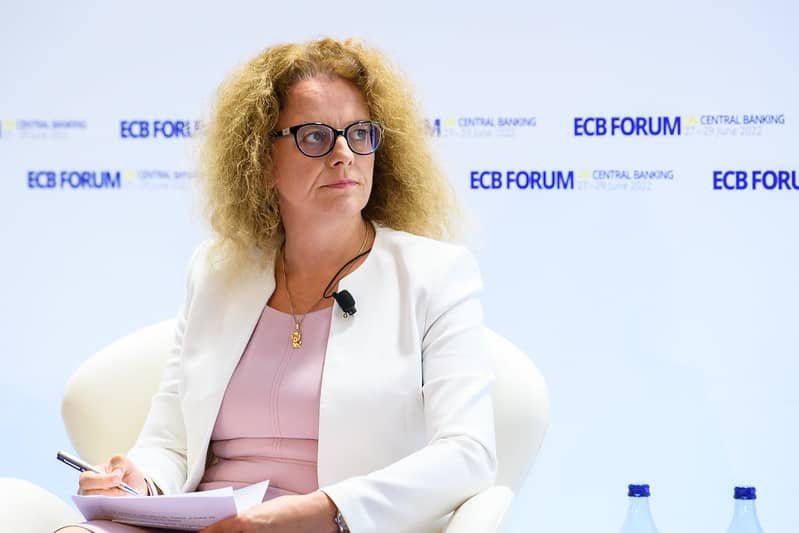

File image of Isabel Schabel. Credit: Photo by Sérgio Garcia. Copyright and licensing: ECB.
The euro to dollar exchange rate is supported by a ‘hawkish’ tilt in Eurozone interest rate expectations.
An influential member of the European Central Bank (ECB) said she was comfortable with current market bets for the next move at the Eurozone’s central bank to be a hike in interest rates.
ECB Governing Council member Isabel Schnabel said in an interview Monday that “both markets and survey participants expect that the next rate move is going to be a hike, albeit not anytime soon. I’m rather comfortable with those expectations.”
Jana Randow, who interviewed Schnabel for Bloomberg, said she was “surprised by the ‘hawkish’ nature.”
“Of course we knew that she had these thoughts but hearing her being so clear about the next step very likely being a hike… that was defnitely news we did not expect out of her mouth,” said Randow.
The surprise reflected in outperformance in Eurozone bond yields relative to those of the U.S. and UK, reflecting the shift in expectations for ECB interest rate policy.

There’s been a lift in ECB rate path expectations. Image courtesy of Spectra Markets.
The euro to dollar exchange rate (EUR/USD) was bid to 1.1672 and holds its December rally above the key 55-day moving average.
“Schnabel feels rather comfortable with both market and survey participant expectations that the next rate move is going to be a hike, albeit not anytime soon,” says a note from KBC Bank in Brussels.
“She’s the first official to put it that bluntly,” it adds.
Schnabel said risks to growth and inflation are skewed towards higher readings than forecast by the ECB, in part because the economy weathered U.S. tariffs better than projected.
She adds that underlying inflation trends have stalled at a time when the economy is recovering and fiscal policy is expanding, creating conditions for price growth to accelerate.
“The market implied probability that the ECB will still have to lower rates first (next year), long the side on which markets erred, is now less than 5%!” says KBC Bank’s response note.
“The probability of a rate hike over the same period is as small, but the market clearly holds a hiking bias from 2027 onwards,” it adds.
It’s not just recent dollar weakness that is bolstering euro-dollar: last week Germany helped the euro when factory orders printed at 1.5% in October, five times the level assumed by the market (0.3%), and the September reading was revised from 1.1% to 2.0%.
French industrial production also surprised, exceeding expectations with a rise of 0.2% against a forecast decline of 0.1%. Spanish output gained 0.7%, beating the 0.5% consensus.
“Eurozone growth has been disappointing for several years. However, we think that’s changing now with Germany embarking on a period of higher military and infrastructure spending,” says Brian Levitt, Chief Global Market Strategist at Invesco.
The firming growth trajectory and still high inflation underscore Schnabel’s case for interest rates to remain unchanged.
With the U.S. Federal Reserve set to lower rate this week, the divergence in U.S. and Eurozone interest rate policy will continue to underscore euro-dollar.