
- Many people leave it as “it should have increased” without looking at the statement
- The exchange fee appears in the difference between the two numbers on the statement
- What you can do after reading this article
- What you will learn in this article
- Demonstration: Calculating the fees from when you deposited, using transaction statements
- Step 1: Find the ‘Deposit’ line
- Step 2: Check if the applied rate is the TTS
- Step 3: Check the TTM for that day
- Step 4: Calculate the fee per dollar
- Step 5: Calculate the fee paid at the time of deposit in yen
- Step 6: Write it out in one line
- Read what to check next from the line you wrote out
- Overall map for consolidating into a single checklist
- What you will get from here on
On the evening news, the announcer reads out, “The yen exchange rate is in the 1XX yen range per dollar.”
At that moment, you suddenly remember. Several years ago, at a bank counter, you were recommended to start a US dollar foreign currency time deposit because “the interest rate is higher than for the yen.” Since you set it to automatically renew upon maturity, you haven’t done anything since.
The yen should be much weaker now than it was back then. If so, it should have increased.
However, even when you open your smartphone app, the balance is only shown in dollars. You don’t know how much it would be if you converted it back to yen. In the first place, you don’t even remember what the rate was per dollar when you deposited it. Has interest been added? Have taxes been deducted? If you convert it back to yen, do you need to file a tax return?
When you try to look it up, terms like “TTS,” “TTB,” and “foreign exchange gains are miscellaneous income” appear. You get annoyed while reading and close the app. “Well, if it’s increased, that’s fine.” And so, another year passes.
This article is for you, a company employee in your 40s who started a US dollar foreign currency deposit at a bank several years ago and has never opened the statement while it has been on automatic renewal.
Many people leave it as “it should have increased” without looking at the statement
Nice to meet you, I am Tax Accountant Roki. I am an active tax accountant. While I usually handle tax affairs for small and medium-sized enterprises and sole proprietors, I also receive consultations on tax returns and money from company employees.
During those consultations, the topic of foreign currency deposits sometimes comes up. The trigger is usually the question, “I’m thinking of converting it back to yen, but will I be taxed?” When I ask, “Then, please show me the statement from when you deposited it,” the reactions generally fall into one of the following categories. I will generalize them so that specific individuals cannot be identified.
-
“A statement… is it? The app only shows the current balance.”
-
“I think I deposited it when it was around 100 yen per dollar.”
-
“I don’t think any fees were charged. Nothing was said at the counter.”
-
“Interest should have been added, but I haven’t checked how much.”
It is not the person’s fault. If you set it to automatic renewal, you don’t have to do anything when it matures, and every time you see news about the yen weakening, you can think “it must have increased,” so there is little reason to check.
When we open the statement together, the conversation usually goes like this: “The applicable rate on the day you deposited is this number.” “It’s higher than the rate I saw on the news.” “Yes. It is common for the bank’s exchange fee to be included in the rate when converting from yen to dollars. Also, it will be charged again when you convert back to yen.” “…Both ways?” The confirmation itself takes about 15 minutes. Even so, for the person, it is often the first time they have learned about this since they deposited the money.
There are three situations where you will be in trouble if you remain unaware.
The first is that it has not increased as much as you thought. The “1 dollar = XX yen” on the news is not the same as the rate the bank uses when you convert back to yen. Since it is common for exchange fees to be charged both when depositing and when withdrawing, your actual take-home amount will be less than the amount you calculated in your head using only the news figures. The Financial Services Agency’s consultation case page also warns about foreign currency time deposits, stating, “Usually, exchange fees are charged when depositing from yen to foreign currency and when withdrawing from foreign currency to yen.”
The second is that you must determine whether a tax return is required in the year you convert back to yen. According to the Japanese Bankers Association’s explanation, foreign exchange gains from foreign currency deposits are treated as “miscellaneous income” and are subject to comprehensive taxation. Even for company employees, a tax return may be required depending on the conditions. And to calculate the foreign exchange gain, you need the yen amount at the time of deposit. If you don’t know this, you cannot even determine whether a tax return is necessary.
The third is that it is not protected in the same way as yen deposits. The Deposit Insurance Corporation of Japan excludes foreign currency deposits from the scope of deposit insurance protection. If you are leaving a large sum of money in one place with the same feeling as a yen time deposit, this is a point I want you to know at least once.
The exchange fee appears in the difference between the two numbers on the statement
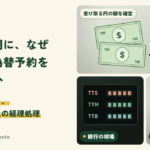
You can understand the talk about foreign currency deposit rates if you know three terms.
-
TTS: The rate used when converting yen to foreign currency. Used when making a deposit.
-
TTB: The rate used when converting foreign currency to yen. Used when converting back to yen.
-
TTM: Mid-rate. The rate determined by the bank as the benchmark for the day, generally placed in the middle of TTS and TTB.
The Japanese Bankers Association also explains that TTS is the rate for converting yen to foreign currency, and TTB is the rate for converting foreign currency to yen. Furthermore, it is noted that exchange fees are often incurred when exchanging yen and foreign currency, and these fees vary by bank.
This is the important part. Looking at a bank’s exchange rate table, TTS is generally set higher than TTM, and TTB is set lower than TTM. That difference corresponds to the exchange fee per dollar. Since you aren’t billed separately at the counter saying ‘the fee is X yen,’ it’s easy to think you aren’t being charged, but in reality, it is often included in the rate.
In other words, if you know the applied rate (TTS) for the deposit written on your statement and the TTM for that day, you can calculate how much you paid in fees on the day you made the deposit in yen.
What you can do after reading this article
By the time you finish reading the free section, you will be able to extract the deposit date, the amount of yen deposited, the amount of dollars, the applied rate (TTS), and the mid-rate (TTM) for that day from your transaction statement and calculate the exchange fee you paid at the time of deposit in yen.
If you proceed to the paid section, you can check the fees for converting back to yen, taxes on interest, whether you need to declare foreign exchange gains, the break-even rate for when you would start losing money if the yen strengthens, and how automatic renewals and deposit insurance are handled. By the end, you will have ‘a single inspection sheet for your foreign currency deposit’.
I’ll say this upfront: this article does not tell you to ‘stop your foreign currency deposit’ or ‘keep doing it.’ Neither I nor anyone else knows what will happen to the exchange rate in the future. There is only one thing to do: make it so you can explain the contents of your foreign currency deposit on a single sheet of paper.
What you will learn in this article
-
Where to find the ‘deposit date,’ ‘deposit amount,’ and ‘applied rate’ on your transaction statement (Free)
-
Calculation of the exchange fee at the time of deposit (TTS – TTM) (Free)
-
[Paid] How to gather your transaction statements, balances, and maturity notices
-
[Paid] Recording the rate and fees at the time of deposit
-
[Paid] Fees when converting back to yen (TTM – TTB) and round-trip costs
-
[Paid] Receipt of interest and separate withholding taxation
-
[Paid] Tax classification of foreign exchange gains and whether declaration is required
-
[Paid] Formula for calculating the break-even rate
-
[Paid] Handling of automatic renewals and maturities
-
[Paid] The premise that it is not covered by deposit insurance
-
[Paid] Points to note when withdrawing as foreign currency or canceling foreign currency time deposits
-
[Paid] A yardstick for comparing with other ways to hold foreign currency
-
[Paid] Questions to ask the bank
-
[Paid] Procedure for annual inspections
-
[Paid] A one-page ‘Foreign Currency Deposit Inspection Sheet’ with fill-in fields
Demonstration: Calculating the fees from when you deposited, using transaction statements
I will do this part for free until the end. What you need to prepare is your foreign currency deposit transaction statement. These are documents with names like ‘Deposit/Withdrawal Statement’ or ‘Transaction History’ in apps or online banking, or ‘Transaction Statement’ or ‘Calculation Sheet’ received when you made the deposit if it is on paper. How to request these if you cannot find any of them will be written in section ① of the paid portion.
The numbers are fictional examples to make things easier to understand. Actual rates and fees vary by bank and by day.
Step 1: Find the ‘Deposit’ line
From the statement, look for the oldest line that looks like ‘Deposit’, ‘Foreign Currency Deposit’, or ‘Transfer from Yen’. For those who have been renewing automatically many times, there should be more lines each time it matures. What you are looking for is the line where you first converted yen to dollars.
On that line, copy down the following four items.
-
Deposit date: For example, April 10th of a certain year
-
Yen amount (yen deducted): 1,110,000 yen
-
Dollar amount (dollars deposited): 10,000.00 dollars
-
Applied rate: 111.00 yen
Step 2: Check if the applied rate is the TTS
If you divide the yen amount by the dollar amount, it should match the applied rate.
1,110,000 yen ÷ 10,000 dollars = 111.00 yen
If it matches, this 111.00 yen is the TTS on the day of deposit. Since this is the line where you converted yen to dollars, the TTS is used. If your statement has a separate column for “exchange fees” with an amount entered, make sure to copy that amount as well.
Step 3: Check the TTM for that day
If the TTM (middle rate) is not written on the statement, check the TTM on the deposit date on a page such as “Past Foreign Exchange Rates” or “Exchange Rate List” on the bank’s website. If it is not listed on the site, you can ask at the counter.
In the example, let’s assume the TTM on the deposit date was 110.00 yen.
Step 4: Calculate the fee per dollar
Subtract the TTM from the TTS.
-
111.00 yen – 110.00 yen = 1.00 yen
This is the exchange fee per dollar. While I am using “1 yen each way” as an example, this margin varies depending on the bank and the method of deposit (counter vs. online). Please calculate using the figures from your own statement.
Step 5: Calculate the fee paid at the time of deposit in yen
Multiply the fee per dollar by the amount of dollars deposited.
-
1.00 yen × 10,000 dollars = 10,000 yen
The person in the example paid an exchange fee of approximately 10,000 yen on the day of the deposit. Relative to the amount of yen deposited, this is 10,000 yen ÷ 1,110,000 yen = approximately 0.9%.
Step 6: Write it out in one line
Write the above in one line in a memo app.
“Deposit date: ___/___/___ / Yen deposited: ___ yen / Dollars deposited: ___ dollars / TTS: ___ yen / TTM: ___ yen / Fee per dollar: ___ yen / Fee at time of deposit: ___ yen”
With this, the starting point of your foreign currency deposit has become “one line that you can explain yourself.” The answer to the question from the beginning, “How much was 1 dollar worth when I deposited it?”, is contained within this one line.
Read what to check next from the line you wrote out
From this one line alone, the following questions naturally arise.
First, “fees.” If it cost 1 yen per dollar to deposit, won’t it cost about the same to convert it back to yen? The next thing to know is how much it will cost for the round trip.
Next, “yen deposited.” If I convert the current balance back to yen, will it be more than this amount? If it has increased, is the difference an amount that requires reporting?
And then there is the “TTS 111.00 yen.” The next thing I want to check from this number is at what yen exchange rate will I lose my principal? The answer is not 111.00 yen. This is because interest and the fees for converting back are included.
Overall map for consolidating into a single checklist
In the paid section, starting from the single line written here, we will follow the next 12 steps to “check all the contents of your foreign currency deposits and consolidate them onto one sheet.”
-
Preparing transaction statements, balances, and maturity notices
-
Exchange rates and fees at the time of deposit (TTS – TTM)
-
Fees for converting back to yen (TTM – TTB) and round-trip costs
-
Receipt of interest and separate self-assessment taxation
-
Tax classification of foreign exchange gains and whether a tax return is required
-
Calculating the break-even exchange rate
-
Handling of automatic renewal and maturity
-
Exclusion from deposit insurance
-
Withdrawing as foreign currency and canceling foreign currency time deposits
-
How to compare with other ways of holding foreign currency
-
How to confirm with the bank
-
Annual inspection
The points people often say they “didn’t know” during consultations are 3, 5, and 6. That fees are also charged when converting back, that a tax return may be required for foreign exchange gains in the year of conversion, and that the break-even line is not the TTS number itself. For those who are thinking about converting back to yen after seeing news of a weaker yen, I want you to check these three things before making a decision.
What you will get from here on
Beyond this point, there are the 12 steps from ① to ⑫ and a take-home ‘Single-Sheet Foreign Currency Deposit Checklist’ with entry fields.
The 12 steps are written based on three points: “where to look on the statement,” “what to calculate and write down,” and “what to ask the bank or tax office if you don’t understand.” Since fees and interest rates for foreign currency deposits differ by bank, I have only included general mechanisms that can be verified by the National Tax Agency’s Tax Answer and Q&A cases, the Deposit Insurance Corporation, the Financial Services Agency, and the Japanese Bankers Association. For parts that differ by bank, I have broken them down into “which document to look at and where” and “what to ask at the counter.” The calculation formula for the break-even rate has been verified by running the numbers from the fictional example in the free section on a calculator.
The ‘Single-Sheet Foreign Currency Deposit Checklist’ is a list with entry fields where you can write down the answers from the 12 steps. Whether you are wondering whether to convert back to yen or when the time for filing your tax return arrives, if you take out that one sheet first, you can answer the things you didn’t understand at the beginning while looking at the paper.
It costs just one coin to verify a fee of 1 yen per dollar. For someone with 10,000 dollars on deposit, that is one-twentieth of the one-way fee.