
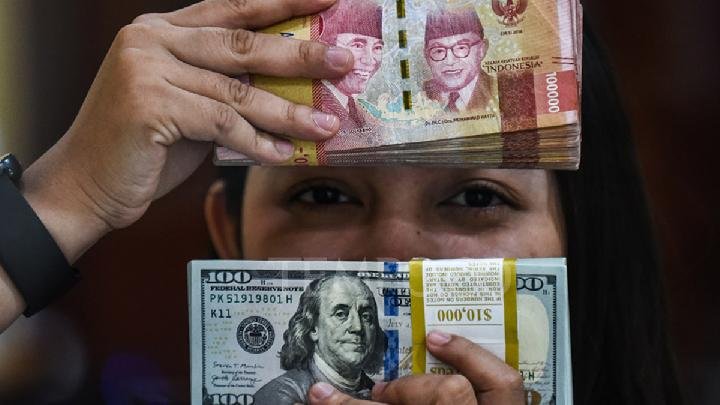
Foreign money was entering Indonesia even as the rupiah was losing ground. The apparent contradiction reveals a distinction often overlooked in global finance: attracting foreign capital and creating demand for a currency are not necessarily the same thing.
Bank Indonesia recorded US$4.80 billion in net capital inflows during the fourth quarter through November 16, 2026. Yet the rupiah remained under pressure, trading at Rp18,245 per US dollar on November 17, down 0.66% from the end of October. A day later, Bank Indonesia raised its benchmark interest rate by 25 basis points to 6.00%.
Although these figures cover different reporting windows and do not establish causation, they raise a question that headline capital-flow statistics cannot answer: how much incoming foreign capital actually translates into demand for the domestic currency?
Imagine two investors financing the same government. One buys rupiah-denominated bonds, the other subscribes to a dollar-denominated bond issued overseas.
The first investment usually requires access to rupiah, although the investor may have acquired the currency earlier and separately hedged the exchange-rate exposure. The second can be settled entirely in dollars. Its effect on rupiah demand depends on what the issuer subsequently does with the proceeds: keep them in foreign currency, service dollar obligations or convert some into rupiah.
Both transactions appear in external financing statistics. They need not create comparable spot-market buying pressure.
Research by Gaston Gelos, Pietro Patelli and Ilhyock Shim, published in the BIS Quarterly Review in 2024, supports the importance of this distinction. They found that the global dollar’s strength has become particularly consequential for flows into emerging-market local-currency bonds and equities, while other forms of foreign-currency financing behave differently.
A headline capital-flow total can therefore conceal several distinct markets, currencies and investor decisions. Calling all of it “money supporting the rupiah” skips the most important transmission step.
When Currency Pressure Arrives Offshore
The missing step is not confined to bond settlement. Exchange-rate pressure can also emerge outside the domestic spot market.
In a non-deliverable forward (NDF), investors take positions on a future exchange rate without delivering the emerging-market currency at settlement. Dealers managing these exposures may then trade in related markets, transmitting pressure across borders.
A BIS working paper published in October 2026 by Gerardo Ferrara, Andreas Schrimpf, Ganesh Viswanath-Natraj and Zijie Wang provides evidence. Using transaction-level data for ten emerging-market currencies between 2013 and 2025, the authors estimate that US$1 billion in additional offshore dollar-buying order flow is associated with approximately 10 basis points of domestic-currency depreciation in spot markets.
The BIS findings identify a transmission mechanism, not the cause of Indonesia’s November depreciation. Establishing that connection would require transaction-level evidence linking offshore positioning, domestic hedging activity and rupiah-market liquidity during the episode.
A billion dollars entering an economy over several weeks may have a different exchange-rate impact from a concentrated wave of dollar-buying orders executed within minutes. Currency prices respond not only to the volume of transactions, but also to their direction, timing and the liquidity available to absorb them.
There is a serious objection. International bond inflows generally do support emerging-market currencies. If so, does one episode of depreciation justify questioning their importance?
Peter Hördahl and Giorgio Valente’s 2022 BIS study of 24 emerging markets found that large bond inflows tended to precede currency appreciation, while large outflows tended to precede depreciation. This is compelling evidence against the exaggerated claim that capital inflows have little relevance for exchange rates.
But a relationship observed across economies and over time is not an accounting identity that must hold every week. A positive net flow can coexist with importers buying dollars, foreign investors withdrawing from equities, residents building external assets or hedgers adjusting exposures. The timing and liquidity of those transactions can dominate the price at a particular moment.
Nor would it be correct to blame derivatives automatically. NDFs help firms and investors insure legitimate currency risks; curbing them indiscriminately could make markets less resilient. The task is to understand pressure, not to label all hedging as speculation.
What the Rate Increase Can and Cannot Do
Higher interest rates can make rupiah assets more attractive, help anchor inflation expectations and reduce incentives for destabilizing outflows. Indonesia’s November decision therefore has a legitimate monetary rationale.
But the policy rate does not dictate when dollar bond proceeds are converted, how importers schedule foreign-currency purchases or how offshore positions are hedged. These are different channels requiring different forms of market intelligence and, where appropriate, intervention.
Bank Indonesia reported approximately US$14.1 billion in domestic hedging transactions following measures introduced in June 2026. The figure indicates substantial use of risk-management instruments, but does not establish their impact on the exchange rate. That distinction reinforces the need to examine how hedging activity, actual currency conversion and market liquidity interact.
Bank Indonesia already operates through a policy mix that includes spot and forward-market instruments. The opportunity is to connect its findings more explicitly to the public interpretation of capital-flow figures.
A useful complementary assessment would track four questions: What share of incoming financing is denominated in rupiah? How much net spot conversion actually occurs? What pressure appears in forward and hedging markets? And how deep is liquidity when those orders arrive?
Where disclosure is safe, aggregated indicators could explain why financing remains available even as currency-market conditions tighten. Such analysis would complement existing balance-of-payments statistics without requiring the disclosure of sensitive trading positions.
The objective is to distinguish pressures arising from portfolio allocation, immediate currency conversion and derivatives-market positioning. Such distinctions can improve the diagnosis of exchange-rate movements and help policymakers select instruments that address the underlying transmission channel.
Capital inflows tell us where financing comes from. Currency markets reveal how that financing, alongside many other transactions, influences the exchange rate. For emerging economies, understanding the difference may be as important as attracting capital itself.
*The views presented in this article are the authors’ own and do not necessarily reflect the views of The Diplomatic Insight.*

Ircham Andrianto Taufick
Ircham Andrianto Taufick is an Indonesian economic op-ed writer and Team Head of Payment System and Currency Management Policy Implementation and Supervision Bank Indonesia Representative Office of North Sulawesi Province. He writes on the intersection of monetary stability, payment systems, digital finance, and regional economic development. He can be reached at [email protected]