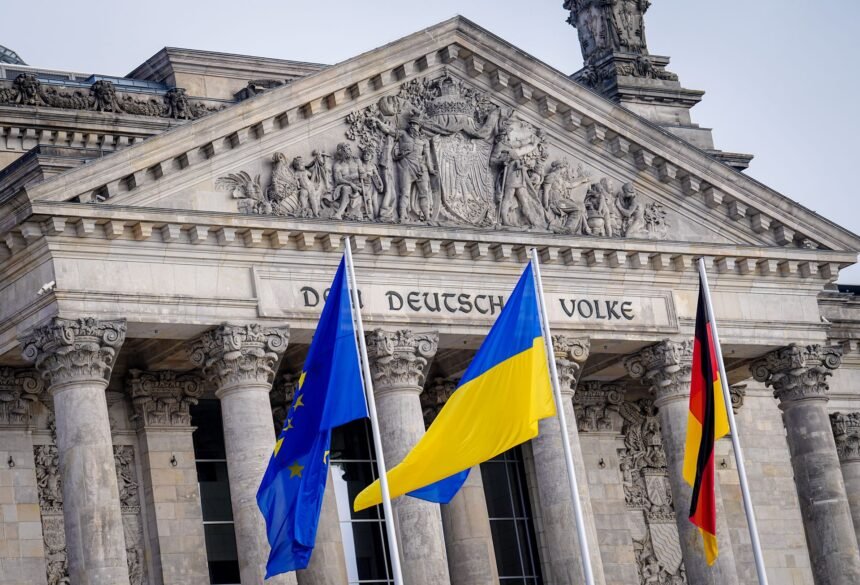
The German Parliament approved 11.6 billion euros ($12.7 billion) in support for Ukraine as part of the country’s 2027 budget, which was voted through on Nov. 27.
President Volodymyr Zelensky identified a 70 billion euro ($77 billion) hole in Ukraine’s finances for 2027, and Kyiv is counting on partners to cover that gap, and fast.
Failure to do so would mean the International Monetary Fund cannot continue its support for Ukraine, which requires Kyiv to have a sound budget, the EU’s Economy Commissioner Valdis Dombrovskis told the Kyiv Independent.
Negotiations are ongoing for the EU to agree a 45 billion euro ($49 billion) loan by the end of 2027, but that still leaves 25 billion euros ($27 billion) for Ukraine’s allies to find and provide — and fast.
Germany’s new budget, now approved by the parliament in Berlin, will bridge almost half of that shortfall on its own.
The final draft of the budget partially breaks down the 11.6 billion, but the largest share, titled simply “Ukraine support,” already accounts for 9 billion ($10 billion) of the total.
Also listed in the budget are smaller amounts for capacity building within Ukraine’s government, specifically in the defense and foreign ministries, plus 25 million euros ($27 million) earmarked for the medical treatment of Ukrainian soldiers.
Germany has also earmarked 649 million euros ($710 million) for the European Peace Facility (EPF), an EU pot of money funded directly by member-state contributions, which can be used to procure weapons for Ukraine.
A week earlier, EU countries agreed to provide 1 billion euros in military support for Ukraine by drawing from the EPF.
Germany is the third-largest donor to Ukraine since Russia initiated its full-scale invasion in 2022, behind only the U.S. and the EU, according to data compiled by the Kiel Institute.
And Chancellor Friedrich Merz is one of the loudest voices pushing for the EU to agree on longer-term financial support for Ukraine by the end of the year, backed by all 27 member states with no opt-outs.