
- What Does Currency Volatility Mean for a Business?
- How Do Currency Swings Affect Imports, Exports and Profit Margins?
- Why Are Overseas Contracts Especially Vulnerable?
- What Causes Currency Volatility?
- How Can Small Businesses Manage Currency Risk?
- Common Currency Risk Mistakes Businesses Should Avoid
- Conclusion
What happens when a business agrees to pay a supplier $10,000, but the exchange rate changes before the payment is due?
The supplier’s price stays the same, but the amount the business pays in its local currency may not. These shifts can affect import costs, export revenue, profit margins, and cash flow. Large companies may have finance teams to manage this risk, but smaller businesses face the same challenges.
Understanding the Currency Volatility Impact on Businesses helps companies prepare for these changes. Let’s look at where the risks appear and how businesses can manage them.
What Does Currency Volatility Mean for a Business?
Currency volatility refers to changes in exchange rates over time. These movements affect how much a business pays or receives when dealing with foreign currencies. Even a small shift can change the final cost of an international transaction.
Consider a business importing goods worth $10,000:
| Exchange rate | Cost of a $10,000 import |
| $1 = ₹83 | ₹8,30,000 |
| $1 = ₹86 | ₹8,60,000 |
Illustrative figures, not actual market rates.
A ₹3 increase in the exchange rate raises the import bill by ₹30,000, even though the supplier’s price remains unchanged.
This is the real challenge of the currency volatility impact on businesses: costs and revenue can change even when a business makes no changes to its operations.
How Do Currency Swings Affect Imports, Exports and Profit Margins?

Currency movements are a key part of the currency volatility impact on businesses, affecting companies differently depending on whether they buy from overseas, sell internationally, or do both. Here are three areas where the impact is most visible.
1. Import Costs
When the domestic currency weakens, imported goods become more expensive. This affects raw materials, machinery, technology, and software purchased from overseas suppliers. Businesses must either pass the extra cost to customers through higher prices or absorb it through lower profit margins.
2. Export Pricing
A weaker domestic currency can make products more affordable for overseas buyers, potentially improving export competitiveness. However, exporters receiving foreign currency may earn less when converting that revenue if exchange rates move against them. Imported components can also reduce the cost advantage.
For companies expanding globally, these currency movements can become an important part of deciding where to source products, how to price overseas orders, and how to manage international revenue.
3. Profit Margins and Cash Flow
Currency swings can change expected profits and increase the amount of local currency needed to settle foreign invoices. Businesses may also need extra working capital to cover unexpected payment increases.
The important distinction: A weaker currency may benefit exporters while hurting importers. For businesses involved in both, the overall effect depends on their international costs, revenue, and payment timing.
Why Are Overseas Contracts Especially Vulnerable?
Overseas contracts often involve a gap between agreeing to a price and making or receiving the payment. During that time, exchange rates can shift, changing the actual value of the deal.
This is particularly risky for businesses with:
- Long-term supply agreements with fixed prices.
- Delayed payments from overseas customers.
- Contracts with payments spread across installments.
- Foreign-currency loans or recurring service fees.
For example, a business agreeing to receive $20,000 in three months may end up with less local-currency revenue if the exchange rate moves against it before payment.
A few contract safeguards can help reduce the currency volatility impact on businesses and protect profit margins :
- Set clear payment deadlines.
- Include currency adjustment clauses.
- Define how long quoted prices remain valid.
- Agree on who carries the exchange-rate risk.
These steps help businesses plan costs and protect margins without turning every contract into a financial guessing game.
What Causes Currency Volatility?
Exchange rates move because the economic and political conditions behind different currencies keep changing. Several factors can influence how much investors and businesses want to buy or sell a currency.
The main drivers include:
- Interest rates: Central bank decisions can make a currency more or less attractive to investors.
- Inflation: Differences in inflation between countries can affect currency values.
- Political uncertainty: Elections, conflicts, and policy changes can unsettle markets.
Businesses planning international expansion must also consider Geopolitical risk for business planning, as conflicts, sanctions, and sudden policy changes can affect investor confidence and currency markets.
- Trade flows: Changes in imports and exports can influence demand for foreign currencies.
- Economic outlook: Slowdowns and changing investor confidence can trigger currency movements.
The scale of currency trading shows how closely connected global markets have become. According to the Bank for International Settlements, foreign-exchange markets recorded an average daily turnover of $9.6 trillion in April 2025, up 28% from 2022.
Interest-rate changes can have wider effects too. When central banks adjust rates, they can influence exchange rates, borrowing costs, and business investment. These shifts are part of the wider global interest rate shifts affecting the business landscape (How global interest rate shifts affect business (T1)), especially for companies operating across borders.
How Can Small Businesses Manage Currency Risk?
Small businesses do not need a large finance team to manage the currency volatility impact on businesses. A few practical steps provided below can help limit unexpected costs and protect profit margins.
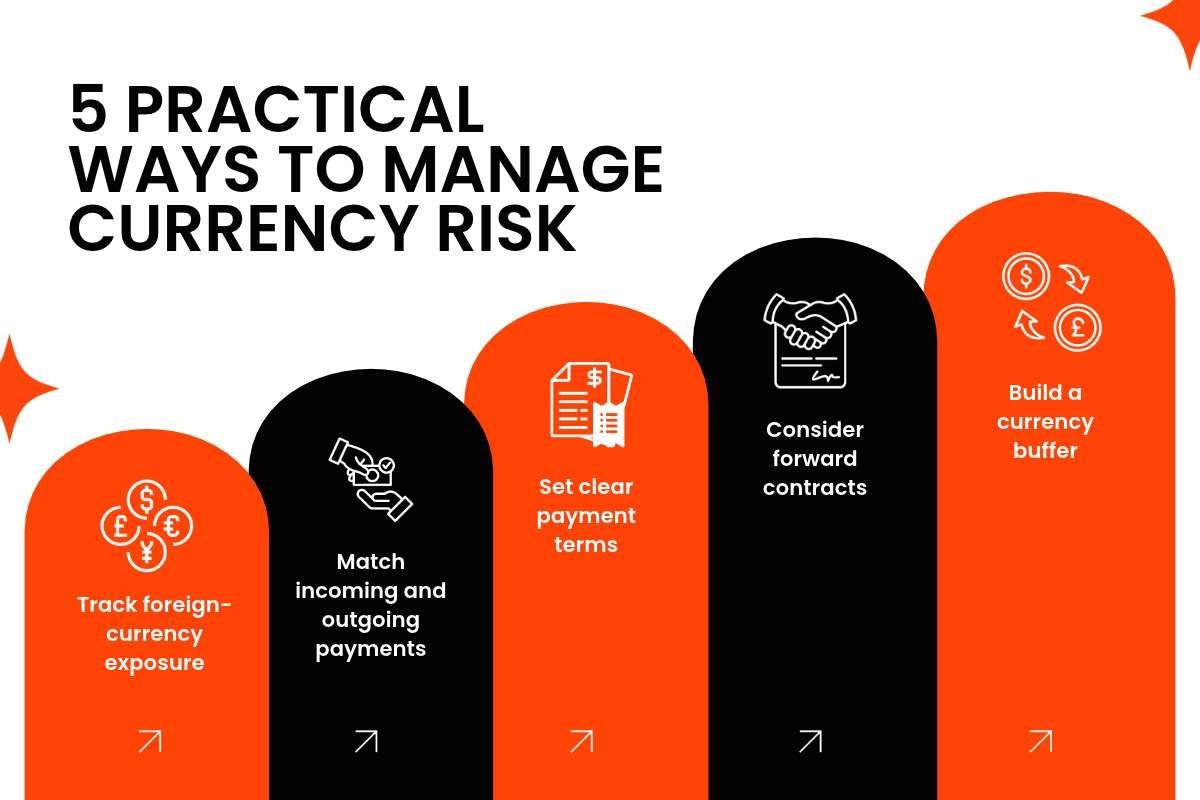
5 Practical Ways to Manage Currency Risk
1. Track foreign-currency exposure
List upcoming international payments and expected export receipts. Record the currency, amount, and payment date so you know where exchange-rate changes could affect your cash flow.
2. Match incoming and outgoing payments
If you earn dollars and also pay a supplier in dollars, use some of that income to cover the expense where possible. This is known as a natural hedge.
3. Set clear payment terms
Agree on payment deadlines, price validity periods, and currency adjustment clauses with overseas customers and suppliers.
4. Consider forward contracts
A forward contract lets a business lock in an exchange rate for a future transaction. This can make costs more predictable, although fees, contract terms, and obligations need careful review.
Forward contracts are widely used in currency markets to manage future exchange-rate exposure. BIS data show that outright forwards accounted for $1.8 trillion in average daily trading in April 2025, representing 19% of global FX turnover.
5. Build a currency buffer
Include some room for exchange-rate changes when preparing budgets and setting prices. Do not assume today’s rate will still apply when an invoice is due.
The US Department of Commerce’s Trade Finance Guide also highlights foreign-exchange risk management as an important part of international trade, particularly for businesses accepting payments in foreign currencies.
The goal is not to predict every currency movement. It is to make sure one unexpected exchange-rate change does not put your entire business budget under pressure.
Common Currency Risk Mistakes Businesses Should Avoid
Managing currency risk is not about predicting every exchange-rate movement. It is about avoiding preventable financial surprises. Businesses should watch out for these common mistakes:
- Waiting until an invoice is due to check exchange rates.
- Assuming currency movements will always work in their favour.
- Signing long-term foreign-currency contracts without reviewing the risks.
- Hedging more than their actual currency exposure.
- Treating currency hedging as a way to make speculative profits.
The goal of managing the currency volatility impact on businesses is simple: protect profit margins and cash flow, not beat the foreign exchange market.
Conclusion
Currency movements are outside a business’s control, but the currency volatility impact on businesses can be managed. Tracking foreign-currency payments, reviewing contract terms, matching cash flows, and exploring suitable hedging options can help reduce financial uncertainty.
Start by listing every foreign-currency payment and receipt your business expects. Once you understand your exposure, you can make better decisions about pricing, contracts, and risk management.
For the bigger picture, explore our guide to Global Business Trends and understand the wider forces shaping international business.
People Also Ask
1. What is currency volatility in business?
It refers to exchange-rate movements that change the value of international payments, receipts, assets, and business costs.
2. How does currency volatility impact businesses import costs?
A weaker domestic currency can make imported goods, materials, and services more expensive.
3. How does currency volatility affect exporters?
It can change overseas revenue and make export pricing and profit margins harder to predict.