
Pound to Dollar Forecast: UBS Targets $1.41 as Goldman Sachs Sees $1.28
UBS expects the Pound to recover against the US Dollar, but Goldman Sachs sees renewed weakness as banks diverge over Sterling’s prospects for 2027.
UBS and Goldman Sachs are pointing in opposite directions for the Pound to Dollar exchange rate in 2027, with targets of $1.41 and $1.28 exposing a disagreement over Sterling’s ability to recover.
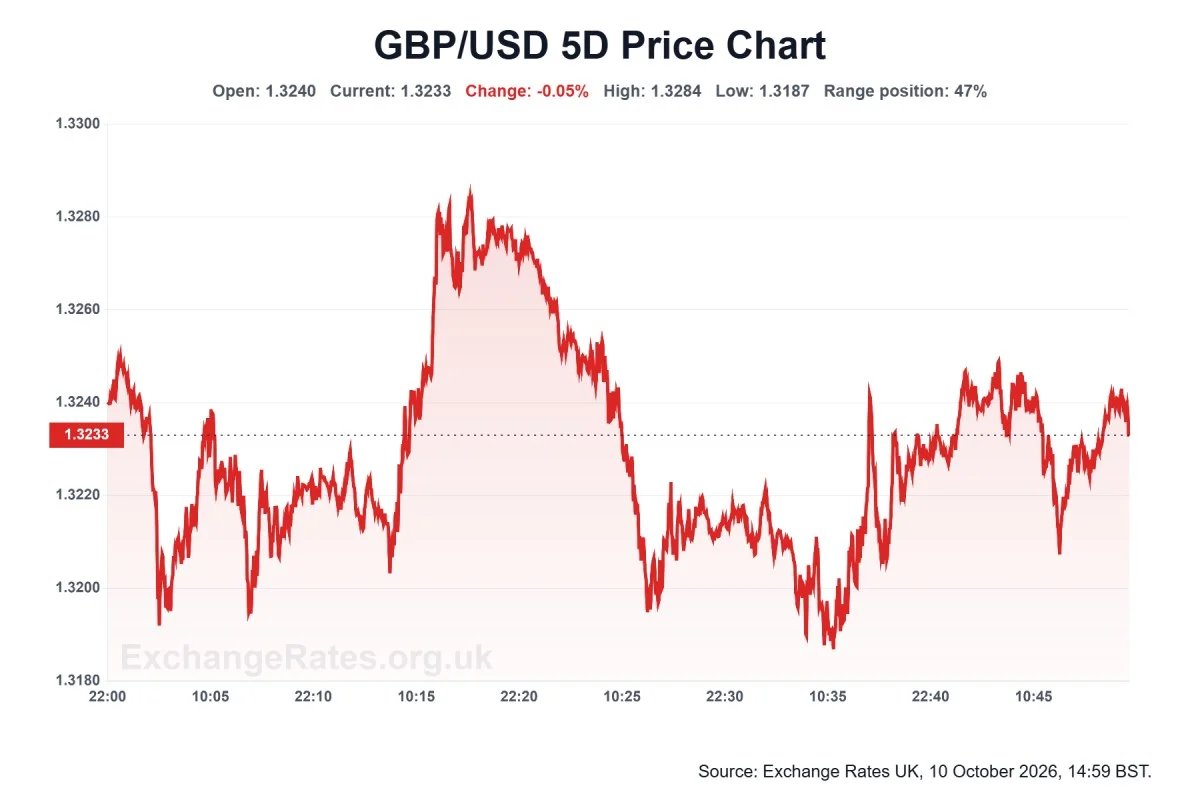
GBP/USD ended Friday near $1.3233, after losing 2.1% in September.
UBS’s 8 October forecasts put the pair at 1.38 in December 2026 and 1.41 in both June and September 2027.
Goldman’s 7 October projections allow for little immediate progress, with 1.33 at three months, around January 2027, followed by 1.28 at 12 months, around October 2027.
The longer targets are approximately comparable rather than identical dates, but the disagreement is already evident near the turn of the year.
Crédit Agricole adds a different path: weakness to 1.31 in December 2026 before a recovery to 1.39 by December 2027.
UBS recovery depends on a weaker Dollar
The latest UBS projections retain the path outlined in our September coverage of its Sterling recovery call.
Its currency table points to a broad retreat in the Dollar, with the Euro also appreciating against the US currency while the Pound makes little lasting progress against the Euro.
Our reading is that the $1.41 target requires a change in the Dollar’s fortunes more than a broad reassessment of Sterling alone.
UBS also expects the Bank of England to raise rates to 4.25% by March 2027 and hold them there through September, when its projected Federal Reserve rate midpoint falls to 3.88%.
That would turn the present small US policy-rate advantage into a UK advantage, making Sterling’s relative return more attractive.
The BoE’s September decision left Bank Rate at 3.75%, although three of its nine policymakers already wanted an increase.
Goldman’s lower currency target nevertheless sits alongside a fairly restrained Fed outlook, rather than an expectation of repeated US tightening.
Goldman says: “We expect the Fed to deliver one more 25bp hike in December to a peak policy rate range of 4.00-4.25%, though we see a strong chance that the Fed will ultimately conclude that additional rate hikes are unnecessary.”
It also expects US activity to remain resilient: “In the US, we expect real GDP growth of 2.3% on a Q4/Q4 basis in 2026, largely reflecting the continued boost from the AI boom.”
UBS and Goldman therefore share a similar near-term Fed peak despite opposite Sterling calls, showing how little the interest-rate forecast alone resolves their currency disagreement.
Crédit Agricole sees UK risks delaying the rebound
Crédit Agricole’s 9 October assessment is more explicit about why Sterling could struggle first.
“We maintain a cautious GBP/USD outlook from current levels that is consistent with our constructive USD outlook. The GBP could remain a pressure valve for anxious market participants fretting about the impact of persistent stagflation risks on the UK economic, monetary and fiscal outlook.”
Weak growth alongside persistent inflation leaves the UK facing a difficult combination: tighter policy can support Sterling’s interest-rate appeal while increasing pressure on borrowers and public finances.
The bank sees a near-term test in the coming week’s UK output figures: “For starters, we believe that incoming UK data like next week’s GDP data for August could highlight the fragility of the economy to tightening financial conditions and persistent stagflationary headwinds.”
It nevertheless sees reasons that pessimism may eventually become excessive.
“We also believe that some negatives are already priced into the GBP, especially vs the EUR, however, given that the Eurozone would have to deal with the consequences from the negative energy supply shock in the wake of the Iran war as well. We further note that the GBP is already looking oversold while global investors seem underinvested in UK assets.”
On the Dollar side, Crédit Agricole links continued support to investment demand, rather than interest rates alone.
“The USD should remain supported also by persistent portfolio flows linked to the US economic outperformance vs other major economies in Asia and Europe. Robust economic outlook & sticky inflation have already boosted Fed policy rate expectations and the USD’s rate appeal, suggesting that positives are already in the price and this could limit the currency upside.”
“US policy uncertainty could linger and fiscal dominance fears could resurface as well, but not before the US economy starts to cool down in 2027. Such risks are still more than offset by the AI boom & thus the US exceptionalism narrative and could keep the USD in demand in the next three to six months.”