


MUFG expects a November rate rise to support the Pound against the Euro, but the UK Budget could test Sterling’s appeal as French fiscal risks mount.
MUFG expects the Bank of England to begin raising interest rates in November, adding support for Sterling against the Euro as investors weigh France’s fiscal difficulties against the UK’s own approaching Budget.
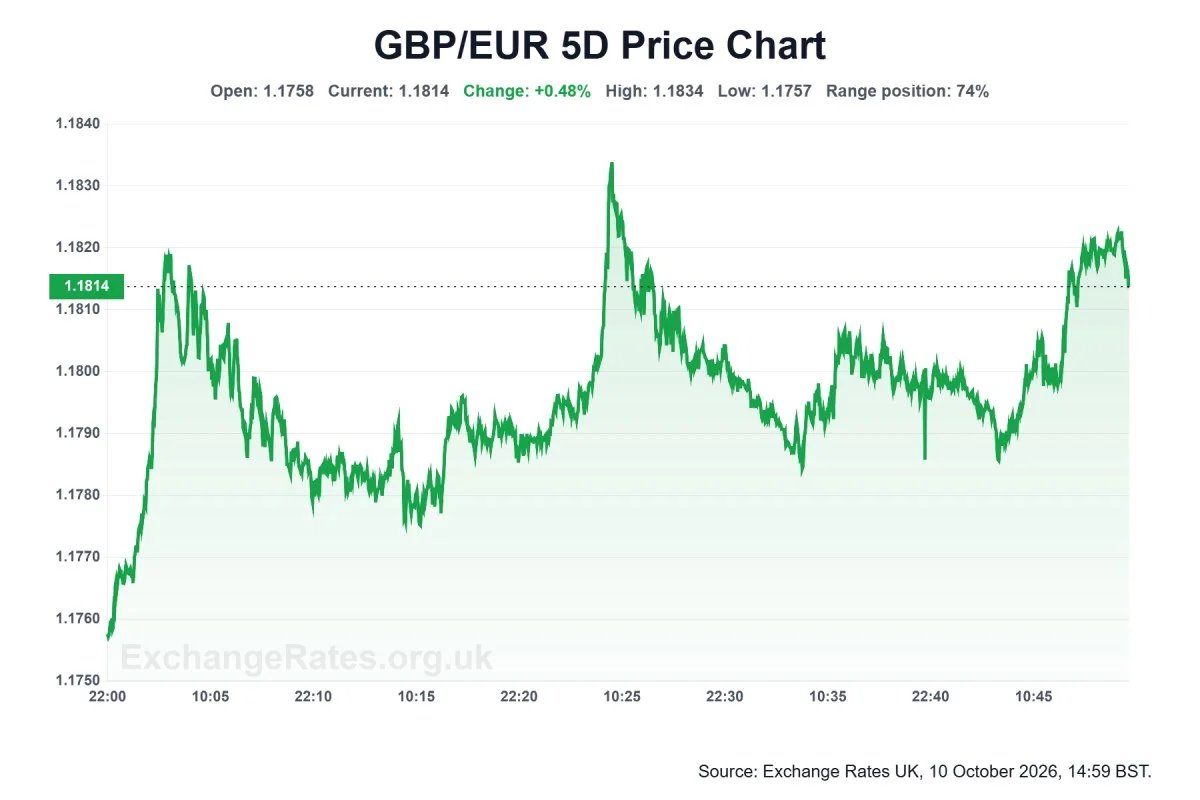
The Pound to Euro exchange rate ended Friday near €1.1814, up around 0.9% since the start of October.
The government must also avoid unsettling bond investors with its 28 October Budget.
Lee Hardman, MUFG’s senior currency analyst, wrote on 8 October: “The pound has strengthened sharply against the euro since the end of last month as the euro sell-off has broadened out. It has resulted in EUR/GBP falling from just above the 0.8600 to a fresh year-to-date low yesterday of 0.8448.”
MUFG’s 0.8448 observation refers to trading on 7 October.
Hardman said MUFG continued to “expect the BoE to finally begin to lift their policy rate for the first time in November, although guidance over the need for further hikes is likely to remain cautious.”
The next decision is due on 5 November, with the September vote to hold rates at 3.75% having split the committee six to three.
Three policymakers wanted an increase, while higher market borrowing costs were already restraining demand.
Those tighter financial conditions could reduce the need for repeated official increases by slowing borrowing and spending, even if MUFG’s first hike arrives in November.
The minutes noted: “There has been little evidence so far of material second-round effects in price and wage-setting.”
The decision depends partly on whether energy costs spread into persistent domestic inflation.
Our earlier coverage of stronger UK activity data and the uneven Sterling response examined how economic resilience had kept a November increase in contention without producing a broad Pound rally.
In his subsequent 8 October remarks on financial resilience, Governor Andrew Bailey said: “I remain sceptical of unconditional promises about future interest rates. The world is too uncertain.”
He emphasised credible monetary and fiscal policy, including commitment to the inflation target.
The Budget must preserve Britain’s relative advantage
Hardman said: “While fiscal concerns are also in focus in the UK with 10-year Gilt yields hitting their highest levels since prior to the Global Financial Crisis in 2007, they are not as acute as in France currently.”
Higher yields driven by fiscal doubts increase borrowing costs without necessarily attracting currency buyers, unlike the potential benefit from credible monetary tightening.
France’s difficulties were affecting the Euro beyond its Sterling exchange rate.
Writing on 8 October, Hardman said: “The US dollar has been benefitted by building concerns over fiscal and political risks in the euro area. After narrowing earlier this week, yield spreads between French and German government bonds have rewidened back out over the last 24 hours encouraging a stronger US dollar.”
The UK’s relative position could prove vulnerable if its own fiscal plans disappoint, making the 28 October Budget a test of the government’s ability to retain lenders’ confidence.
Chancellor John Healey promised when announcing the date: “It will be built on fiscal discipline.”
MUFG expects that sensitivity to bond markets to influence the government’s choices.
Hardman said: “Media reports have suggested that the Labour government is well aware of challenging global bond market conditions ahead of this month’s budget scheduled for 28th October which is encouraging them to play it safe as they seek to limit the risk of negative market reaction. A development that would help to ease downside risks for the pound.”