


The GBP/USD forecast gap widens from five cents around year-end to thirteen cents by September 2027 as Sterling slips towards 1.32.
Goldman Sachs and UBS disagree increasingly about the British Pound to Dollar (GBP/USD) exchange rate as their forecasts extend into 2027.
Goldman’s twelve-month projection of 1.28 sits thirteen cents below UBS’s September 2027 target of 1.41, comparing broadly equivalent horizons.
Pound Sterling traded at 1.3208 on Tuesday afternoon, down 0.35% from Monday’s close and around 2% below its pre-Fed-decision close on 15 September.
Those year-ahead forecasts imply roughly 3.1% downside or 6.8% upside from that snapshot.
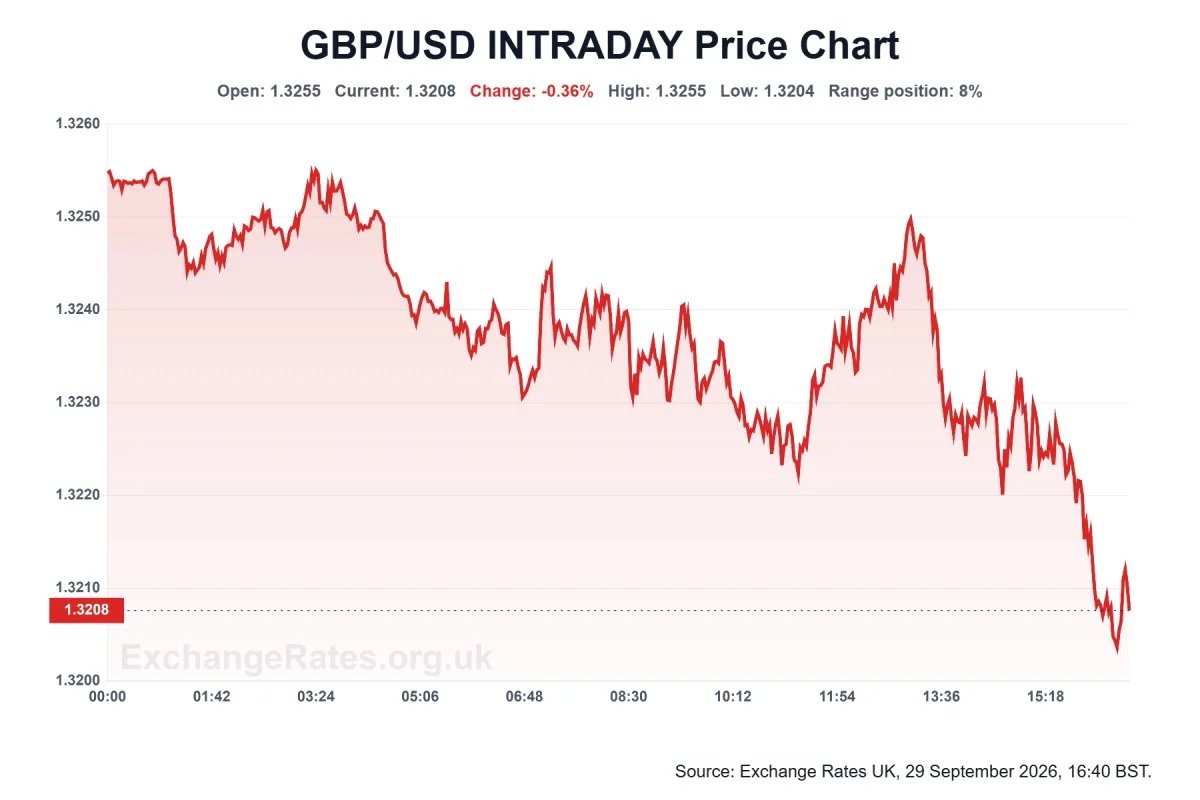
Goldman forecasts 1.33 in three months and 1.29 in six months before reaching 1.28.
UBS’s projected Sterling recovery runs through 1.38 in December 2026 and 1.39 in March 2027, reaching 1.41 in June and holding there in September.
Even Goldman’s near-term forecast therefore allows a modest recovery from today’s level before renewed weakness.
How much support can the Dollar retain?
Goldman links the recent move to US policy and energy costs:
“We see recent Dollar strength as a function of Fed follow-through, pressure from commodity prices, and the associated move higher in yields.”
UBS thinks investors have become too aggressive about further tightening:
“While we acknowledge US resilience, we also see stronger European data and believe market pricing has reached peak hawkishness-especially for the Fed.”
UBS adds: “That said, we only expect one more rate hike, and believe the data would need to beat expectations strongly for the Fed to tighten beyond that.”
The growth comparison remains challenging for Sterling.
S&P Global’s September surveys showed the US leading the four largest developed economies, with the UK the weakest performer despite continued expansion.
Yet Goldman’s bearish Sterling forecast does not depend on an unqualified call for more Fed hikes.
Its broader Dollar assessment also gives weight to US investment returns:
“We expect relatively low total returns outside of carry, and more mixed Dollar performance from spot levels given our relatively dovish Fed call but solid capital return prospects in the US.”
Our currency coverage draws on live market data, official economic releases and published bank research.