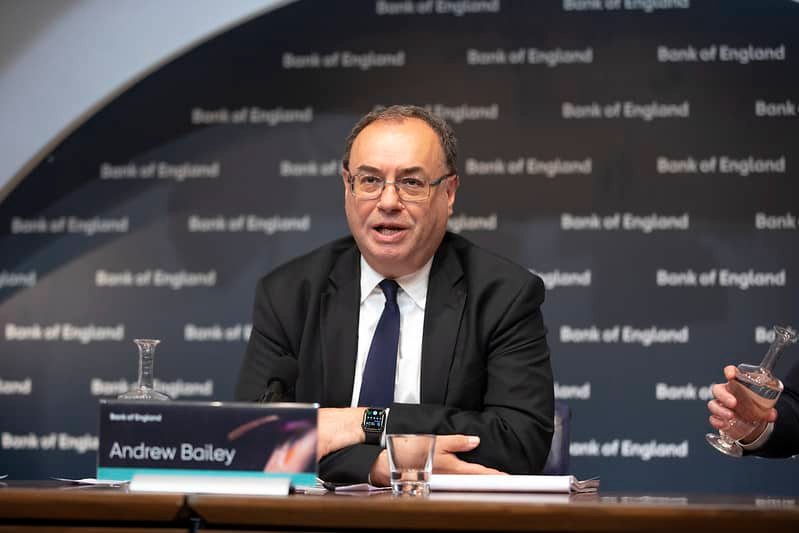

Andrew Bailey, Governor of the Bank of England. Image courtesy of the Bank of England.
Pound sterling was left softer following midweek inflation numbers, analysts see further losses in the near term.
The Bank of England won’t follow the U.S. Federal Reserve’s overnight decision to raise interest rates when it announces its own policy update and guidance at midday London time.
Instead, the Bank will make a great emphasis of a labour market that is consistent with declining wage pressures and downside economic risks, while noting that all the inflationary pressures Britain faces are imported via the energy channel.
Yet, the ONS told us on Wednesday inflation is at 3.1%, very much above the 2.0% target the Bank is mandated to target.
“The BoE has historically maintained looser policy than traditional rules would imply, and we continue to expect rates to remain unchanged this week,” points out a recent note from investment bank CIBC.
Pound sterling enters the Bank’s decision on the back foot in the wake of Wednesday’s inflation release which was actually in line with consensus expectations. Indeed, the underlying numbers showed that domestic inflationary pressures are more or less still trending down.
That will encourage a majority of the Monetary Policy Committee (MPC) to hold interest rates. In light of last week’s ECB hike, and Wednesday’s Fed hike, that creates a divergence in policy that should work against the pound.
The pound-to-euro rate is down on every day of this week, reaching 1.1670 at the time of writing. Those who have been watching the charts will note the exchange rate is still more or less in the range of the past week, but our read is that the pair is struggling to rebuild momentum and is at risk of a deeper decline on any ‘dovish’ BoE call.

“We think the risks are actually on the dovish side this week. Unlike the ECB, we suspect BoE doves will hold their ground and stress that there is no evidence price pressures are extending beyond energy prices,” says a recent strategy note from ING, the Dutch bank.
Sterling’s fate on the day rests with how the Bank chooses to guide about the outlook.
The market looks for up to four rate hikes into 2027, and we would expect Governor Bailey to push back against that expectation.
Indeed, Pound Sterling Live considers four hikes simply unattainable, which creates a mismatch between expectation and reality that should work against the currency.
The downside risk is Bailey pushing back hard and add pressure on the pound.

Above: The chart that MPC ‘doves’ will lean on, it shows underling inflation trends are behaving.
ING strategists say they are not minded to trust the recent GBP/EUR recovery. “We struggle to see EUR/GBP falling much further from here,” says ING’s FX Strategist, Frencesco Pesole.
He explains that most risks appear on the upside for the euro in the coming weeks with the pound facing building downside risks, from the monetary policy story mentioned above to potential fiscal headlines ahead of the late October budget to growing pressure on Downing Street to allow independence referendums in Scotland, Wales and Northern Ireland.
ING’s target remains 0.87 for EUR/GBP, which gives a GBP/EUR of 1.15.
The Upside Case: Prudent Risk Management
The view that the Bank can’t meet the market’s expectations for four rate hikes is widely held across the analyst community, and we suspect most traders are positioned for that outcome.
However, the case for a ‘hawkish’ hike can’t be ruled out: here the Bank leaves rates on hold but sends the signals that a November rate rise is in play.
If so, we could well see a ‘buy the fact’ reaction where the pound’s selloff is reversed by confirmation of the day’s decision to hold rates but the reality of a November hike is cemented.
The argument for a hold will be that MPC members want more evidence that the energy shock will generate second-round effects, i.e. the rise in gas and fuel starts to push wage demands and price rises across the board.
That’s where the Bank would need to get involved, judging that higher rates will discourage such decisions.
Dr. Savvas Savouri, economist at Quantmetriks, says the Bank should hike today as a form of risk management.
“The Bank does not need to prove that second-round effects are coming, which unreliable survey data could not show conclusively in any case. It needs to decide whether the data today are sufficient to conclude that the risk of second-round effects becoming embedded is too high to ignore. We judge they most certainly are,” he says.
Some members on the MPC will make this case today, the question is whether Governor Bailey joins them and pushes the balance in favour of the ‘hawks’.
If so, the GBP could end the day higher than where it started.