

Pound Sterling is holding close to the 1.35 level against the Dollar after stronger UK growth data, but the market reaction has been more cautious than the headline GDP figures suggest.
UK GDP increased 0.4% in the second quarter after growth of 0.6% in the first quarter, while monthly GDP grew 0.3% in June after no growth in May.
The figures were good enough to show resilience, but not strong enough to force a decisive repricing of Bank of England expectations.
Services remained the main support, with quarterly services output rising 0.5%, while construction increased 0.3% and production was flat.
That mix explains why Sterling’s post-GDP gains have been uneven.
The data reduce the risk of a near-term UK slowdown, but they do not remove the pressure from energy prices, weak real incomes and the prospect of a tighter fiscal stance later in the year.
The external backdrop is also less Dollar-positive than it was earlier in the week.
US producer prices were unchanged in July, below forecasts for a 0.2% rise, while annual PPI slowed to 4.7% from 5.5%.
Jobless claims rose moderately, but continuing claims fell, leaving the US labour market looking stable rather than weak.
That keeps Fed pricing finely balanced, with Friday’s US retail sales and Michigan sentiment now the next important Dollar tests.
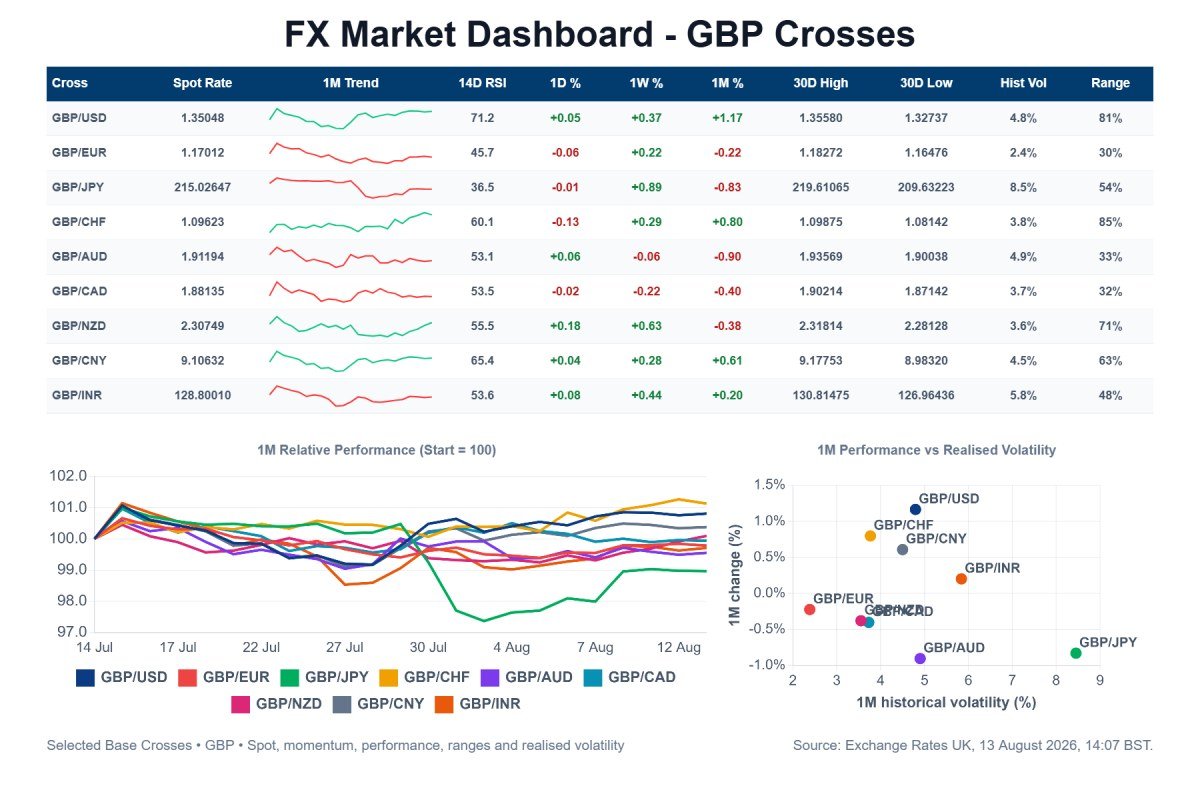
The FX dashboard shows GBP/USD still close to the top of its 30-day range, with the 14-day RSI above 70 and one-month performance up 1.17%.
GBP/CHF and GBP/CNY are also positive over one month, while GBP/AUD, GBP/CAD, GBP/NZD and GBP/JPY remain negative on the same measure.
That is the key message from the dashboard: Sterling is still firm against the Dollar, but it is not a broad-based Pound rally.

The 24-hour GDP reaction chart shows the initial UK data impact fading quickly.
GBP/CAD held up best after the release, while GBP/NZD lagged as the New Zealand Dollar retained better short-term momentum.
The overall reaction suggests investors are not treating the GDP beat as a standalone reason to rebuild large Sterling longs.

The one-month currency strength chart still leaves the Pound in the lower half of the G8 basket.
The Australian Dollar and Japanese Yen remain the strongest major currencies on this measure, while the US Dollar remains at the bottom.
Latest Exchange Rates UK pricing shows GBP/USD at 1.350484, GBP/EUR at 1.170122, GBP/CAD at 1.881349, GBP/NZD at 2.307488 and GBP/AUD at 1.911936.
US Dollar (GBP/USD) – 1.350484 (+0.05%)
The Pound to Dollar exchange rate is holding above 1.35 as softer US price data keeps the Dollar under pressure.
July CPI had already encouraged traders to reduce the probability of a September Fed hike, and today’s unchanged PPI reading gives the same argument more support.
The Dollar has not broken lower because jobless claims still point to a stable labour market rather than a hard downturn.
GBP/USD now needs either a weak US retail sales print or another fall in inflation expectations to extend through the 1.3540-1.3560 resistance area.
Euro (GBP/EUR) – 1.170122 (-0.06%)
GBP/EUR is softer despite the better UK GDP data, which shows the Euro is not under the same pressure as the Dollar.
The single currency has also found some support from the fact that UK growth was not strong enough to materially change Bank of England pricing.
The next Eurozone tests arrive on Friday, when GDP, employment and trade figures are released.
Energy is still a risk for the Euro, with extreme heat expected to remove 15% of France’s nuclear capacity on Friday and push more power generation toward gas and coal.
The 1.17 level remains the pivot for GBP/EUR.
Japanese Yen (GBP/JPY) – 215.02647 (-0.01%)
The Yen is holding firm as markets continue to treat Bank of Japan policy as the main long-term driver.
Japan’s wholesale inflation stayed elevated in July, reinforcing expectations that the BoJ could raise rates in September.
The late-July intervention effect is fading, but traders are still wary of rebuilding aggressive Yen shorts while the policy debate has shifted in a more hawkish direction.
GBP/JPY has recovered from last week’s lows, but upside still looks limited unless US yields rise again or BoJ hike expectations fade.
Australian Dollar (GBP/AUD) – 1.911936 (+0.06%)
The Australian Dollar remains one of the better-supported currencies in the G8 strength chart.
RBA Assistant Governor Christopher Kent warned that inflation risks remain tilted to the upside and that further tightening may still be needed if conditions deteriorate.
That keeps AUD supported even when global risk appetite is mixed.
GBP/AUD is slightly higher today, but the dashboard still shows the cross down 0.90% over one month and far below its year-to-date highs.
A stronger Dollar after Friday’s US data would be the main short-term risk for AUD.
Canadian Dollar (GBP/CAD) – 1.881349 (-0.02%)
The Canadian Dollar is firmer on the day, but its usual oil support is less straightforward.
Brent crude fell around 1.4% to $87.82 as higher US inventories and softer demand forecasts offset continuing Gulf disruption risks.
That leaves CAD without a clean commodity tailwind, even though the currency is still more resilient than many lower-yielding majors.
Canada’s manufacturing shipments and wholesale trade figures are due on Friday and will decide whether domestic data can add support.
GBP/CAD remains below its early-August highs, with 1.88 still the key short-term support area.
Swiss Franc (GBP/CHF) – 1.09623 (-0.13%)
The Swiss Franc is recovering some ground after recent weakness.
CHF remains close to the bottom of the one-month G8 strength index, but softer US producer prices and a more cautious global tone are helping defensive currencies stabilise.
The Franc is still not getting a full safe-haven bid because markets are not in outright risk-off mode.
GBP/CHF remains high in its 30-day range, but the cross is vulnerable to profit-taking if Friday’s US data push yields lower again.
New Zealand Dollar (GBP/NZD) – 2.307488 (+0.18%)
The New Zealand Dollar is weaker today, but it is still one of the strongest major currencies over the one-month window.
The Kiwi’s earlier support came from relative rate expectations and broader demand for higher-beta currencies, but the recent rally now looks stretched.
The last major domestic labour-market update showed unemployment at a decade high of 5.6%, which remains a check on how far RBNZ tightening expectations can run.
GBP/NZD has pushed above 2.30, but the cross still needs follow-through to confirm a broader recovery.
Chinese Yuan (GBP/CNY) – 9.10632 (+0.04%)
The Yuan is steady as traders wait for Chinese credit data.
The PBOC has pledged to keep the Yuan broadly stable and expand the currency’s international use, which has helped limit volatility in CNY.
The growth story is less convincing.
New yuan loans are expected to have slowed sharply in July after heavy front-loaded lending in June, with official figures due between August 10 and 15.
A weak credit release would renew concerns over domestic demand and make it harder for CNY to rally, even if the Dollar remains soft.
Indian Rupee (GBP/INR) – 128.80010 (+0.08%)
The Rupee remains contained by RBI smoothing, but the local trade story is getting harder.
India’s merchandise trade deficit widened to a six-month high of $31.98bn in July as imports rose, with higher crude prices and freight costs linked to Middle East tensions still a pressure point.
The Rupee also slipped modestly as dollar outflows linked to derivative maturities and overseas debt repayments offset the effect of lower volatility.
GBP/INR is firmer today, but INR losses should remain controlled if the RBI continues to lean against disorderly currency moves.
Key Events Ahead: August 13-15, 2026
- UK Q2 GDP has now crossed, with the economy expanding 0.4% quarter-on-quarter and monthly GDP rising 0.3% in June.
- US PPI has now crossed, with producer prices unchanged in July and annual PPI slowing to 4.7%.
- US jobless claims rose moderately, but continuing claims fell, leaving the labour-market message mixed rather than clearly weak.
- Friday brings US retail sales, University of Michigan sentiment and business inventories.
- Friday also brings Eurozone GDP, employment and trade figures.
- Canada manufacturing shipments and wholesale trade are due on Friday.
- China credit data remain due this week, with markets watching whether July lending slows sharply.
- India’s wider trade deficit keeps GBP/INR sensitive to oil prices, freight costs and RBI intervention.
- Energy markets remain sensitive to Gulf shipping disruption, US crude inventories and lower demand forecasts.