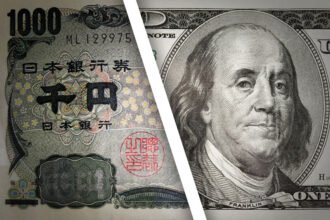

The Japanese Yen (JPY) remains on the back foot against a broadly firmer US Dollar (USD) through the Asian session on Monday and seems vulnerable to prolong its recent downtrend to a nine-month low, touched last week. Government data released earlier today showed that Japan’s economy contracted in the July-September period for the first time in six quarters. This comes amid Japan’s Prime Minister Sanae Takaichi’s fiscal stimulus plans and support for ultra-loose monetary policy, dampening bets for a Bank of Japan (BoJ) rate hike and undermining the JPY. The USD, on the other hand, benefits from reduced bets for another rate cut by the US Federal Reserve (Fed) in December and assists the USD/JPY pair in holding steady near mid-154.00s.
The JPY bears, however, seem reluctant to place aggressive bets amid speculations that Japanese authorities might step into the markets to stem further weakness in the domestic currency. Apart from this, a weaker risk tone contributes to limiting losses for the safe-haven JPY. Furthermore, concerns about the weakening economic momentum on the back of the longest-ever US government shutdown could act as a headwind for the Greenback. This, in turn, warrants some caution before positioning for an extension of the USD/JPY pair’s recent move up witnessed over the past month or so. Traders might also opt to wait for this week’s release of FOMC meeting Minutes and the delayed US Nonfarm Payrolls (NFP) report for October.
Japanese Yen struggles to lure buyers bulls remain on the sidelines as weak GDP print fuels BoJ rate hike uncertainty
- The Cabinet Office reported this Monday that Japan’s economy contracted by 0.4% in the July-September period, marking the first fall in six quarters. Furthermore, the Gross Domestic Product fell 1.8% year-on-year in the September quarter following a 2.3% rise in the previous quarter.
- The readings were less worse than consensus estimates, though pointed to a limited strength in the Japanese economy. This forced investors to pare their bets that the Bank of Japan will hike interest rates soon amid increasing political resistance and undermines the Japanese Yen.
- Japan’s Prime Minister Sanae Takaichi’s administration is compiling a stimulus package to cushion the blow to households from rising living costs. Takaichi said last week that she would work on setting a new fiscal target extending through several years to allow more flexible spending.
- China and Japan exchanged sharp warnings after Takaichi’s remarks over the use of military force in any Taiwan conflict. In response, China threatened severe consequences, raising the risk of further escalation of tensions and the worsening diplomatic standoff between the two nations.
- This, in turn, is seen weighing on investors’ sentiment and offering some support to the safe-haven JPY. Meanwhile, the recent decline in the JPY prompted some verbal intervention from Japanese authorities. This further holds back the JPY bears from placing fresh bets and limits losses.
- In fact, Japan’s Finance Minister Satsuki Katayama said last week that she will be watching FX moves with a sense of urgency. Moreover, Japan’s Economy Minister Minoru Kiuchi said on Friday that a weak JPY can push up CPI through import costs, warranting caution for the JPY bears.
- Meanwhile, a growing number of Federal Reserve policymakers signaled caution on further easing amid the lack of economic data. This tempers expectations for another interest rate cut by the US central bank in December, which lends some support to the US Dollar and the USD/JPY pair.
- The market attention now shifts to the delayed release of the closely-watched US Nonfarm Payrolls report on Thursday. Apart from this, FOMC meeting minutes and Fed speeches will be scrutinized for cues about the future rate-cut path, which should provide a fresh impetus to the buck.
USD/JPY constructive setup backs the case for additional gains; move beyond 155.00 awaited

From a technical perspective, Friday’s goodish rebound from the 153.60 support, representing the 100-period Simple Moving Average (SMA) on the 4-hour chart, and a close above the 154.45-154.50 hurdle favors the USD/JPY bulls. Moreover, oscillators on the daily chart are holding comfortably in positive territory and are still away from being in the overbought zone. Some follow-through buying and acceptance above the 155.00 psychological mark will reaffirm the constructive outlook and lift spot prices to the 155.60-155.65 intermediate barrier en route to the 156.00 round figure.
On the flip side, weakness below the 154.00 immediate support might continue to attract some buyers and find decent support near the 153.60-153.50 region, below which the USD/JPY pair could slide to the 153.00 round figure. The latter should act as a key pivotal point, which, if broken decisively, might shift the near-term bias in favor of bearish traders and drag spot prices to the next relevant support near the 152.15-152.10 area.
Japanese Yen FAQs
The Japanese Yen (JPY) is one of the world’s most traded currencies. Its value is broadly determined by the performance of the Japanese economy, but more specifically by the Bank of Japan’s policy, the differential between Japanese and US bond yields, or risk sentiment among traders, among other factors.
One of the Bank of Japan’s mandates is currency control, so its moves are key for the Yen. The BoJ has directly intervened in currency markets sometimes, generally to lower the value of the Yen, although it refrains from doing it often due to political concerns of its main trading partners. The BoJ ultra-loose monetary policy between 2013 and 2024 caused the Yen to depreciate against its main currency peers due to an increasing policy divergence between the Bank of Japan and other main central banks. More recently, the gradually unwinding of this ultra-loose policy has given some support to the Yen.
Over the last decade, the BoJ’s stance of sticking to ultra-loose monetary policy has led to a widening policy divergence with other central banks, particularly with the US Federal Reserve. This supported a widening of the differential between the 10-year US and Japanese bonds, which favored the US Dollar against the Japanese Yen. The BoJ decision in 2024 to gradually abandon the ultra-loose policy, coupled with interest-rate cuts in other major central banks, is narrowing this differential.
The Japanese Yen is often seen as a safe-haven investment. This means that in times of market stress, investors are more likely to put their money in the Japanese currency due to its supposed reliability and stability. Turbulent times are likely to strengthen the Yen’s value against other currencies seen as more risky to invest in.